I can't take criticism without exploding
6 min read
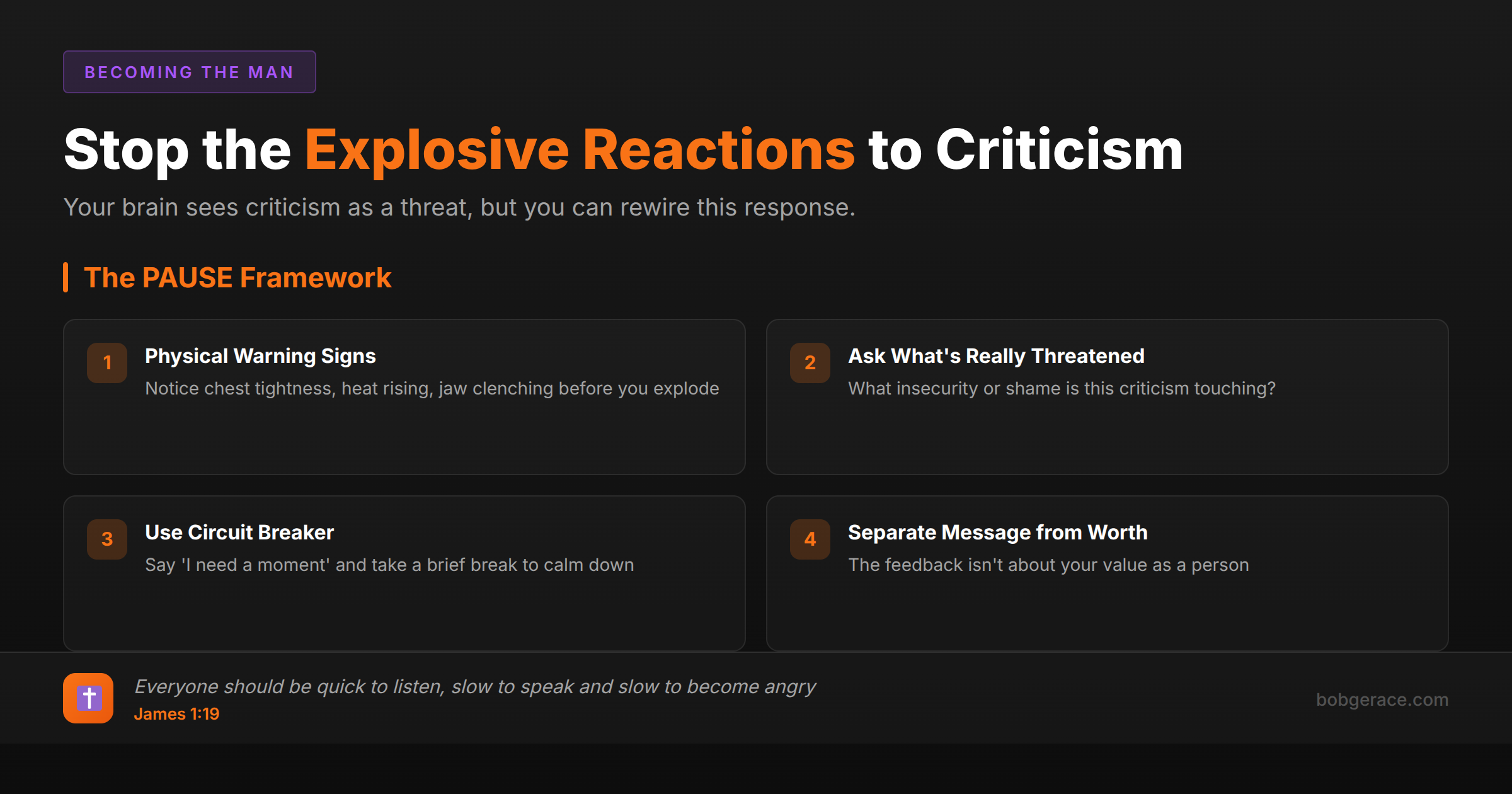
Explosive reactions to criticism often stem from feeling attacked rather than heard. Your brain perceives criticism as a threat, triggering fight-or-flight responses that bypass rational thinking. This isn't a character flaw—it's a learned pattern that can be changed. The key is recognizing your early warning signs before you explode. Notice the physical sensations: tightness in your chest, heat rising, or your jaw clenching. When you feel these signals, pause and breathe deeply. Ask yourself: 'What am I really afraid of hearing?' Often, we explode because the criticism touches on our deepest insecurities or shame. Learning to separate the message from the emotion—and your worth from your mistakes—transforms how you receive feedback in your marriage.
The Full Picture
Explosive reactions to criticism don't happen in a vacuum. They're usually the result of years of conditioning, past wounds, and protective mechanisms that once served you but now sabotage your marriage.
Think about your childhood. How was criticism handled in your family? Were mistakes met with shame, anger, or dismissal? Many of us learned early that criticism equals rejection, so our nervous system treats even gentle feedback from our spouse as a five-alarm fire.
Your spouse isn't your enemy—they're trying to be heard. When they point out something that bothers them, they're usually not attacking your character. They're expressing a need or frustration. But when you explode, the original message gets buried under the emotional debris of your reaction.
The explosion serves a purpose: it deflects attention from the issue and makes your spouse focus on managing your emotions instead. This might provide temporary relief from facing uncomfortable truths, but it erodes trust and intimacy over time.
Here's what's really at stake: Every time you explode, you're training your spouse to walk on eggshells around you. They learn that bringing up concerns isn't safe, so they either shut down or build resentment. Neither leads to the marriage you actually want.
The good news? This pattern can be broken. It requires understanding what's driving your reactions, developing better emotional regulation skills, and learning to separate criticism of your actions from attacks on your identity. Your marriage can become a place where feedback flows freely because both of you feel safe to be honest.
What's Really Happening
From a neurological perspective, explosive reactions to criticism involve your amygdala hijacking your prefrontal cortex—the part of your brain responsible for rational thinking. When you perceive criticism as a threat, your brain floods your system with stress hormones, preparing you to fight or flee.
This response often has roots in attachment wounds. If you experienced criticism as rejection in childhood, your adult brain still carries those neural pathways. Every piece of feedback from your spouse can unconsciously trigger that old 'I'm not safe' alarm.
Emotional dysregulation also plays a key role. Many people who explode under criticism never learned healthy emotional regulation skills. They go from zero to one hundred because they lack the tools to process and respond to uncomfortable emotions gradually.
Shame is often the hidden driver. When criticism hits a core area where you already feel inadequate, the explosion becomes a way to deflect attention from those painful feelings. It's easier to be angry than to feel ashamed or vulnerable.
The pattern becomes self-reinforcing because explosions often work in the short term—people back off, apologize, or stop bringing up the issue. But this 'success' strengthens the neural pathway, making explosive reactions more likely in the future.
Recovery involves building new neural pathways through practices like mindfulness, emotional regulation techniques, and gradual exposure to feedback in safe environments. The brain's neuroplasticity means these patterns can change, but it requires consistent practice and often professional support to rewire these deep-seated responses.
What Scripture Says
Scripture has much to say about how we handle correction and difficult conversations. Proverbs 27:5-6 reminds us that "Better is open rebuke than hidden love. Wounds from a friend can be trusted, but an enemy multiplies kisses." Your spouse's willingness to bring up difficult topics is actually a gift, even when it doesn't feel that way.
James 1:19-20 gives us the blueprint: "My dear brothers and sisters, take note of this: Everyone should be quick to listen, slow to speak and slow to become angry, because human anger does not produce the righteousness that God desires." Notice the order—listen first, speak second, anger comes last and should be carefully managed.
Proverbs 15:31-32 speaks directly to this issue: "Whoever heeds life-giving correction will be at home among the wise. Those who disregard discipline despise themselves, but the one who heeds correction gains understanding." Your ability to receive correction is actually connected to wisdom and self-respect, not weakness.
Ephesians 4:26-27 acknowledges that anger isn't always sinful, but warns: "In your anger do not sin: Do not let the sun go down while you are still angry, and do not give the devil a foothold." Explosive reactions often cross the line from righteous anger to sinful destruction.
Matthew 7:3-5 challenges us to examine our own hearts before becoming defensive: "Why do you look at the speck of sawdust in your brother's eye and pay no attention to the plank in your own eye?" Sometimes our explosive reactions are really about avoiding the uncomfortable truth in what's being said.
God's design for marriage involves iron sharpening iron (Proverbs 27:17)—but that requires both people to be teachable, humble, and committed to growth rather than self-protection.
What To Do Right Now
-
1
Identify your early warning signs. Notice what happens in your body before you explode—tension, heat, racing heart. These are your cues to pause.
-
2
Create a circuit breaker. When you feel those warning signs, say 'I need a few minutes to process this' and take a brief break to calm your nervous system.
-
3
Practice the 4-7-8 breathing technique. Breathe in for 4 counts, hold for 7, exhale for 8. This activates your parasympathetic nervous system and helps you think clearly.
-
4
Ask yourself: 'What am I afraid of hearing?' Often explosive reactions mask deeper fears about inadequacy, rejection, or failure. Address the fear, not just the reaction.
-
5
Separate the message from the messenger. Focus on what's being communicated rather than how it's making you feel. Ask clarifying questions instead of defending.
-
6
Apologize for your reaction, even if you disagree with the criticism. Say 'I'm sorry for exploding. Can we try this conversation again?' This rebuilds trust and models emotional responsibility.
Related Questions
Ready to Stop the Explosive Cycle?
Breaking patterns of defensiveness takes more than willpower—it takes strategy and support. Let's work together to transform how you handle difficult conversations.
Get Help Now →