I justify instead of listen
6 min read
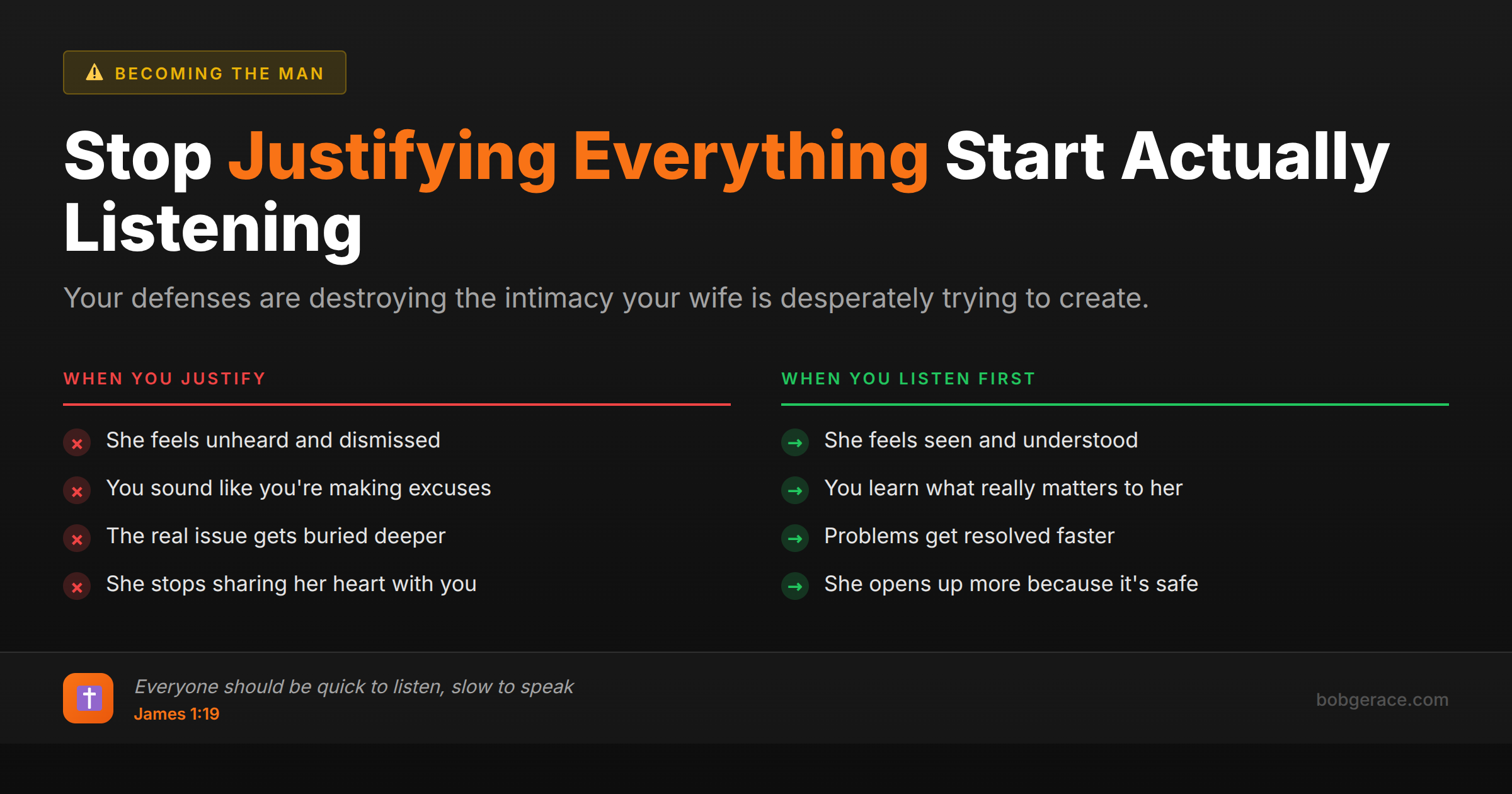
Justifying instead of listening is a defense mechanism that protects your ego but destroys intimacy. When your spouse brings up a concern, your brain immediately shifts into self-protection mode, crafting explanations for why you did what you did instead of actually hearing their heart. This pattern creates a frustrating cycle where your spouse feels unheard and you feel constantly attacked. The solution isn't to stop having reasons for your actions—it's learning to listen first, validate their experience, and only then share your perspective if appropriate. Most of the time, your spouse isn't looking for your justifications; they're looking for you to understand how your actions affected them.
The Full Picture
Here's what's really happening when you justify instead of listen: Your spouse shares their hurt, and your brain hijacks the conversation. Instead of hearing "I felt dismissed when you interrupted me," you hear "You're a terrible person who interrupts." So you immediately launch into explaining why you interrupted—you were excited, you had something important to say, you didn't realize they weren't finished.
But here's the problem: none of that changes how they felt. Your justifications might be completely valid, but they're irrelevant to the core issue. Your spouse isn't questioning your motives; they're telling you about their experience.
This pattern is incredibly damaging because it teaches your spouse that their feelings don't matter as much as your reputation. Every time you justify, you're essentially saying, "Your hurt is less important than my need to be understood as a good person."
The justification cycle works like this: - Spouse expresses hurt or concern - You feel criticized or attacked - You defend your actions with explanations - Spouse feels unheard and dismissed - They escalate or shut down - You feel frustrated because your "reasonable" explanations aren't working - The real issue never gets addressed
The most destructive part? You're often right about your motivations. You probably didn't mean to hurt them. You probably had good reasons for what you did. But being right about your intentions doesn't make their hurt less real or valid.
Breaking this pattern requires recognizing that listening and justifying are fundamentally different goals. Listening seeks to understand; justifying seeks to be understood. You can't do both simultaneously.
What's Really Happening
Justification as a first response is a classic example of emotional flooding and defensive processing. When we perceive criticism—even constructive feedback—our amygdala triggers a threat response faster than our prefrontal cortex can engage rational thinking.
This creates what I call "explanation addiction"—the compulsive need to be understood and vindicated before we can emotionally regulate enough to truly listen. The individual literally cannot hear their partner's emotional experience because their brain is busy constructing a defense case.
What makes this particularly damaging in marriage is that it creates negative sentiment override. The listening partner begins to expect defensiveness rather than empathy, which leads them to approach future conversations with frustration or resignation already activated.
The neurological reality is that justification and listening activate different neural networks. Justification engages our self-preservation systems, while empathetic listening requires activating our social connection networks. We cannot do both simultaneously.
The path forward involves developing distress tolerance—the ability to sit with the discomfort of being misunderstood or imperfect long enough to prioritize connection over correction. This requires practice and often involves challenging core beliefs about conflict, criticism, and self-worth that were formed in childhood.
What Scripture Says
Scripture consistently calls us to listen before we speak, to be slow to defend ourselves, and to prioritize understanding others over being understood ourselves.
James 1:19 gives us the foundational principle: "My dear brothers and sisters, take note of this: Everyone should be quick to listen, slow to speak and slow to become angry." Notice the order—listen first, speak second. Most justification happens because we reverse this order.
Proverbs 18:13 cuts right to the heart of the issue: "To answer before listening—that is folly and shame." When we justify before we've truly heard our spouse's heart, we're acting foolishly according to God's wisdom.
Philippians 2:3-4 challenges our self-protective instincts: "Do nothing out of selfish ambition or vain conceit. Rather, in humility value others above yourselves, not looking to your own interests but each of you to the interests of the others." Justification is often about protecting our own interests—our reputation, our sense of being right, our comfort.
Proverbs 15:1 shows us a better way: "A gentle answer turns away wrath, but a harsh word stirs up anger." Justifications, even when delivered calmly, often feel harsh to a hurting spouse because they dismiss their emotional experience.
1 Peter 3:8 calls us to "be like-minded, be sympathetic, love one another, be compassionate and humble." True listening requires all of these qualities—especially humility and compassion.
The Biblical model is clear: listen first, understand deeply, respond with humility. Our default should be curiosity about our spouse's experience, not defense of our own actions.
What To Do Right Now
-
1
Practice the pause: When your spouse expresses hurt, count to three before responding. Ask yourself: 'Are they attacking my character or sharing their experience?'
-
2
Use reflection statements: Instead of explaining, try 'It sounds like you felt...' or 'Help me understand...' This keeps you in listening mode.
-
3
Acknowledge their reality: Say 'I can see how that would hurt' or 'Your feelings make sense' before sharing any perspective.
-
4
Ask permission to explain: If context truly matters, ask 'Would it help if I shared what I was thinking?' Don't assume they need your explanation.
-
5
Focus on impact over intent: Address how your actions affected them first. Your good intentions don't erase their hurt experience.
-
6
Practice apologizing without 'but': Try 'I'm sorry I hurt you' instead of 'I'm sorry, but I didn't mean to.' The 'but' erases everything before it.
Related Questions
Ready to Listen Like Your Marriage Depends on It?
Breaking the justification habit requires more than good intentions—it requires proven strategies and personalized guidance.
Get Help Now →