What is 'negative sentiment override' and does she have it?
6 min read
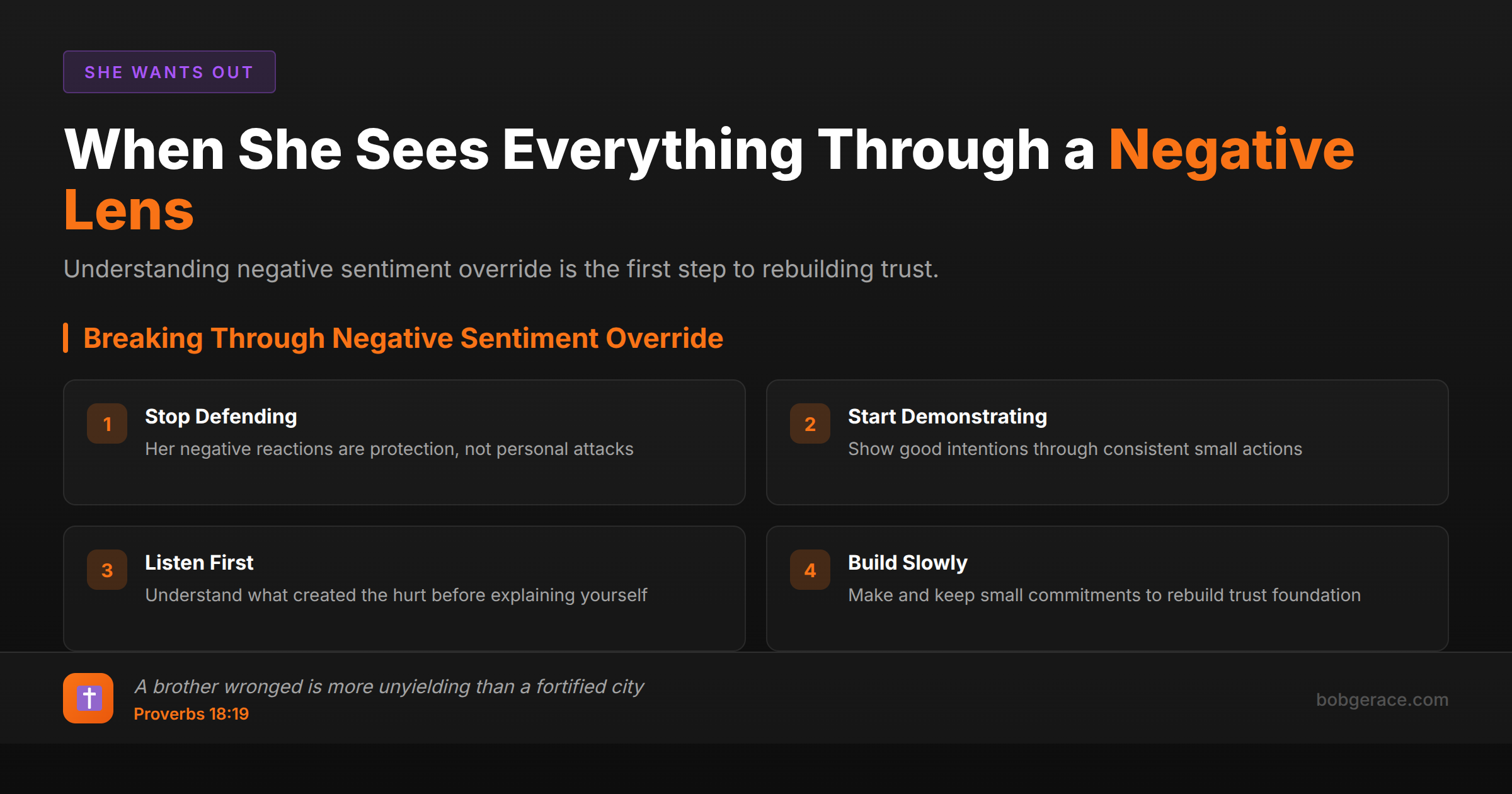
Negative sentiment override is Dr. John Gottman's term for when your wife has become so hurt and hopeless that she automatically interprets everything you do through a negative lens - even genuinely positive actions. When she's in this state, your attempt to help with dinner gets seen as criticism of her cooking, your compliment feels manipulative, and your apology sounds hollow. This isn't about her being unfair or unreasonable. It's a protective mechanism that develops after years of accumulated hurt, disappointment, or feeling unseen in the marriage. The good news? It's not permanent, but it requires understanding what created it and consistent, patient work to rebuild the positive emotional bank account between you.
The Full Picture
Negative sentiment override occurs when the emotional atmosphere in your marriage has become so polluted that positive interactions can't break through. Think of it like wearing sunglasses indoors - everything looks darker than it actually is.
Here's how it shows up practically:
• You bring her flowers, she wonders what you did wrong • You offer to help with household tasks, she sees it as criticism that she's not doing enough • You try to be affectionate, she feels like you only want sex • You attempt to have a conversation, she hears judgment or dismissiveness
What most men get wrong is thinking they can logic their way out of this or prove their good intentions through grand gestures. You can't debate someone out of negative sentiment override because it's not a rational response - it's an emotional protection system.
The critical insight: This didn't happen overnight. It developed through thousands of micro-interactions where she felt unseen, unheard, or unsafe emotionally. Maybe you were dismissive when she tried to share concerns. Maybe you made promises you didn't keep. Maybe you prioritized work, hobbies, or even the kids over connecting with her.
The pattern creates a downward spiral. She becomes more guarded and critical, which makes you defensive and withdrawn, which confirms her negative expectations. Breaking this cycle requires you to understand that her negative interpretation isn't personal attack - it's a signal that the marriage's emotional foundation needs serious repair work.
What's Really Happening
From a neurobiological perspective, negative sentiment override represents a shift in how the brain processes relationship information. When someone experiences chronic relational stress or emotional neglect, their nervous system becomes hypervigilant to threat detection. The brain's threat-detection system (amygdala) becomes overactive, while the prefrontal cortex's ability to give others the benefit of the doubt becomes suppressed.
Gottman's research shows that couples in negative sentiment override have a fundamentally different physiological experience during interactions. Their heart rates elevate more quickly, stress hormones remain elevated longer, and they show decreased ability to repair conflicts effectively. This isn't a character flaw - it's a predictable neurological response to feeling emotionally unsafe.
What's particularly important to understand is that negative sentiment override often develops gradually through what we call 'death by a thousand paper cuts.' It's rarely the result of major betrayals alone, but rather the accumulation of smaller moments where emotional bids for connection were missed, dismissed, or rejected.
The therapeutic approach focuses on creating safety first, then slowly rebuilding positive interaction patterns. This requires the pursuing partner (typically the husband in these situations) to demonstrate consistent, patient, non-defensive responses over time. The goal is to help the nervous system learn that it's safe to be vulnerable again.
Recovery is possible, but it requires understanding that this is fundamentally about emotional safety, not logical persuasion. The timeline for healing depends on how long the negative patterns have been established and how consistent the repair efforts are.
What Scripture Says
Scripture gives us profound wisdom about how hearts become hardened and how they can be softened again. In Ephesians 4:26-27, Paul warns: 'In your anger do not sin: Do not let the sun go down while you are still angry, and do not give the devil a foothold.' When we allow resentment to build day after day, we create exactly the conditions for negative sentiment override.
Proverbs 18:19 tells us: 'A brother wronged is more unyielding than a fortified city; disputes are like the barred gates of a citadel.' This perfectly describes what happens when trust breaks down - the heart becomes like a fortress, protecting itself from further hurt.
But God also shows us the path forward. In Ezekiel 36:26, He promises: 'I will give you a new heart and put a new spirit in you; I will remove from you your heart of stone and give you a heart of flesh.' Healing hardened hearts is God's specialty, but He often works through our faithful, patient love.
Jesus demonstrates this in Luke 15:20 with the prodigal son's father, who 'ran to his son, threw his arms around him and kissed him' before the son could even finish his apology. Sometimes breakthrough comes not through words but through consistent, grace-filled actions.
1 Peter 4:8 reminds us that 'above all, love each other deeply, because love covers over a multitude of sins.' This doesn't mean ignoring problems, but rather approaching them with the kind of patient, sacrificial love that creates safety for hearts to soften.
The biblical pattern is clear: hardened hearts are healed through consistent demonstration of faithful love, not through arguments or self-defense.
What To Do Right Now
-
1
Stop trying to convince her of your good intentions and start demonstrating them through consistent small actions
-
2
Accept that her negative interpretations are protection, not personal attacks - respond with patience, not defensiveness
-
3
Focus on understanding what created the hurt rather than defending yourself against her current reactions
-
4
Make and keep small commitments consistently - reliability in little things rebuilds trust foundation
-
5
Listen to understand her experience without immediately explaining your perspective or intentions
-
6
Give her space to feel safe being negative without you trying to fix or change her mood
Related Questions
- What does 'I love you but I'm not in love with you' really mean?
- What are the Four Horsemen and which ones killed us?
- What does Gottman research say about how marriages die?
- What is the 'distance and isolation cascade'?
- What are 'failed bids for connection' and how many did I miss?
- Why does she remember everything differently than I do?
- What is 'positive sentiment override' in the affair context?
- What is 'accumulated resentment'?
- Why does she seem to attach to everyone but me?
- What does it mean when contempt enters a marriage?
Also find Bob on
Subscribe for weekly videos on Christian marriage.
Your Marriage Isn't a Textbook Case
Negative sentiment override looks different in every relationship. A coach who knows your specific history can help you see what created it in your marriage—and what will actually rebuild trust with her.
Talk to Bob →