When does waiting become enabling?
6 min read
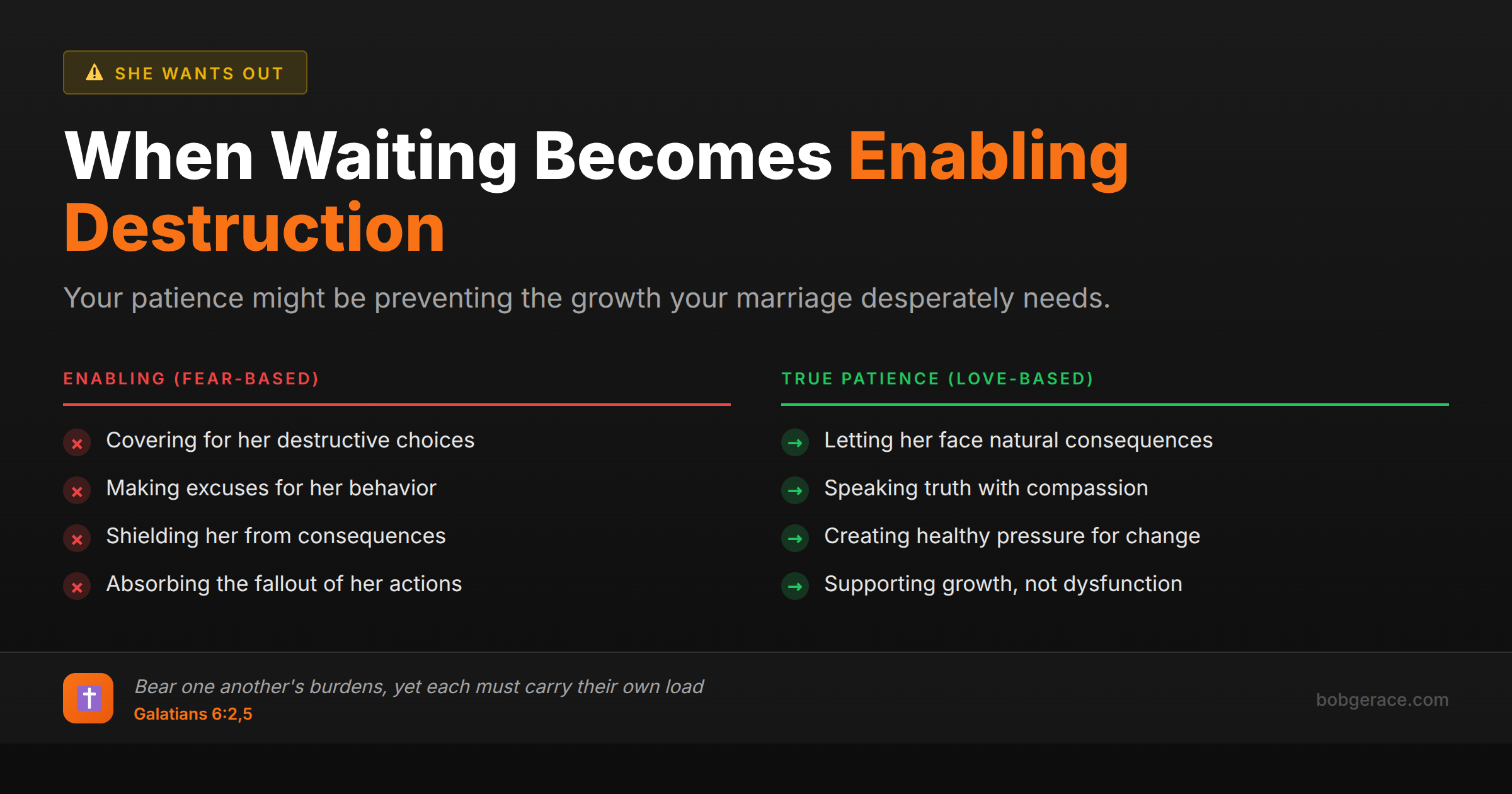
Waiting becomes enabling when you're absorbing the consequences of your spouse's destructive choices instead of letting them experience those consequences themselves. The line is crossed when your patience prevents growth rather than creates space for it. If your wife is having an affair, struggling with addiction, or consistently disrespecting the marriage, and your "waiting" means covering for her, making excuses, or shielding her from natural outcomes, you've moved from love into enabling. True patience creates healthy pressure for change, while enabling removes that pressure entirely. The question isn't whether you should be patient—of course you should. The question is whether your patience is serving love or fear.
The Full Picture
Here's what most men don't understand: there's a massive difference between waiting with strength and waiting from weakness. Waiting with strength means you're creating space for your wife to change while maintaining clear boundaries about what you will and won't accept. Waiting from weakness means you're desperately hoping things will magically improve while you absorb all the pain and chaos.
Enabling looks like: • Making excuses for her behavior to friends and family • Covering financial consequences of her poor choices • Accepting disrespect "to keep the peace" • Doing her emotional work for her • Pretending everything is fine when it's not • Avoiding difficult conversations because they might upset her
Healthy waiting looks like: • Clear communication about unacceptable behaviors • Natural consequences for destructive choices • Maintaining your own emotional and physical health • Setting and enforcing reasonable boundaries • Getting support for yourself regardless of her choices • Loving her enough to let her feel the weight of her decisions
The brutal truth? Many men choose enabling because it feels easier in the moment. It avoids conflict, prevents her anger, and maintains the illusion of peace. But enabling is actually the opposite of love—it prevents the very discomfort that could motivate real change. When you shield someone from the consequences of destructive behavior, you're not protecting them; you're protecting the behavior itself.
What's Really Happening
From a clinical perspective, enabling behaviors often stem from what we call anxious attachment patterns combined with codependent dynamics. When a spouse consistently rescues their partner from consequences, they're operating from a trauma response—specifically, the fear that setting boundaries will result in abandonment.
Research in family systems therapy shows that enabling actually reinforces the very behaviors we want to stop. This happens through what behaviorists call "intermittent reinforcement"—when destructive behaviors are occasionally rewarded (by avoiding consequences), they become more entrenched, not less.
The neurological reality is that growth requires discomfort. When we experience natural consequences, our brains activate problem-solving mechanisms and motivation centers. Remove the consequences, and you remove the brain's primary motivation for change. This is why addictions treatment focuses so heavily on allowing natural consequences rather than shielding the addict from them.
Enabling also creates what therapists call "learned helplessness" in the enabled spouse. When someone consistently has their problems solved for them, they stop developing their own coping mechanisms and problem-solving skills. This creates a vicious cycle where they become increasingly dependent on being rescued.
The therapeutic goal isn't to stop caring—it's to care in ways that actually promote growth. This means tolerating your own anxiety about your spouse's discomfort while they learn to handle their own problems. It's counterintuitive, but allowing someone to struggle appropriately is often the most loving thing you can do.
What Scripture Says
Scripture provides clear guidance on the difference between patient love and enabling destructive behavior. Galatians 6:2 tells us to "bear one another's burdens," but verse 5 immediately clarifies that "each one should carry their own load." This isn't contradictory—it's wisdom about when to help and when to step back.
Proverbs 19:19 warns: "A hot-tempered person must pay the penalty; rescue them, and you will have to do it again." This verse directly addresses the enabling trap—when we consistently rescue people from the consequences of their choices, we're not helping them; we're ensuring they'll need rescuing again.
Matthew 18:15-17 gives us Jesus' model for addressing destructive behavior: direct communication, escalating consequences, and ultimately, boundaries that protect the community. Notice that Jesus doesn't say to endlessly absorb bad behavior—He provides a process that leads to separation if repentance doesn't occur.
Ephesians 4:15 calls us to "speak the truth in love." Truth-telling isn't enabling—it's the opposite. When we avoid honest conversations about destructive behavior, we're not being loving; we're being cowardly.
1 Corinthians 13:6 reminds us that love "does not delight in evil but rejoices with the truth." Real love doesn't enable sin or destructive patterns—it confronts them with grace and strength.
The biblical model is clear: love with boundaries, truth with grace, patience with strength. God Himself models this—He's incredibly patient with us, but He doesn't shield us from all consequences of our choices. His love includes discipline because discipline leads to growth.
What To Do Right Now
-
1
Identify specific behaviors you've been covering for or making excuses about—write them down honestly
-
2
Stop making her problems your emergency—let her handle the natural consequences of her choices
-
3
Communicate your boundaries clearly and calmly, then follow through consistently regardless of her reaction
-
4
Get your own support system in place—counselor, men's group, or trusted friends who can help you stay strong
-
5
Focus on what you can control—your responses, your choices, your growth—rather than trying to manage her emotions
-
6
Practice saying 'That sounds difficult' instead of jumping in to fix every problem she shares
Related Questions
- How long do I wait before giving up?
- At what point am I just torturing myself?
- How do I know if I'm in denial or in faith?
- What does healthy hope look like vs. fantasy?
- What's the difference between standing and stagnating?
- When does standing become idolatry of the marriage?
- What boundaries should I set?
- What's the difference between boundary and ultimatum?
- How do I model grace without enabling?
Also find Bob on
Subscribe for weekly videos on Christian marriage.
Not sure where the line is in your marriage?
A coach who knows your specific situation can help you see what patience looks like versus what enabling looks like—in your actual marriage, not in theory.
Talk to Bob →