What does healthy hope look like vs. fantasy?
6 min read
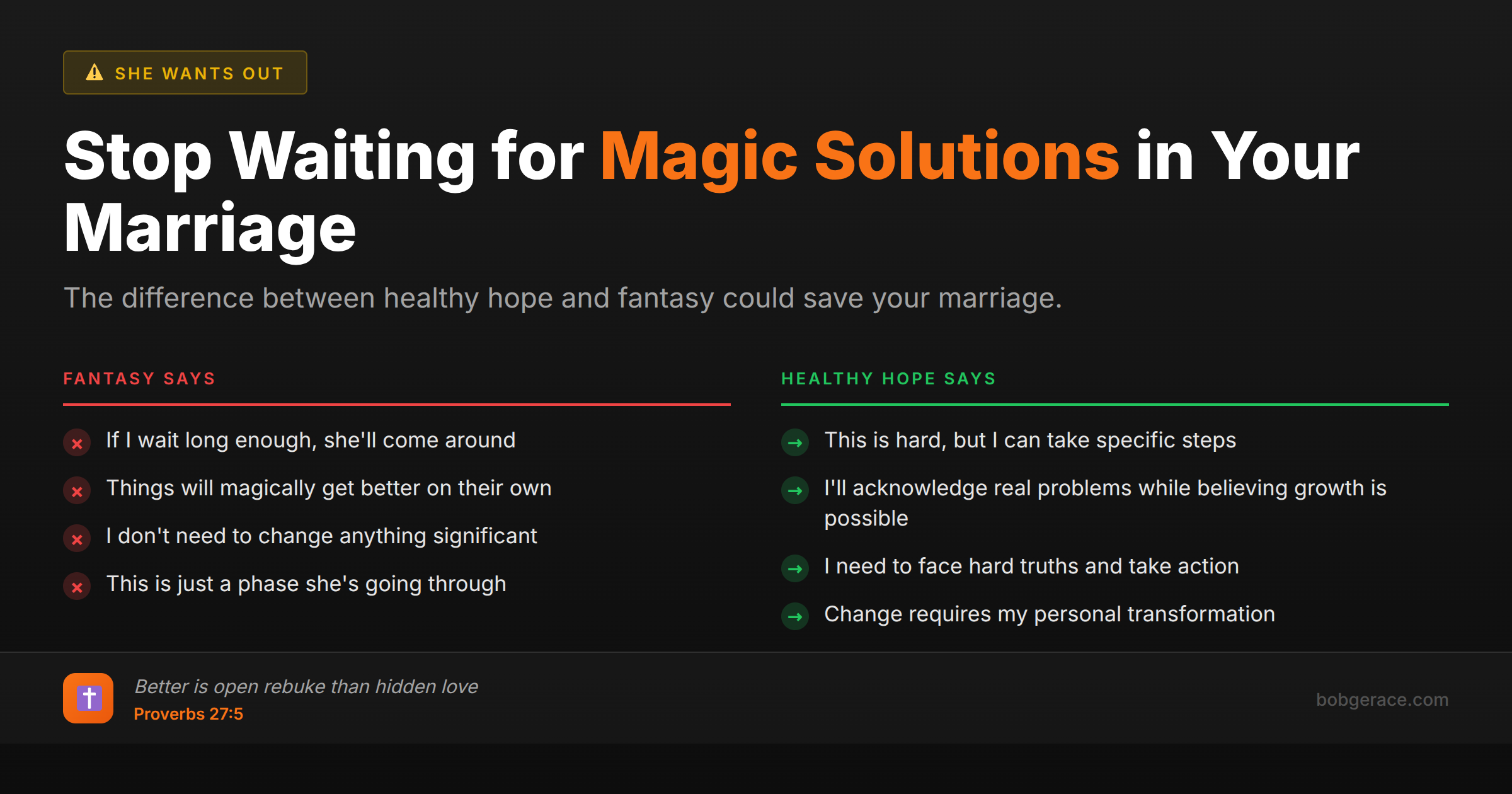
Healthy hope is grounded in reality and leads to constructive action, while fantasy disconnects you from what's actually happening and keeps you stuck in wishful thinking. Healthy hope says: 'This is hard, but I can take specific steps to grow and contribute to positive change.' Fantasy says: 'If I just wait long enough, everything will magically get better without me having to change anything significant.' The difference isn't in the outcome you're hoping for – it's in how you engage with reality. Healthy hope acknowledges the real problems in your marriage while maintaining faith that growth is possible. Fantasy minimizes problems and avoids the hard work of personal transformation. One leads to action, the other to passive waiting.
The Full Picture
Most men whose wives want out are living in some form of fantasy, and it's keeping them stuck. Here's what I see regularly:
Fantasy thinking looks like: • "She's just going through a phase – she'll come around" • "If I just give her some space, things will go back to normal" • "Once the kids are older/work gets better/we move, everything will be fine" • "She doesn't really mean it when she talks about divorce" • Waiting for her to change while avoiding your own hard work
Healthy hope, on the other hand: • Acknowledges the real severity of where you are • Takes responsibility for your part without taking on everything • Focuses on what you can control – your own growth and responses • Sets realistic timelines for change (think months and years, not weeks) • Prepares for multiple outcomes while working toward the best one
The trap is that fantasy feels better in the short term. It's less scary to believe "she'll come around" than to face the reality that your marriage is in crisis and might not survive. But fantasy is actually cruel because it prevents you from taking the actions that could actually make a difference.
Healthy hope is grounded in truth. It says, "This is really broken, AND it's not over yet." It motivates you to become the man your marriage needs, whether your wife stays or goes. Fantasy keeps you passive, hoping someone else will fix what's broken.
What's Really Happening
From a clinical perspective, the distinction between healthy hope and fantasy relates to what we call reality testing – your ability to accurately perceive and respond to your actual circumstances rather than what you wish were true.
Fantasy-based thinking often stems from cognitive dissonance – the psychological discomfort of holding contradictory beliefs. When faced with evidence that your marriage is failing, your brain may choose to minimize or distort that information rather than face the painful reality. This is a normal protective mechanism, but it becomes problematic when it prevents adaptive responses.
Healthy hope demonstrates several key psychological characteristics: • Accurate threat assessment – you see problems clearly without catastrophizing • Internal locus of control – you focus on what you can influence • Cognitive flexibility – you can adjust your approach based on new information • Distress tolerance – you can sit with difficult emotions without avoiding them
Research on post-traumatic growth shows that people who recover best from major life crises share one trait: they acknowledge the full reality of their situation while maintaining agency over their response. They don't minimize the damage, but they also don't become helpless victims.
The neurological reality is that fantasy-based thinking actually weakens your problem-solving capacity. When you avoid reality, your prefrontal cortex – responsible for executive function and planning – becomes less engaged. Healthy hope, grounded in accurate perception, activates your brain's adaptive systems and enables more effective responses to crisis.
What Scripture Says
Scripture consistently calls us to hope that's grounded in truth, not wishful thinking. Proverbs 27:5-6 says, *"Better is open rebuke than hidden love. Wounds from a friend can be trusted, but an enemy multiplies kisses."* Sometimes healthy hope requires facing hard truths rather than believing comfortable lies.
Romans 12:3 instructs us to *"think of yourself with sober judgment, in accordance with the faith God has distributed to each of you."* Sober judgment means seeing reality clearly – including your own contributions to problems. This isn't self-condemnation; it's the foundation for real change.
The difference between biblical hope and fantasy is evident in Jeremiah 29:11: *"'For I know the plans I have for you,' declares the Lord, 'plans to prosper you and not to harm you, to give you hope and a future.'"* Notice this promise came to people in exile – God didn't minimize their difficult circumstances, but offered hope within them.
Philippians 4:19 promises that *"God will meet all your needs according to the riches of his glory in Christ Jesus."* But this follows verses about learning contentment in all circumstances and doing what is right. Biblical hope is active, not passive.
Proverbs 21:5 provides the practical framework: *"The plans of the diligent lead to profit as surely as haste leads to poverty."* Healthy hope makes diligent plans based on reality. Fantasy rushes to conclusions that avoid the hard work of change.
True biblical hope acknowledges suffering while trusting God's sovereignty. It doesn't pretend problems don't exist – it believes God can work through them when we respond faithfully.
What To Do Right Now
-
1
Write down three specific problems your wife has mentioned about your marriage – don't soften them or explain them away
-
2
Identify one fantasy you've been holding onto ("she'll come around," "this is just temporary," etc.) and acknowledge it out loud
-
3
List three concrete actions you can take this week that address real issues, regardless of how she responds
-
4
Set a realistic timeline for your own growth – think 6-12 months for significant change, not weeks
-
5
Find one person who will tell you the truth about your situation and ask for their honest perspective
-
6
Pray specifically for wisdom to see clearly and courage to act on what you see, rather than for your circumstances to change
Related Questions
- How do I know if I'm in denial or in faith?
- When does waiting become enabling?
- What's the difference between standing and stagnating?
- What is 'closure' and do I need it to move on?
- How do I grieve a marriage that isn't dead yet?
- What's the difference between hope and presumption?
- What if godly people disagree on what I should do?
- How do I separate fear from wisdom?
- What does real forgiveness look like?
Also find Bob on
Subscribe for weekly videos on Christian marriage.
You Don't Have to Figure This Out Alone
A coach who knows your marriage can tell you when you're sliding into fantasy and when your hope is actually grounded. Bob works with men who are done guessing.
Talk to Bob →