How do I know if I'm in denial or in faith?
6 min read
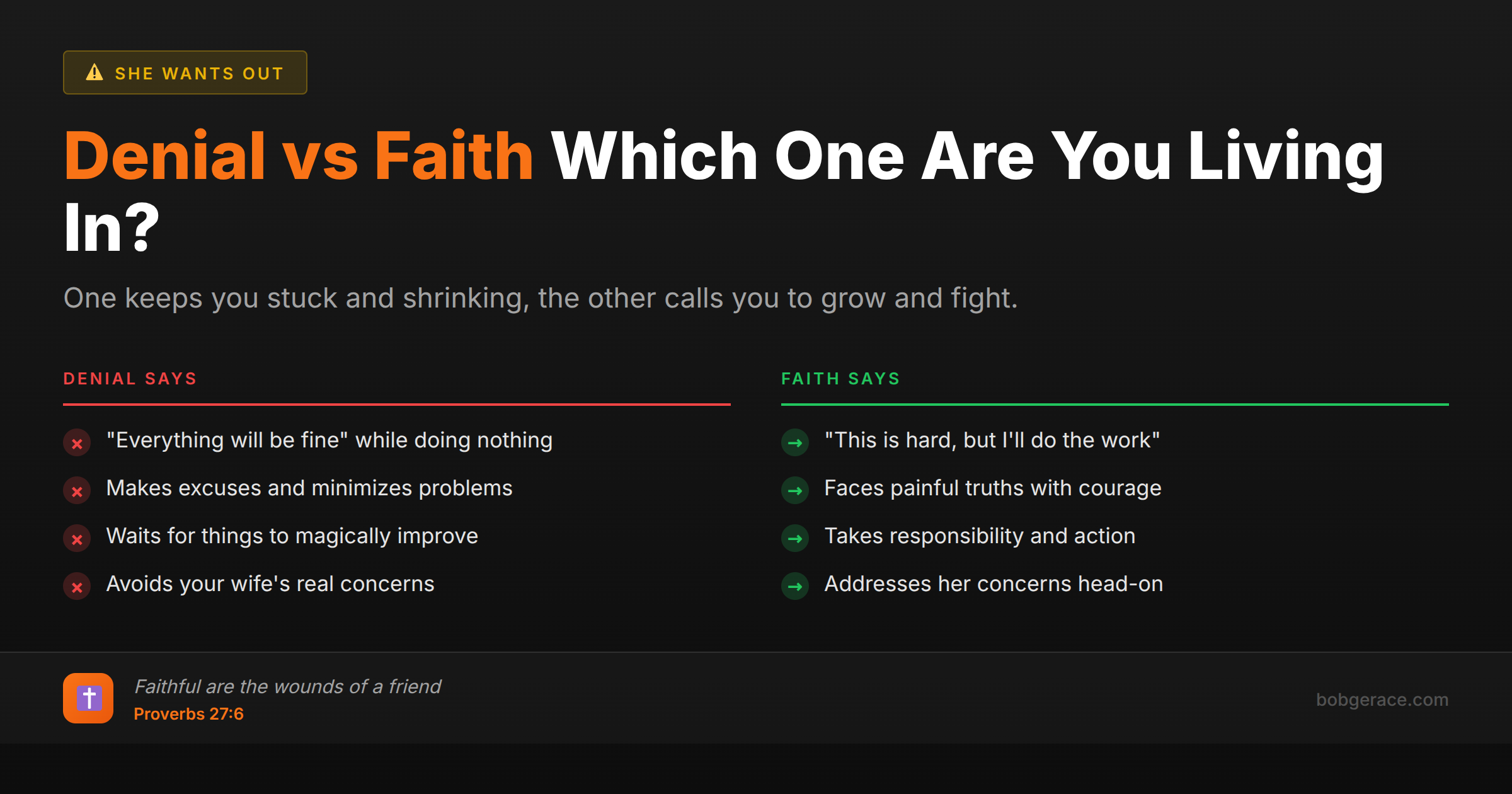
Here's the hard truth: denial feels passive and makes you smaller, while faith feels active and calls you to grow. When you're in denial, you're avoiding reality and waiting for things to magically improve without your participation. You're making excuses, minimizing problems, and blaming external circumstances. Faith, on the other hand, acknowledges the full reality of your situation - including the pain - but trusts God's ability to work through it as you take responsibility and action. Faith doesn't ignore your wife's legitimate concerns; it faces them head-on with courage and humility. If you find yourself saying 'everything will be fine' while doing nothing different, that's denial. If you're saying 'this is hard, but I'm going to do the work God is calling me to do,' that's faith.
The Full Picture
The line between faith and denial can feel razor-thin when your marriage is in crisis. Both involve believing in something you can't fully see yet. But the difference is profound and will determine whether you move toward healing or deeper dysfunction.
Denial is passive resistance to reality. It shows up as:
• Making excuses for your wife's behavior instead of hearing her complaints • Insisting 'she'll come around' while refusing to examine your own patterns • Focusing on her problems while minimizing your contributions • Believing time alone will heal deep relational wounds • Avoiding difficult conversations or professional help • Spiritualizing your inaction ('I'm just trusting God' while doing nothing)
Faith is active engagement with reality. It looks like:
• Acknowledging the full scope of your marriage problems without minimizing • Taking ownership of your part in the dysfunction • Seeking counsel, coaching, or therapy even when it's uncomfortable • Having hard conversations because love requires truth • Changing your behavior patterns, not just your intentions • Trusting God's process while participating in it fully
The common mistake men make is thinking that denial and faith both require 'believing the best.' But faith believes the best *while preparing for and working toward that outcome*. Denial believes the best while *avoiding the work required to achieve it*. One leads to transformation; the other leads to stagnation and often divorce papers.
What's Really Happening
From a clinical perspective, denial and faith activate different neurological pathways and produce different behavioral outcomes. Denial is fundamentally a defense mechanism - what we call 'experiential avoidance' in therapy. The brain perceives threat and shuts down processing of painful information to protect the ego from overwhelming anxiety.
Research in attachment theory shows that men often employ denial when facing relationship threats because vulnerability feels dangerous. The primitive brain interprets emotional pain as physical threat, triggering fight-or-flight responses that shut down the prefrontal cortex - the area responsible for rational thinking and empathy.
Faith, however, engages what psychologists call 'post-traumatic growth' mechanisms. It activates the brain's capacity to find meaning in suffering and mobilize resources for change. Neuroimaging studies show that people operating from genuine faith demonstrate increased activity in areas associated with emotional regulation, empathy, and executive function.
The clinical markers are clear: denial creates rigidity, faith creates flexibility. Denial narrows your focus to avoid discomfort; faith expands your perspective to embrace growth. Men in denial often exhibit what we call 'emotional dysregulation' - they swing between minimizing problems and catastrophizing about outcomes. Those operating from faith show greater emotional stability because they're not constantly defending against reality.
The therapeutic goal is helping clients distinguish between 'hoping for the best' (which can be either denial or faith) and 'working toward the best' (which is always faith). True faith requires what we call 'radical acceptance' - fully acknowledging current reality while maintaining hope for change through intentional action.
What Scripture Says
Scripture consistently calls us to face reality with courage while trusting God's faithfulness. Proverbs 27:6 reminds us that 'faithful are the wounds of a friend' - meaning that faith often requires hearing and accepting difficult truths, even when they hurt.
Hebrews 11:1 defines faith as 'the assurance of things hoped for, the conviction of things not seen.' Notice that faith is both assurance AND conviction - it's not passive wishful thinking but active confidence that produces action. The heroes of faith in Hebrews 11 all took concrete steps based on their beliefs.
James 2:17 cuts through any confusion: 'Faith by itself, if it does not have works, is dead.' Faith without corresponding action isn't faith at all - it's presumption or denial dressed up in spiritual language. If your 'faith' isn't producing changes in how you treat your wife, how you communicate, or how you address your own character issues, it's likely denial.
Psalm 139:23-24 provides a perfect example of faith-based thinking: 'Search me, O God, and know my heart; test me and know my anxious thoughts. See if there is any offensive way in me, and lead me in the way everlasting.' This is faith - inviting God to reveal uncomfortable truths because you trust Him to use that revelation for good.
Proverbs 28:13 offers hope: 'Whoever conceals his transgressions will not prosper, but he who confesses and forsakes them will obtain mercy.' Faith confesses and forsakes; denial conceals and continues. Romans 8:28 promises that God works all things together for good - but only for those who are 'called according to his purpose,' which requires active participation in His transforming work.
What To Do Right Now
-
1
Write down your wife's specific complaints about your marriage without defending or minimizing any of them
-
2
Ask yourself: 'What concrete actions have I taken in the past 30 days to address these issues?'
-
3
Schedule a session with a marriage counselor or coach within the next two weeks, regardless of whether your wife will attend
-
4
Confess to a trusted friend or mentor one way you've been avoiding responsibility in your marriage
-
5
Create a specific action plan with measurable steps to address your wife's top three concerns
-
6
Pray daily for the courage to see yourself and your marriage as God sees them, asking Him to reveal blind spots
Related Questions
- What does healthy hope look like vs. fantasy?
- When does waiting become enabling?
- What's the difference between standing and stagnating?
- How long do I wait before giving up?
- When does standing become idolatry of the marriage?
- What's the difference between hope and presumption?
- What does surrendered prayer look like?
- How do I separate fear from wisdom?
- What does real forgiveness look like?
Also find Bob on
Subscribe for weekly videos on Christian marriage.
Your Marriage Isn't a Generic Case Study
Denial or faith? That question has a different answer depending on what's actually happening in your home. A coach who knows your story can tell you what you're not seeing.
Talk to Bob →