What should change in his emotional regulation?
6 min read
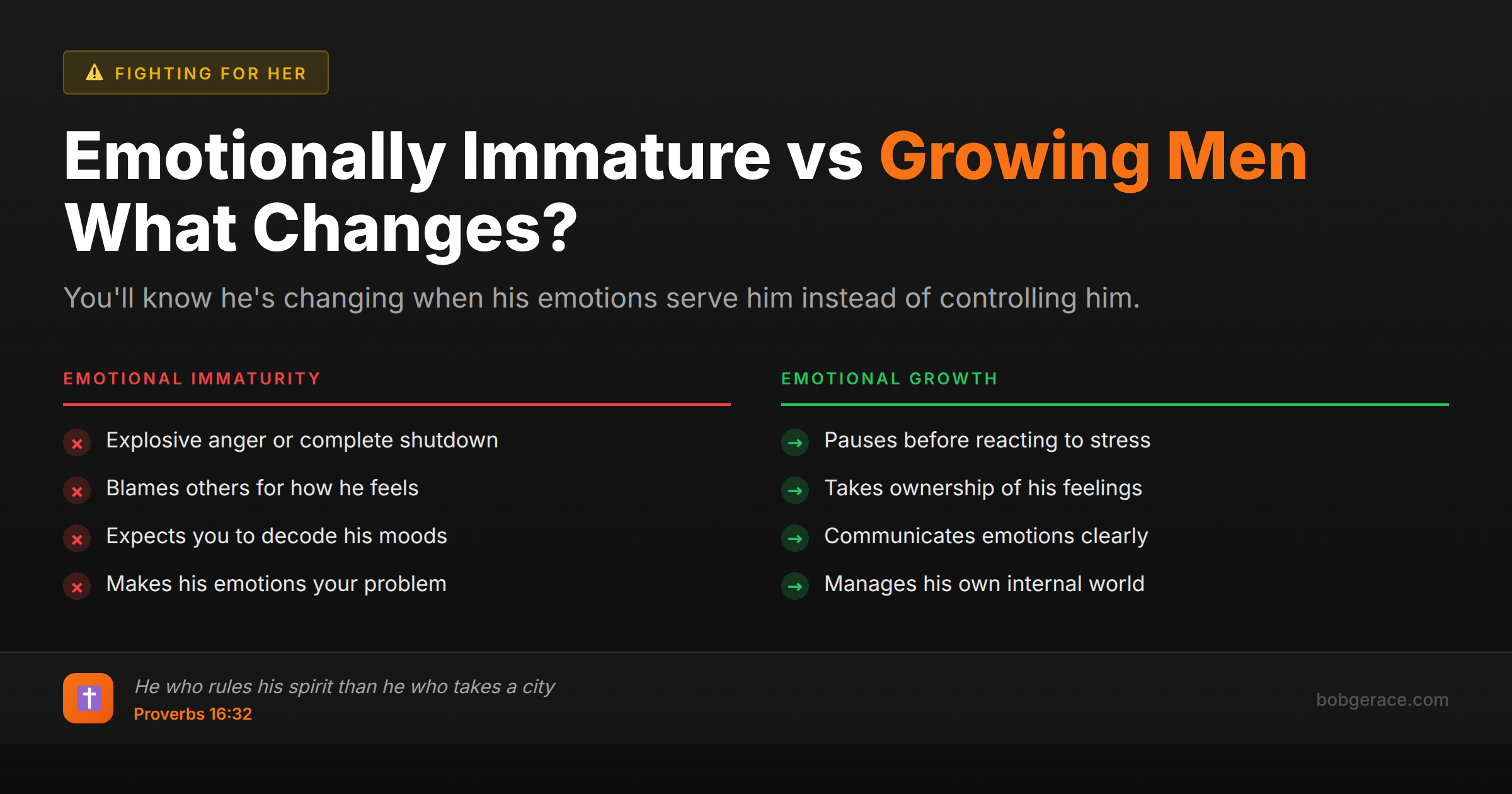
When a man is growing in emotional regulation, you'll see him move from reactive patterns to responsive ones. Instead of explosive anger or emotional shutdown, he'll begin pausing before reacting, taking responsibility for his emotions, and communicating his feelings clearly rather than expecting you to decode his moods. He'll stop making his emotional state your responsibility and start managing his own internal world with maturity. The biggest change is ownership - he'll acknowledge his emotions without blaming others or circumstances for how he feels. This doesn't mean he becomes emotionless, but rather that his emotions serve him instead of controlling him.
The Full Picture
Real emotional regulation in men looks different than what most wives expect. It's not about him becoming a robot or suppressing all feelings. Healthy emotional regulation means he owns his emotional responses and chooses his reactions deliberately.
You'll notice several key shifts when a man is truly growing in this area. First, the time between trigger and response increases. Where he might have exploded immediately, you'll see him pause, breathe, and consider his words. This isn't fake or performative - it's genuine self-control developing.
Second, he stops making you responsible for managing his emotions. No more walking on eggshells wondering what mood he's in. He'll communicate his emotional state clearly rather than expecting you to be a mind reader. When he's stressed about work, he'll say so instead of snapping at the kids.
His apologies will change too. Instead of "I'm sorry you feel that way" or quick, shallow apologies to end conflict, you'll hear genuine ownership: "I was wrong to raise my voice. I was frustrated about work and took it out on you. That's not acceptable."
Most importantly, you'll see consistency over time. Anyone can regulate emotions for a day or week. True change shows up in how he handles stress, disappointment, and conflict month after month. The goal isn't perfection - it's a man who takes responsibility for his inner world and doesn't make his family casualties of his emotional immaturity.
What's Really Happening
From a clinical perspective, emotional regulation involves the prefrontal cortex overriding the limbic system's immediate reactions. When men develop healthy emotional regulation, we're seeing actual neuroplastic changes - their brains are literally rewiring to create space between stimulus and response.
The key indicators I look for are emotional granularity - can he identify and name specific emotions beyond "fine," "angry," or "stressed"? Men who develop regulation can distinguish between frustration, disappointment, overwhelm, and irritation. This specificity allows for appropriate responses rather than generic emotional explosions.
Co-regulation is another crucial element. A man with good emotional regulation doesn't just manage his own emotions - he helps stabilize the emotional climate of his family. His calm presence during crisis becomes an anchor rather than adding to the chaos.
Physiologically, you'll notice changes in his stress responses. His breathing will remain controlled during conflict, his voice will stay level, and his body language will be open rather than defensive or aggressive. These aren't conscious performances but automatic responses from a regulated nervous system.
The timeline for real change typically spans 6-18 months with consistent effort. Surface-level behavioral changes might appear quickly, but genuine emotional regulation - the kind that persists under real pressure - requires deeper neural pathway development and often professional guidance to address underlying trauma or learned patterns.
What Scripture Says
Scripture consistently calls men to emotional maturity and self-control. Proverbs 16:32 tells us, *"Whoever is slow to anger is better than the mighty, and he who rules his spirit than he who takes a city."* This isn't about suppressing anger but governing it wisely.
Ephesians 4:26-27 provides the framework: *"Be angry and do not sin; do not let the sun go down on your anger, and give no opportunity to the devil."* Healthy emotional regulation acknowledges emotions while choosing righteous responses. A man growing in this area will feel anger but express it constructively, not destructively.
James 1:19-20 instructs: *"Let every person be quick to hear, slow to speak, slow to anger; for the anger of man does not produce the righteousness of God."* You'll see this lived out when your husband starts listening more and reacting less, especially during conflict.
The fruit of the Spirit in Galatians 5:22-23 includes *"self-control"* - the Greek word *enkrateia*, meaning mastery over one's desires and impulses. This isn't willpower alone but the Holy Spirit producing supernatural emotional regulation.
Proverbs 27:14 warns against unregulated emotions affecting others: *"Whoever blesses his neighbor with a loud voice, rising early in the morning, will be counted as cursing."* Even positive emotions need regulation to serve others well.
1 Corinthians 13:5 reminds us that love *"is not irritable or resentful."* A husband growing in emotional regulation will show increasing patience and grace, not because he feels less but because he chooses love over his immediate emotional impulses.
What To Do Right Now
-
1
Observe patterns - track his responses to stress, conflict, and disappointment over several weeks
-
2
Notice the gap between trigger and response - is he pausing more before reacting?
-
3
Pay attention to his apologies - are they taking ownership or deflecting responsibility?
-
4
Watch for emotional vocabulary - can he name specific emotions beyond basic categories?
-
5
Assess consistency - does his emotional regulation hold up during real pressure, not just easy days?
-
6
Celebrate genuine progress while maintaining boundaries around unacceptable behavior
Related Questions
- What should change in his conflict behavior?
- What should change in his communication?
- What should change in his responsiveness to you?
- What daily practices indicate commitment?
- What does proactive repair look like?
- What does humility in process look like?
- I can't control my anger
- What is 'amygdala hijack' and how do I interrupt it?
- How do I stay in prefrontal cortex during conflict?
Also find Bob on
Subscribe for weekly videos on Christian marriage.
Not Sure If He's Actually Changing?
A coach who knows your marriage can tell you what's real progress and what's performance. You don't have to keep guessing alone.
Talk to Bob →