What does 'taking responsibility' actually look like?
6 min read
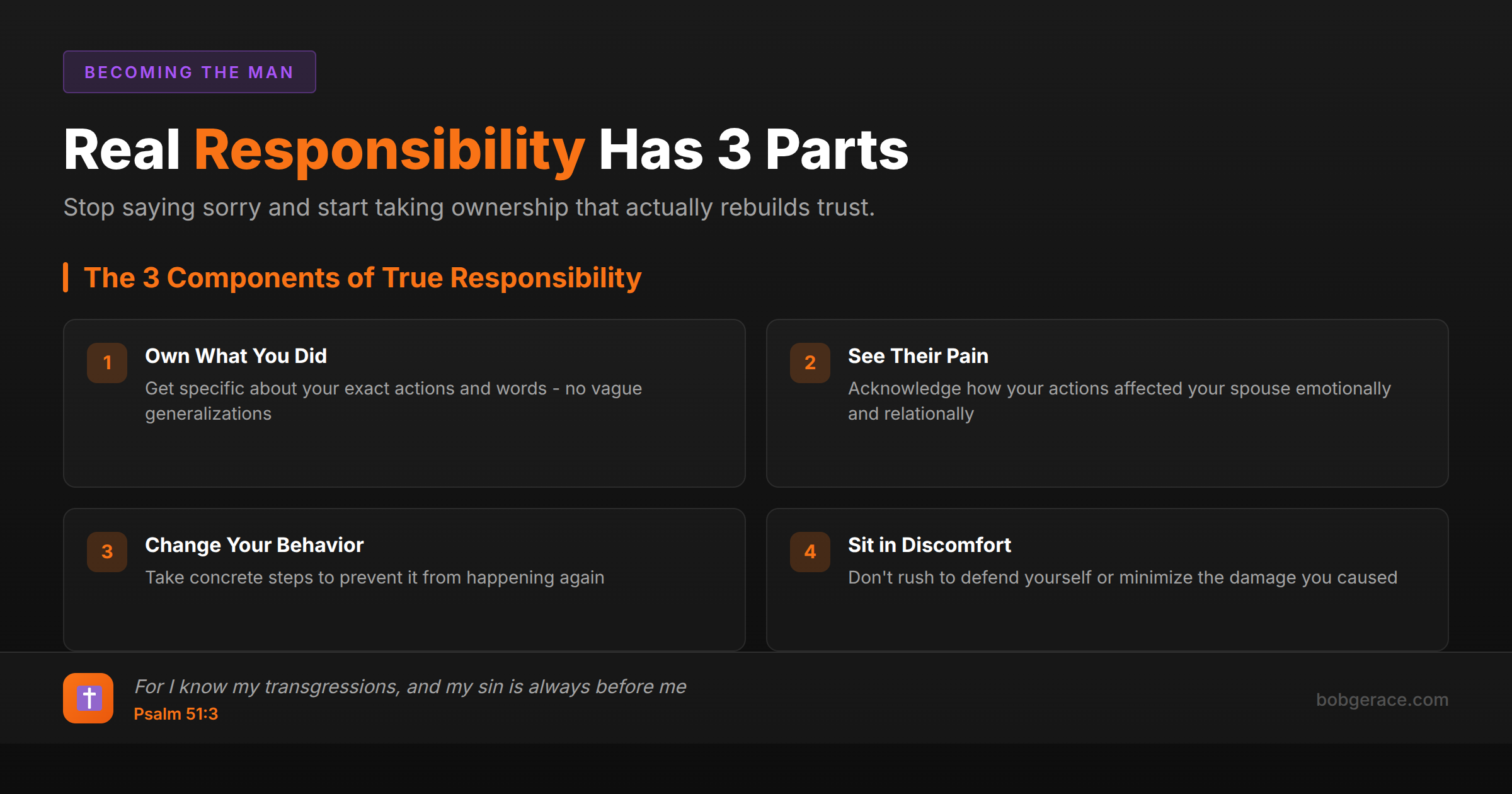
Taking responsibility means owning your actions, their impact, and your role in the problem without deflecting or making excuses. It's not just saying 'I'm sorry' – it's demonstrating through specific acknowledgment, changed behavior, and consistent follow-through that you understand what went wrong and are committed to doing better. Real responsibility involves three components: acknowledging what you did specifically, understanding how it affected your spouse, and taking concrete steps to prevent it from happening again. It means sitting in the discomfort of your spouse's hurt without rushing to defend yourself or minimize the damage. This isn't about self-flagellation – it's about mature ownership that creates the foundation for genuine healing and restored trust in your marriage.
The Full Picture
Most people think taking responsibility is just admitting fault, but that's only the beginning. True responsibility is a multi-layered process that requires emotional maturity, humility, and sustained action.
First, it means specific acknowledgment – not vague apologies like 'I'm sorry if I hurt you,' but clear statements like 'I was wrong to raise my voice and walk away when you were trying to talk to me about our finances.' This specificity shows you actually understand what happened, not just that your spouse is upset.
Second, responsibility includes impact acknowledgment – recognizing how your actions affected your spouse emotionally, relationally, and practically. It's saying 'I can see that when I shut down, it made you feel alone and unheard, and it prevented us from solving this important issue together.'
Third, it involves ownership of your internal process – acknowledging not just what you did, but why you did it and what was happening inside you. This isn't excuse-making; it's taking responsibility for your emotional responses, triggers, and patterns.
Finally, true responsibility includes commitment to change with specific actions. It's not enough to promise to 'do better' – you need concrete plans for handling similar situations differently in the future. This might mean committing to take a timeout when you feel overwhelmed, seeking counseling for anger management, or establishing new communication protocols.
The key difference between false responsibility and genuine responsibility is follow-through. Anyone can apologize in the moment, but taking responsibility means your behavior actually changes over time, demonstrating that your words were more than damage control.
What's Really Happening
From a clinical perspective, difficulty taking responsibility often stems from shame-based defensive mechanisms. When people feel threatened by the possibility of being 'bad' or 'wrong,' their nervous system activates protective responses – deflection, minimization, counter-attacking, or shutdown.
True responsibility requires distress tolerance – the ability to sit with uncomfortable emotions without immediately trying to escape them. Many people struggle with this because they confuse taking responsibility with accepting shame or condemnation. But responsibility is actually shame's antidote – it moves us from 'I am bad' to 'I did something harmful that I can repair.'
Neurologically, taking responsibility activates the prefrontal cortex – our rational, problem-solving brain – rather than the amygdala's fight-or-flight responses. This shift from reactive to responsive allows for genuine repair and learning.
The process also requires mentalization – the ability to understand the mental states underlying both your own and your spouse's behavior. This means recognizing that your spouse's hurt isn't an attack on you, but a natural response to being harmed, and that your defensive reactions come from your own fears and insecurities.
Attachment theory shows us that people with secure attachment find responsibility easier because they don't equate making mistakes with losing love. Those with insecure attachment patterns may struggle more, viewing responsibility as confirmation of their unworthiness rather than a path to deeper connection.
What Scripture Says
Scripture consistently calls us to own our failures and pursue genuine repentance, not shallow apologies. Psalm 51:3-4 shows David's model of taking responsibility: *'For I know my transgressions, and my sin is always before me. Against you, you only, have I sinned and done what is evil in your sight.'* Notice the specificity and complete ownership without excuse-making.
James 5:16 instructs us to *'confess your sins to each other and pray for each other so that you may be healed.'* This isn't just about confession to God – it's about the healing that comes through vulnerable honesty with those we've hurt.
Matthew 5:23-24 takes it further: *'Therefore, if you are offering your gift at the altar and there remember that your brother or sister has something against you, leave your gift there in front of the altar. First go and be reconciled to them; then come and offer your gift.'* God prioritizes relational repair over religious activity.
Luke 3:8 calls us to *'produce fruit in keeping with repentance,'* emphasizing that true repentance shows up in changed behavior, not just words.
Proverbs 28:13 promises that *'whoever confesses and renounces their sins finds mercy,'* showing that responsibility combined with genuine change leads to restoration.
1 John 1:9 assures us that *'if we confess our sins, he is faithful and just and will forgive us our sins and purify us from all unrighteousness.'* This foundation of divine forgiveness gives us the security to take responsibility without fear of ultimate rejection.
What To Do Right Now
-
1
Stop defending and start listening – When your spouse expresses hurt, resist the urge to explain yourself and instead focus entirely on understanding their experience
-
2
Get specific about what you did wrong – Write down your exact actions and words, not vague generalizations or partial admissions
-
3
Acknowledge the impact without 'but' statements – Tell your spouse specifically how you can see your actions affected them emotionally and relationally
-
4
Take ownership of your internal process – Identify what triggered you, what you were feeling, and why you responded the way you did, without using it as an excuse
-
5
Commit to specific behavior changes – Don't just promise to 'do better' – outline concrete steps you'll take when similar situations arise in the future
-
6
Follow through consistently over time – Demonstrate your responsibility through sustained changed behavior, checking in regularly on your progress and your spouse's experience
Related Questions
Ready to Take Real Responsibility?
Learning to take genuine responsibility is one of the most powerful skills for healing your marriage. Let's work together to break defensive patterns and build authentic accountability.
Get Help Now →