What if I already reacted badly?
5 min read
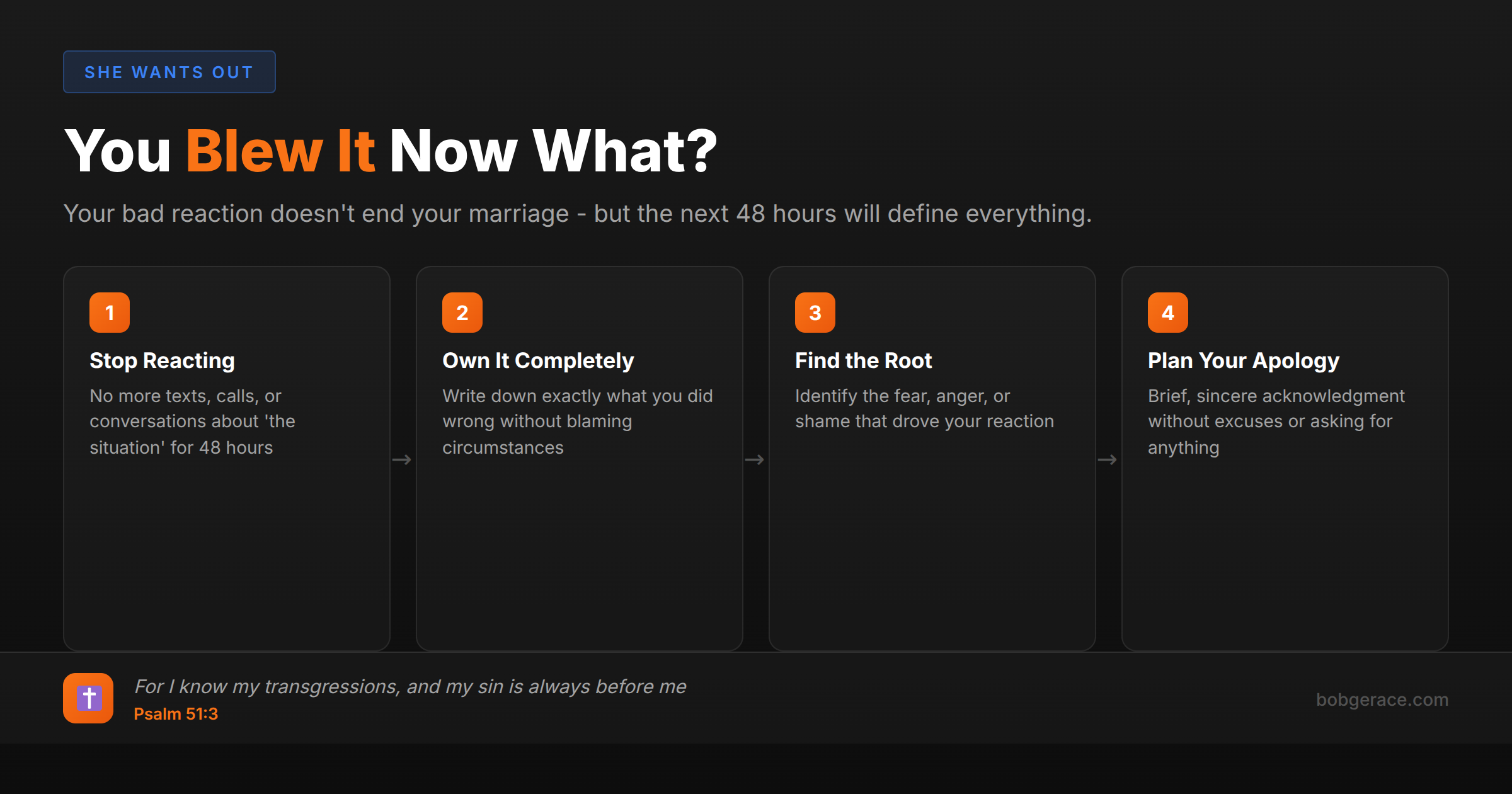
First, take a breath. Yes, you reacted badly. Maybe you yelled, begged, made threats, or said things you regret. The damage feels enormous right now, but it's not permanent. I've worked with hundreds of men who felt like they'd destroyed their last chance, and many of them saved their marriages. Here's what you need to understand: your wife already expected you to react badly. She's been planning this conversation for months, maybe years. She knows you better than anyone, and she prepared for your worst response. The fact that you delivered it doesn't shock her - but how you handle the next 48 hours absolutely will. This is where the real work begins, and ironically, where your biggest opportunity lies.
The Full Picture
When your wife drops the bomb that she wants out, your brain doesn't function normally. The part of your mind responsible for rational thinking - your prefrontal cortex - literally goes offline. You're operating from pure survival instinct, which means you're probably going to say and do exactly the wrong things.
Common bad reactions I see: • Anger and yelling ("How could you do this to our family?") • Immediate bargaining ("I'll change everything, just give me a chance") • Threats or ultimatums ("If you leave, you'll never see the kids again") • Complete emotional breakdown in front of her • Bringing in the kids or extended family immediately • Making promises you can't possibly keep
Here's what most men don't realize: your wife has been rehearsing this conversation in her mind for months. She's anticipated your anger, your tears, your promises. She's built up defenses against all of it. Your bad reaction actually confirms what she already believed about you and your relationship.
But here's the thing - she also expects you to keep reacting badly. She expects you to chase, plead, and make the same mistakes over the next weeks and months. This is where you have your opportunity. When you stop doing what she expects and start responding with wisdom, strength, and genuine change, you create space for her to see you differently.
The key is understanding that your bad reaction wasn't the problem - it was a symptom of deeper issues in your relationship. Use this moment as a wake-up call, not a reason to give up.
What's Really Happening
When faced with relationship threats, we experience what psychologists call 'amygdala hijack' - our emotional brain takes over, bypassing rational thought processes. This is why even intelligent, successful men often respond poorly to their wife's declaration that she wants out.
Research shows that during high-stress relational conflicts, our bodies flood with cortisol and adrenaline, creating a fight-or-flight response that's completely counterproductive to relationship repair. Your bad reaction wasn't a character flaw - it was a predictable neurobiological response to perceived abandonment.
However, there's hope in understanding what happens next. Studies on relationship recovery indicate that couples can actually emerge stronger after crisis moments, but only when both partners move beyond their initial reactive patterns. The key is what researchers call 'meta-emotion' - your ability to have emotions about your emotions and regulate them accordingly.
For men specifically, research shows that wives are more likely to reconsider their position when they see genuine emotional regulation and behavioral change, not just promises of change. Your wife's brain is currently in a state of 'negative sentiment override' - she's interpreting everything you do through a negative lens. Breaking through this requires consistent, non-reactive responses over time.
The most important clinical insight here is this: your bad reaction actually provides valuable data about your emotional regulation patterns. Use it as a diagnostic tool, not a reason for shame.
What Scripture Says
Scripture is remarkably honest about human failure and the path to restoration. King David's response after his confrontation with the prophet Nathan shows us the right way forward after we've blown it.
Psalm 51:3-4 - "For I know my transgressions, and my sin is always before me. Against you, you only, have I sinned and done what is evil in your sight." David didn't make excuses or blame others. He owned his failure completely.
Proverbs 27:5-6 - "Better is open rebuke than hidden love. Wounds from a friend can be trusted, but an enemy multiplies kisses." Your wife's words, though painful, may be the wake-up call God is using to expose areas where you need to grow.
James 1:19-20 - "My dear brothers and sisters, take note of this: Everyone should be quick to listen, slow to speak and slow to become angry, because human anger does not produce the righteousness that God desires." This is exactly what you failed to do initially, but it's the standard moving forward.
1 Peter 3:7 - "Husbands, in the same way be considerate as you live with your wives, and treat them with respect as the weaker partner and as heirs with you of the gracious gift of life, so that nothing will hinder your prayers." Notice that disrespecting your wife actually hinders your prayers - God takes this seriously.
The biblical pattern is clear: acknowledge the failure, learn from it, and demonstrate genuine change through your actions. God specializes in restoration, but it requires humility and authentic repentance, not just regret about consequences.
What To Do Right Now
-
1
Stop all reactive behavior immediately - no more texts, calls, or conversations about 'the situation' for 48 hours
-
2
Write down exactly what you said and did wrong, taking full responsibility without blaming circumstances
-
3
Identify the underlying emotions that drove your bad reaction (fear, anger, shame, abandonment)
-
4
Plan a brief, sincere apology that acknowledges your behavior without making excuses or asking for anything
-
5
Give your wife space to process without trying to 'fix' her feelings about your reaction
-
6
Begin demonstrating the emotional regulation you failed to show initially through your daily actions
Related Questions
- What do I say when she asks for divorce?
- What are the first words out of my mouth?
- Should I try to talk her out of it immediately?
- Do I show emotion or stay calm?
- How do I regulate when my body is in fight-or-flight?
- What is 'anxious protest behavior' and am I doing it?
- I can't control my anger
- I said things I can't take back
- How do I stop exploding?
- What does proactive repair look like?
Also find Bob on
Subscribe for weekly videos on Christian marriage.
You Don't Have to Fix This Alone
You already know what went wrong. The question is what you do in the next 48 hours with your specific marriage, your specific wife. A coach who knows your story can help you stop guessing.
Talk to Bob →