What are the first words out of my mouth?
5 min read
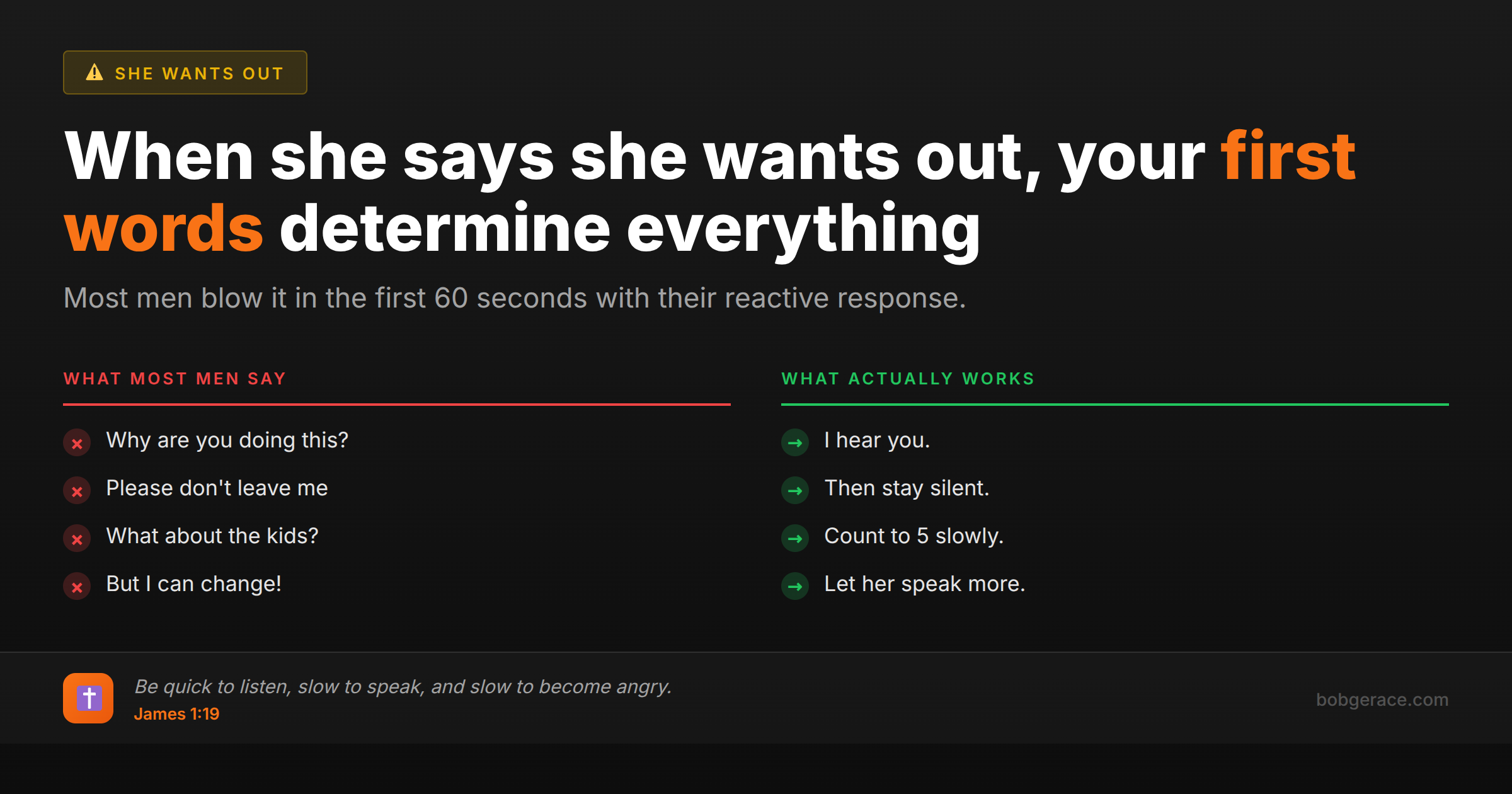
Stop. Take a breath. Then say this: "I hear you, and I understand this is serious. I love you and I want to understand what's brought us here." That's it. Nothing more right now. Your instinct will be to defend yourself, make promises, or try to fix everything immediately. Don't. Your wife has likely been building toward this moment for months or years. She's not looking for your quick fixes - she's looking to see if you can actually *hear* her without making it about you. The first words out of your mouth will either open a door for dialogue or slam it shut forever. Choose them like your marriage depends on it - because it does.
The Full Picture
When your wife says she wants out, your brain goes into emergency mode. Fight, flight, or freeze - none of which help you respond wisely. Most men immediately launch into damage control mode: "But honey, we can work this out!" or "You don't really mean that!" or the classic "What about the kids?"
These responses, while understandable, are marriage killers. Here's why:
• They minimize her experience - She's telling you something monumentally important, and you're already trying to talk her out of it • They make it about you - Your panic, your solutions, your timeline • They prove you're not listening - Which is likely part of why she wants out in the first place • They trigger her defenses - Now she has to defend her decision instead of explaining it
The goal of your first response isn't to save your marriage - it's to keep the conversation alive. Your marriage won't be saved in the first five minutes after she drops this bomb. But it can absolutely be destroyed in those five minutes if you respond poorly.
What she's really testing is whether you've changed, whether you can handle difficult emotions (yours and hers), and whether you're capable of putting her needs ahead of your own panic. Your first words are your first opportunity to show her something different than what she's been experiencing.
Remember: She didn't wake up this morning and randomly decide to blow up your life. This has been building. Your job right now is to create safety for her to tell you the truth about what's been happening in her heart and mind.
What's Really Happening
From a psychological perspective, this moment represents what we call a "pivotal interaction" - a brief exchange that can fundamentally alter the trajectory of the relationship. Research by Dr. John Gottman shows that how couples handle these critical moments predicts relationship outcomes with remarkable accuracy.
When your wife says she wants out, her nervous system is likely in a state of hypervigilance. She's unconsciously scanning for signs that this conversation will go the way previous difficult conversations have gone. If your immediate response is defensive, dismissive, or solution-focused, you're confirming her fears that nothing has really changed.
Neurologically, your brain is flooded with stress hormones - cortisol and adrenaline - making it nearly impossible to think clearly. This is why your first instinct is often your worst option. The prefrontal cortex, responsible for executive decision-making, goes offline during intense stress. You're literally not thinking with your full brain capacity.
What creates safety in this moment is what psychologists call "emotional validation" - demonstrating that you can receive her emotional experience without immediately trying to change or fix it. This isn't agreement with her decision; it's acknowledgment of her emotional reality.
The couples who navigate these crisis moments successfully share one characteristic: the ability to stay emotionally regulated when their partner is in distress. This requires what we call "distress tolerance" - the capacity to sit with uncomfortable emotions (yours and hers) without immediately acting to reduce that discomfort. Your first words either demonstrate this capacity or reveal its absence.
What Scripture Says
Scripture has profound wisdom about the power of our words, especially in crisis moments. James 1:19 instructs us: *"My dear brothers and sisters, take note of this: Everyone should be quick to listen, slow to speak and slow to become angry."* This isn't just good advice - it's a biblical command that directly applies to this moment.
Proverbs 18:13 warns: *"To answer before listening—that is folly and shame."* When your wife says she wants out, your first instinct might be to answer immediately, but God's Word calls this folly. She's telling you something crucial, and your job is to listen first, speak second.
Proverbs 15:1 reminds us that *"A gentle answer turns away wrath, but a harsh word stirs up anger."* Your wife isn't necessarily angry in this moment - she might be hurt, disappointed, or emotionally exhausted. But if you respond harshly or defensively, you'll escalate the situation unnecessarily.
Ephesians 4:29 provides a filter for your words: *"Do not let any unwholesome talk come out of your mouths, but only what is helpful for building others up according to their needs, that it may benefit those who listen."* Ask yourself: Are my first words going to build her up or tear her down? Do they meet her needs in this moment, or just mine?
1 Peter 3:7 calls husbands to *"be considerate as you live with your wives, and treat them with respect."* Respect in this moment means taking her words seriously, not dismissing them or immediately trying to change her mind.
The biblical response isn't passive - it's actively loving. It prioritizes understanding over being understood, listening over defending, and her emotional needs over your emotional comfort.
What To Do Right Now
-
1
Stop talking immediately after saying those first words - resist the urge to keep explaining or defending
-
2
Make eye contact and sit down if you're standing - show her you're present and not going anywhere
-
3
Put your phone away and eliminate all distractions - this conversation deserves your full attention
-
4
Ask one follow-up question: 'Will you help me understand what's been happening for you?'
-
5
Listen to her entire response without interrupting, defending, or planning your rebuttal
-
6
Validate what you heard by reflecting it back: 'It sounds like you've been feeling...' before saying anything else
Related Questions
- What do I say when she asks for divorce?
- Should I try to talk her out of it immediately?
- Do I show emotion or stay calm?
- What if I already reacted badly?
- She dropped the bomb — what do I do in the next 24 hours?
- How do I regulate when my body is in fight-or-flight?
- I just found out — what do I do in the next hour?
- How do I not lose my mind right now?
- What is 'amygdala hijack' and how do I interrupt it?
- How do I stop exploding?
Also find Bob on
Subscribe for weekly videos on Christian marriage.
Your Marriage Needs More Than Scripts
A coach who knows your story can help you say the right thing in your specific situation — not just the first crisis conversation, but the 30 days after that determine whether she stays.
Talk to Bob →