How do I function at work after hearing this?
6 min read
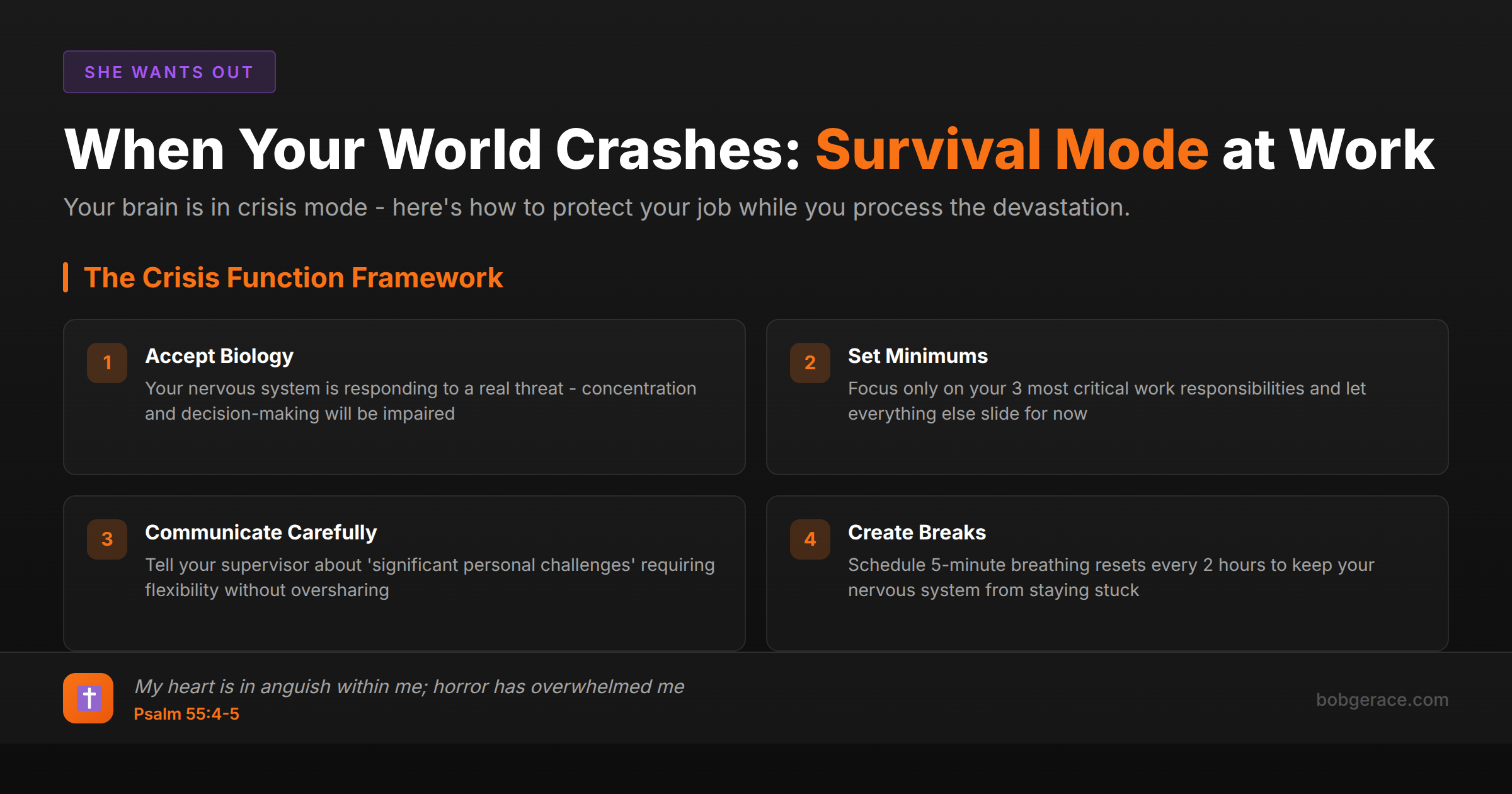
You're not going to function well. Accept that now. Your goal isn't excellence — it's survival. Do the minimum required to not get fired: show up, hit deadlines, avoid major mistakes. Tell one trusted person at work if you need to. Take walks. Cry in your car at lunch if you need to. This is a season, not forever. Protect your job without expecting yourself to thrive.
The Full Picture
Let's be honest: you're going to be terrible at your job for a while. Your brain is running a background process called 'my marriage might be ending' and it's consuming 80% of your mental CPU. You can't think clearly. You can't focus. You're reading the same email five times.
This is normal. This is biology. And pretending otherwise will only make things worse.
Here's how to survive work during this season:
Lower the bar dramatically. Your goal is not to excel. Your goal is to not get fired. Do what's required. Hit your deadlines. Show up to meetings. But stop expecting yourself to perform at your usual level. You're running a marathon on a broken leg.
Automate what you can. Anything that doesn't require active thought, put on autopilot. Use checklists. Set reminders. Let systems carry you when your brain can't.
Protect high-stakes moments. If you have a big presentation or critical meeting, schedule it for when you're least likely to be dysregulated. Morning is usually better than afternoon. Don't stack important things back-to-back.
Build in pressure releases. Take a walk at lunch. Sit in your car for 10 minutes. Step outside and breathe. You need small moments to let the pressure out or you'll blow up in the wrong context.
Tell one person. You don't need to broadcast your situation, but having one person at work who knows gives you cover. 'I'm going through some personal stuff at home' is enough. They don't need details.
Watch your tells. You might be shorter with people than usual. More distracted. Less patient. Monitor yourself and apologize quickly when you slip.
Don't make career decisions now. This is not the time to quit your job, confront your boss, or take a risky new position. Your judgment is compromised. Keep things stable.
What's Really Happening
What you're experiencing is the cognitive impact of acute stress. When your attachment system is threatened, your brain shifts resources away from 'optional' functions like concentration, creativity, and working memory, and toward survival functions like threat monitoring and emotional processing.
This isn't weakness. It's neurobiology.
Studies on divorce and workplace performance show significant decreases in productivity, increased errors, and impaired decision-making — often lasting 6-12 months. The prefrontal cortex, responsible for executive function, is literally impaired by chronic stress hormones.
What helps:
1. External structure. Your internal structure is compromised, so lean on external systems — calendars, lists, routines, reminders.
2. Physical regulation. Movement, even brief, helps clear stress hormones. A 10-minute walk can restore some cognitive function.
3. Compartmentalization (healthy version). This isn't about denying your feelings. It's about giving yourself permission to set them aside temporarily: 'I will feel this, but not right now. I'll feel it at lunch.'
4. Sleep protection. Your cognitive function is directly tied to sleep. Prioritize it ruthlessly, even if that means sleeping aids short-term.
Research also shows that social support at work — even just one trusted colleague — significantly improves coping and performance during personal //blog.bobgerace.com/4-crisis-theaters-christian-husband-must-master/:crisis.
What Scripture Says
Colossians 3:23 tells us: 'Whatever you do, work at it with all your heart, as working for the Lord, not for human masters.'
But what does 'all your heart' mean when your heart is broken?
It means showing up. It means being present. It means doing what you can with what you have.
David wrote psalms while fleeing for his life. Paul wrote letters from prison. The call to work unto the Lord doesn't require optimal conditions — it requires faithfulness in whatever condition you're in.
Ecclesiastes 9:10: 'Whatever your hand finds to do, do it with your might.' Notice it doesn't say 'do it perfectly.' It says do it with whatever might you have available.
Your work right now is an act of obedience. Not because you feel like it. Not because you're performing well. But because you're showing up when everything in you wants to collapse.
There's also wisdom in Proverbs 27:23: 'Be sure you know the condition of your flocks, give careful attention to your herds.' In modern terms: protect your livelihood. Don't let the crisis at home create a crisis at work. Your family needs you employed.
What To Do Right Now
-
1
Accept that 'good enough' is the goal right now. You're not going to be your best self at work. That's okay. Aim for competent, not excellent.
-
2
Identify one trusted person at work and give them a heads up: 'I'm dealing with something heavy at home. I might be off for a bit.' You don't owe details.
-
3
Build one pressure release into each workday — a walk, sitting in your car, stepping outside. Non-negotiable.
-
4
Use external systems ruthlessly. Write everything down. Set alarms. Don't trust your brain to remember anything.
-
5
If you catch yourself spiraling at your desk, do a 60-second grounding exercise: 5 things you can see, 4 you can hear, 3 you can touch, 2 you can smell, 1 you can taste.
-
6
Do not make any major career decisions for at least 90 days. Your judgment is compromised.
Related Questions
- Should I tell anyone right away?
- She dropped the bomb — what do I do in the next 24 hours?
- What's happening in my nervous system right now?
- Why can't I think straight after hearing this?
- What is amygdala hijack and how do I get out of it?
- How do I regulate when my body is in fight-or-flight?
- How do I not lose my mind right now?
- What is 'betrayal trauma' and do I have it?
- Why do I feel like I'm going to die?
- How do I function when my body won't calm down?
Also find Bob on
Subscribe for weekly videos on Christian marriage.
You Don't Have to White-Knuckle This Alone
A coach who knows your marriage can help you hold it together at work while you do the real work at home. You need someone in your corner who sees the whole picture.
Talk to Bob →