How do I co-regulate when she's dysregulated too?
6 min read
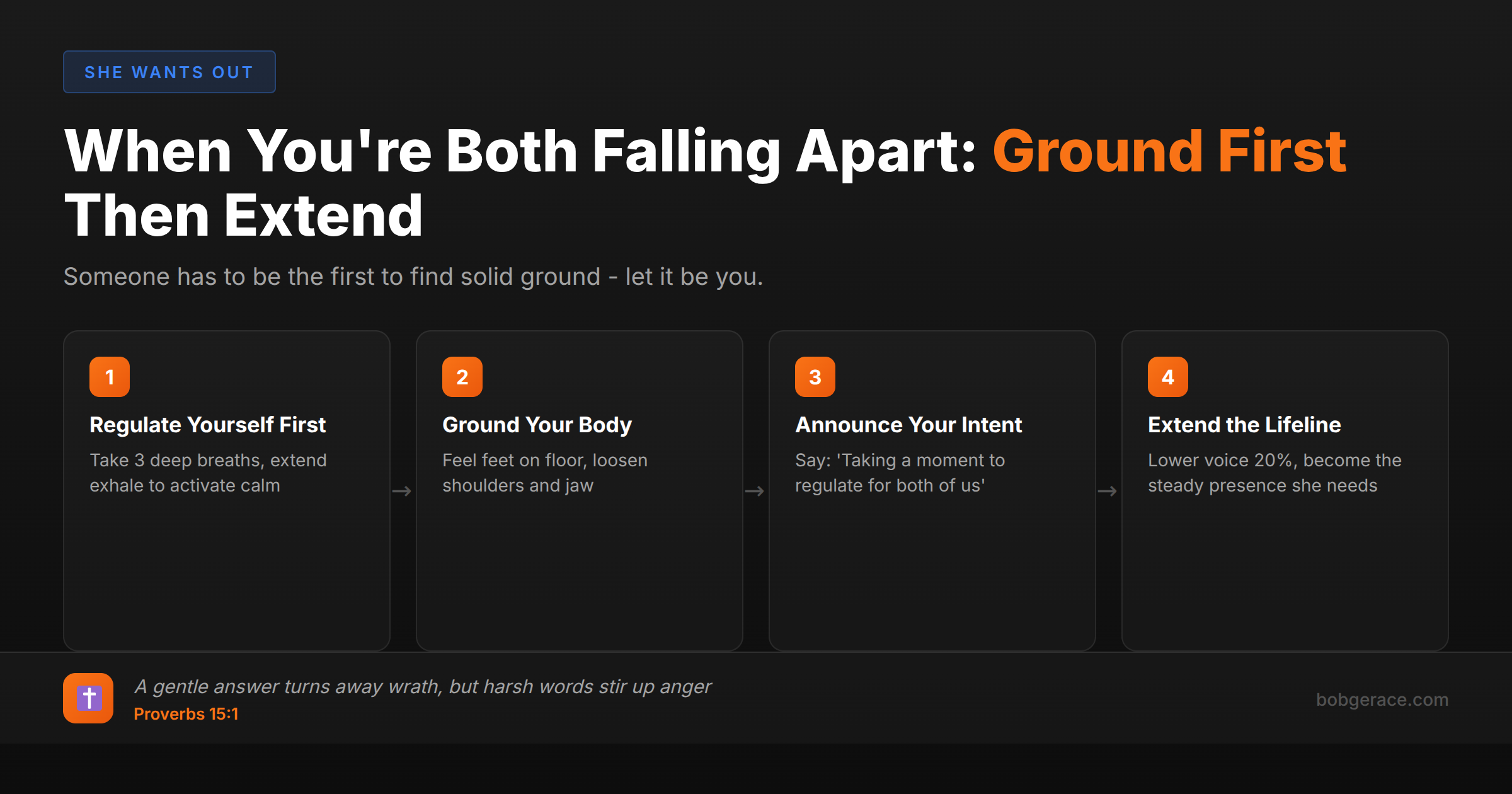
When you're both dysregulated, someone has to be the first to find solid ground. This isn't about being the perfect husband - it's about becoming the steady presence your marriage desperately needs. You can't pull her out of emotional chaos while you're drowning in it yourself. The key is what I call 'grounding first, then extending.' You have to regulate your own nervous system before you can help with hers. This means taking 30 seconds to breathe, physically stepping back if needed, and reminding yourself that this moment isn't the end of your marriage - it's information about what needs healing. Once you've found even a small pocket of calm, you can become the lifeline she needs.
The Full Picture
When both partners are dysregulated, you're dealing with two nervous systems in complete survival mode. Your amygdala is hijacked, rational thinking is offline, and you're both operating from fight, flight, freeze, or fawn responses. This creates what therapists call 'dysregulation feedback loops' - her activation triggers yours, which amplifies hers, and the cycle spirals.
The harsh reality: Someone has to break the cycle, and it needs to be you. Not because you're responsible for her emotions, but because you're responsible for your response to them. When wives say they want out, they're often communicating that they don't feel safe - emotionally, relationally, or even physically safe.
Common mistakes men make: • Trying to logic her out of dysregulation ('calm down, you're being irrational') • Matching her emotional intensity ('if she's going to yell, I'll yell louder') • Immediately trying to fix or solve before anyone is regulated • Walking away without communicating intention ('I'm taking space to regulate, not abandoning this conversation')
The goal isn't to control her nervous system - that's impossible. The goal is to become so grounded in your own regulation that your presence becomes a stabilizing force rather than an escalating one. Think of it like being the calm in the storm, not trying to stop the storm itself.
What's Really Happening
Neurologically, when both partners are dysregulated, you're witnessing two limbic systems in full activation with minimal prefrontal cortex engagement. Research from Dr. Dan Siegel shows us that co-regulation - the process by which one person's regulated nervous system helps calm another's - requires at least one person to maintain some level of ventral vagal activation (the calm, connected state).
When both partners are in sympathetic arousal (fight/flight) or dorsal shutdown (freeze/collapse), you create what we call 'mutual dysregulation.' This state is characterized by increased cortisol, decreased oxytocin, and impaired capacity for empathy or perspective-taking. The relationship literally becomes a threat to both nervous systems.
Polyvagal Theory Application: Your wife's nervous system is constantly scanning for safety (neuroception). If your presence consistently correlates with activation rather than calming, her system will begin to perceive you as a threat, even when you're trying to help. This explains why well-intentioned attempts to comfort can sometimes escalate rather than soothe.
The therapeutic goal is developing what we call 'earned secure attachment' - learning to self-regulate first, then co-regulate. This requires building distress tolerance, emotional granularity (naming specific emotions rather than just 'upset'), and somatic awareness (recognizing your body's signals before full activation occurs).
What Scripture Says
Scripture speaks directly to this dynamic of remaining steady in chaos. Proverbs 27:14 reminds us, 'A gentle answer turns away wrath, but a harsh word stirs up anger.' This isn't about being passive - it's about the power of regulated response over reactive explosion.
Ephesians 4:26-27 instructs, 'In your anger do not sin: Do not let the sun go down while you are still angry, and do not give the devil a foothold.' This passage acknowledges that anger itself isn't sin, but what we do with it matters enormously. When both spouses are dysregulated, unprocessed anger becomes a foothold for destruction.
James 1:19-20 provides the practical framework: 'Everyone should be quick to listen, slow to speak and slow to become angry, because human anger does not produce the righteousness that God desires.' Notice the order - listen first, speak slowly, manage your anger response. This is co-regulation in action.
Galatians 6:1 calls us to, 'restore one another gently' when someone is 'caught in a sin.' The word 'gently' here suggests a regulated approach to helping someone who is struggling. You cannot restore gently while you're emotionally activated.
Finally, 1 Peter 3:7 instructs husbands to live with their wives 'in an understanding way,' honoring them as 'fellow heirs.' Understanding requires regulation - you cannot truly understand someone while your nervous system is in survival mode. This is both a calling and a practical necessity for marriage restoration.
What To Do Right Now
-
1
Take three deep breaths, extending your exhale longer than your inhale to activate your parasympathetic nervous system
-
2
Physically ground yourself by feeling your feet on the floor and loosening your shoulders and jaw
-
3
Say out loud: 'I'm taking a moment to regulate so I can be present for both of us'
-
4
Identify one specific emotion you're feeling beyond 'frustrated' or 'angry' (hurt, scared, overwhelmed, etc.)
-
5
Lower your voice and slow your speech by 20% - this signals safety to both nervous systems
-
6
Offer a simple, non-pressuring statement like 'I'm here when you're ready to talk' without demanding immediate response
Related Questions
- What's happening in my nervous system right now?
- How do I regulate when my body is in fight-or-flight?
- What does 'window of tolerance' mean and why am I outside it?
- What is 'co-regulation' and why can't we do it?
- How do I become a safe presence again?
- What happens neurologically when she sees my number pop up?
- What is 'amygdala hijack' and how do I interrupt it?
- How do I self-regulate before I connect?
- What does emotional co-regulation look like?
- What does nervous system regulation look like?
Also find Bob on
Subscribe for weekly videos on Christian marriage.
Can't Find That Ground Alone?
A coach who knows your marriage can help you build the regulation capacity your specific situation demands—not theory, but what works when she's actually in front of you.
Talk to Bob →