What is 'earned secure' vs. 'earned insecure'?
6 min read
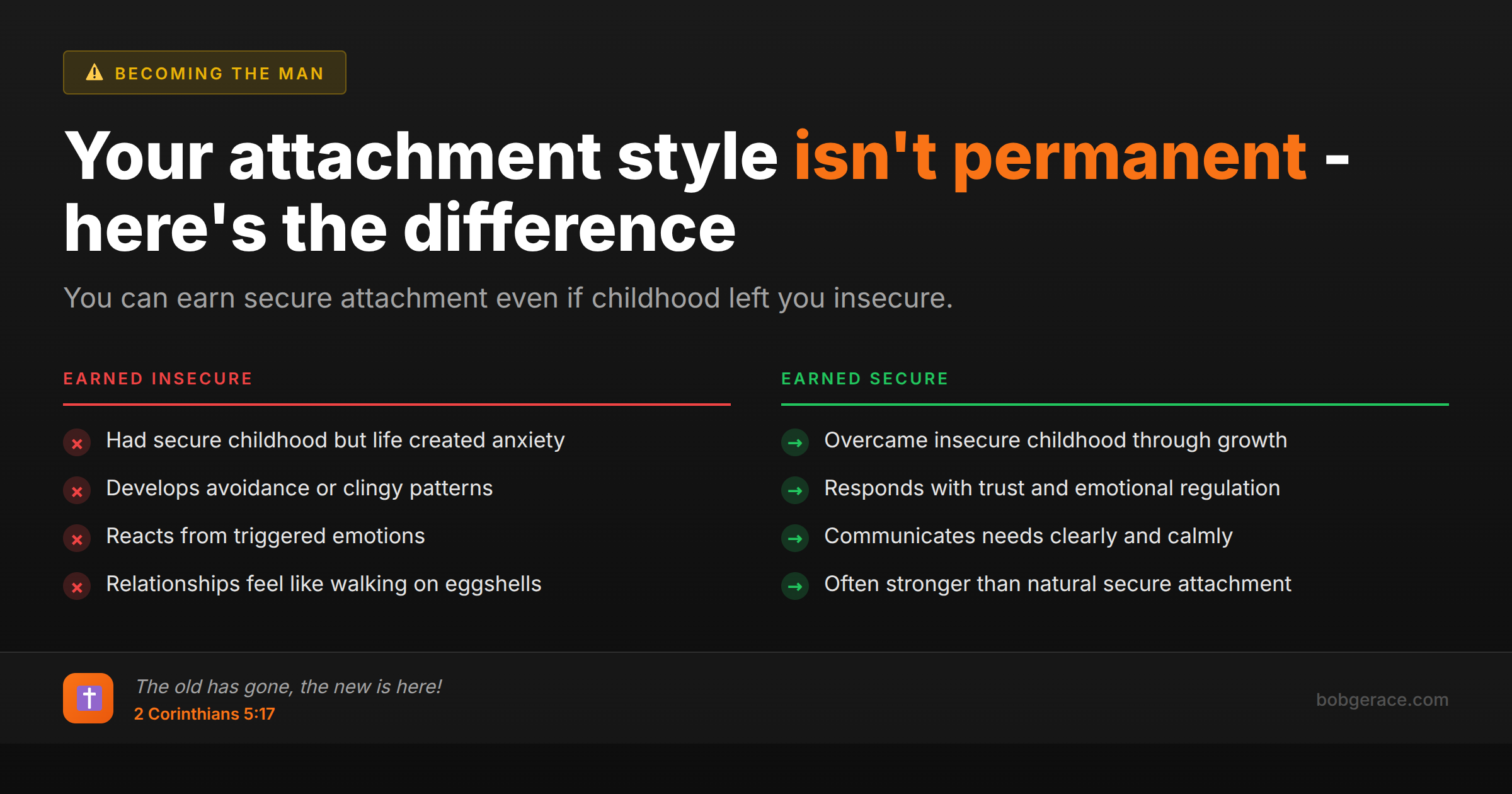
Your attachment style isn't set in stone from childhood. 'Earned secure' means you've developed healthy relationship patterns despite an insecure childhood attachment - you've done the work to heal and now relate with trust, emotional regulation, and intimacy. 'Earned insecure' is the opposite - you had secure early attachment but life experiences created insecurity, anxiety, or avoidance in relationships. The beauty of 'earned secure' is that it's often stronger than natural secure attachment because it's been battle-tested. You've consciously worked through your stuff, learned to communicate well, and developed emotional intelligence. Many people in great marriages have earned secure attachment - they weren't handed it, they fought for it through therapy, spiritual growth, and intentional relationship work.
The Full Picture
Here's what most people don't understand about attachment: it's not a life sentence. Your early childhood experiences with caregivers create your initial attachment style, but that's just the starting point, not the final destination.
Earned secure attachment happens when someone with an insecure childhood attachment (anxious, avoidant, or disorganized) does the hard work of healing and develops secure relationship patterns. These folks often become incredibly emotionally intelligent because they've had to consciously learn what others might take for granted. They've learned to:
- Self-soothe when triggered instead of exploding or shutting down - Communicate their needs clearly instead of expecting mind-reading - Stay present during conflict instead of running or attacking - Trust their partner while maintaining healthy boundaries
Earned insecure attachment is when someone who had secure early attachment develops insecure patterns due to later trauma, betrayal, or significant life stresses. Maybe they experienced infidelity, emotional abuse, or major losses that shook their fundamental trust in relationships.
The encouraging news? Both can be healed. Earned secure folks prove that your past doesn't determine your future. And those with earned insecure attachment already have that foundation of early security to rebuild upon. The brain's neuroplasticity means we can literally rewire our attachment patterns at any age through consistent, healing relationships and intentional growth work.
What's Really Happening
From a clinical standpoint, earned attachment represents the brain's remarkable ability to form new neural pathways around relationships and safety. When we measure attachment through tools like the Adult Attachment Interview, we're looking at someone's current mental model of relationships, not just their history.
Earned secure individuals show what we call 'coherent narratives' about their difficult childhoods. They can tell their story without becoming overwhelmed or dismissive. They've integrated their experiences and developed what we call 'reflective functioning' - the ability to understand behavior in terms of underlying mental states.
Neurobiologically, earned security involves strengthening the prefrontal cortex's regulation of the amygdala. Through therapy, healthy relationships, or spiritual practices, people literally change their brain's default responses to relationship stress. They develop new implicit memories of safety and connection that compete with old patterns of fear or disconnection.
Earned insecure attachment often involves trauma responses that have dysregulated previously healthy attachment systems. The key difference is that the foundation of early security is still there - it's been covered over, not absent. This is why people with earned insecure attachment often respond more quickly to interventions than those with lifelong insecure patterns. Their nervous system remembers safety; it just needs help returning to that state.
What Scripture Says
Scripture is full of hope for transformation and renewal, which perfectly aligns with the concept of earned secure attachment. "Therefore, if anyone is in Christ, the new creation has come: The old has gone, the new is here!" (2 Corinthians 5:17). This isn't just about salvation - it's about how God transforms every aspect of our being, including how we relate to others.
The process of earning secure attachment mirrors spiritual growth. "And we all, who with unveiled faces contemplate the Lord's glory, are being transformed into his image with ever-increasing glory" (2 Corinthians 3:18). Just as we grow in Christlikeness gradually, we can grow in relational health through intentional work and God's grace.
God Himself models secure attachment. "Cast all your anxiety on him because he cares for you" (1 Peter 5:7) and "Never will I leave you; never will I forsake you" (Hebrews 13:5). As we experience God's consistent love and faithfulness, we learn to offer the same to our spouse - even if we never experienced it growing up.
"He heals the brokenhearted and binds up their wounds" (Psalm 147:3). This healing extends to our deepest relational wounds. God doesn't just save us; He restores us to full relational health. "Forget the former things; do not dwell on the past. See, I am doing a new thing!" (Isaiah 43:18-19). Your attachment history doesn't have to define your marriage future.
What To Do Right Now
-
1
Assess your current attachment patterns honestly - How do you typically respond to relationship stress? Do you pursue, withdraw, or flip between both?
-
2
Identify your triggers and early warning signs - What situations or words tend to activate your insecure responses? Write them down.
-
3
Practice self-soothing techniques when triggered - Before reacting to your spouse, take deep breaths, pray, or use grounding exercises to calm your nervous system.
-
4
Communicate your attachment needs clearly - Tell your spouse what helps you feel secure and ask what they need from you.
-
5
Seek professional help if needed - Consider individual therapy or couples counseling to work through deeper attachment wounds.
-
6
Celebrate small wins in earned security - Notice when you respond differently than your old patterns and acknowledge this growth to reinforce the new neural pathways.
Related Questions
- What attachment style did I develop in childhood?
- Can adult attachment patterns change?
- What is 'internal working model' and how do I change mine?
- What did I learn about love from my parents?
- How do childhood attachment wounds show up in marriage?
- What attachment injuries did I experience?
- What is 'attachment injury' and did I cause one?
- What does secure attachment behavior look like in him?
- How does attachment style relate to affair risk?
- What is anxious attachment and am I doing it right now?
Also find Bob on
Subscribe for weekly videos on Christian marriage.
You Can't Earn Secure Alone
Changing your attachment pattern in your actual marriage—not just understanding it—takes a human who knows your specific story and can call out what you're missing in real time.
Talk to Bob →