How do I not pursue while also not abandoning?
6 min read
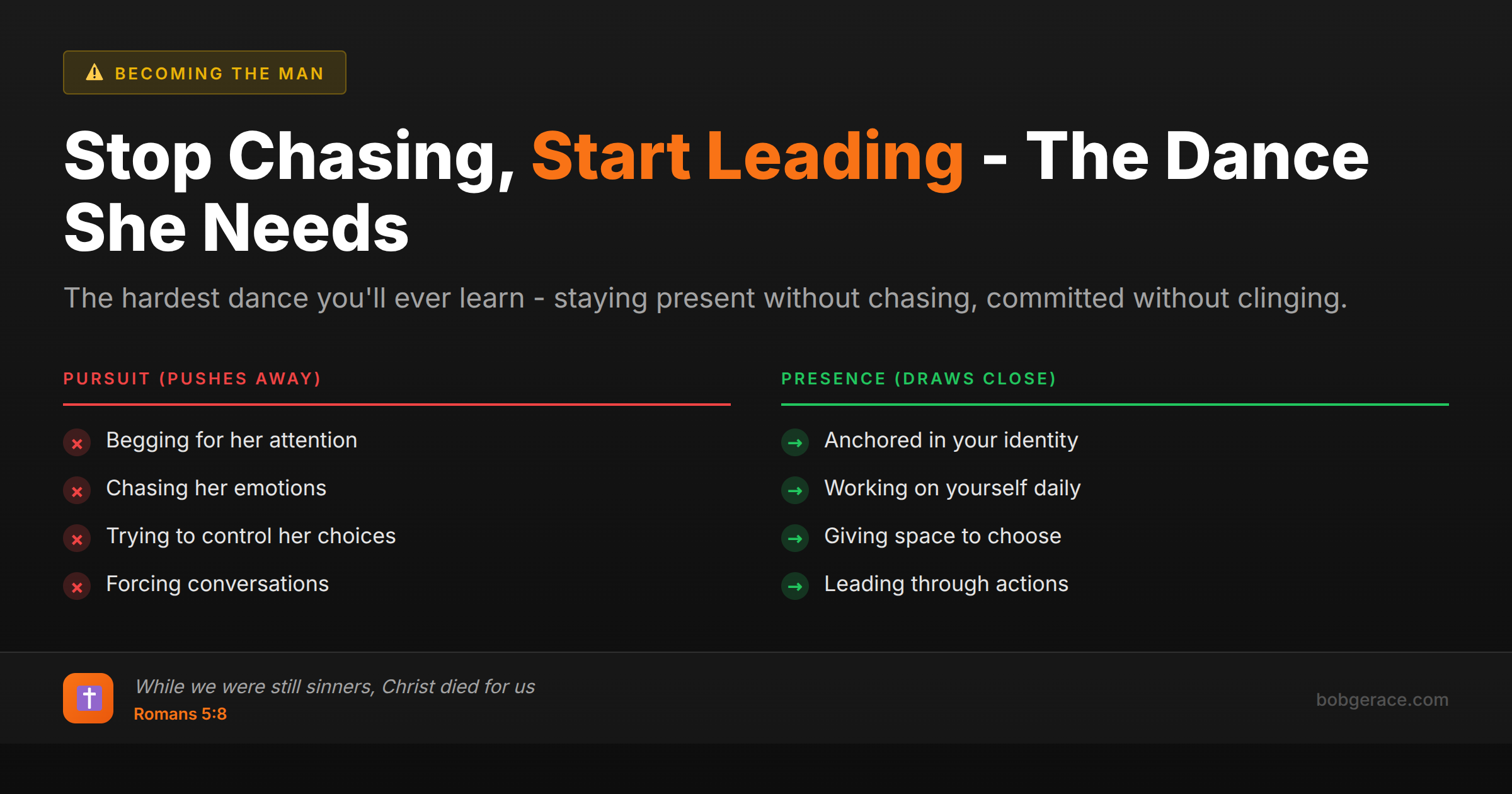
This is the hardest dance you'll ever learn - staying present without chasing, committed without clinging. The key is shifting from emotional pursuit to intentional presence. You're not abandoning when you stop chasing her emotions, begging for attention, or trying to control her choices. You're actually showing up as the man she needs you to be. True non-abandonment means staying committed to the marriage covenant while giving her the space to choose. It's saying 'I'm here, I'm working on myself, and I'm not going anywhere' through your actions, not your words. This requires you to anchor yourself in something bigger than her response to you - your identity in Christ and your commitment to becoming the husband God called you to be.
The Full Picture
When there's another man in the picture, your natural instinct is to fight harder, pursue more intensely, and prove your love through increased effort. This is exactly the wrong approach. What feels like love to you feels like pressure to her. What feels like commitment to you feels like desperation to her.
The paradox is real: the more you chase, the further she runs. The more you try to control the situation, the more out of control everything becomes. You're caught between two fears - losing her if you don't fight hard enough, and pushing her away if you fight too hard.
Here's what most men don't understand: pursuit and abandonment aren't your only two options. There's a third way - purposeful presence. This means you stay emotionally and spiritually anchored in the marriage while refusing to engage in the chase dynamic that's been destroying your connection.
Purposeful presence looks like showing up consistently without expecting anything in return. It's doing the right things because they're right, not because they'll get you the response you want. It's being the husband you're called to be whether she notices or not, whether she appreciates it or not, whether she chooses you or not.
This isn't passive resignation - it's active strength. You're not giving up on the marriage; you're giving up on trying to force outcomes you can't control. You're not abandoning her; you're abandoning the dysfunctional patterns that drove her away in the first place.
The space you create isn't empty space - it's sacred space. Space for her to miss you, space for her to remember who you really are beneath all the pursuing and pleading, space for God to work in ways your efforts never could.
What's Really Happening
From an attachment perspective, pursuing behavior typically stems from anxious attachment patterns that were likely formed long before this marriage crisis. When threat is perceived - in this case, another man - the anxiously attached person's system floods with panic, driving them toward protest behaviors: calling, texting, explaining, pursuing.
What's happening neurologically is that your amygdala is hijacking your prefrontal cortex. You're operating from a place of threat detection rather than intentional choice. Your wife's system, meanwhile, is likely responding with avoidant strategies - the more you pursue, the more her nervous system signals 'danger' and activates withdrawal patterns.
The concept of 'earned security' is crucial here. Even if you have anxious attachment tendencies, you can develop secure responses through intentional practice. Secure attachment in marriage means you can remain emotionally regulated while your spouse is dysregulated. You can stay present without being reactive.
Non-abandonment from a clinical standpoint means maintaining consistent, predictable presence without demands or conditions. It's showing your nervous system - and hers - that you're safe, stable, and not going anywhere, regardless of her current emotional state or choices. This creates the psychological safety necessary for her to potentially reconsider her attachment to the other person.
The goal isn't to manipulate her back through better technique. The goal is to become genuinely secure in yourself so that your presence becomes an invitation rather than a demand. This internal shift often creates the external change you've been desperately trying to force.
What Scripture Says
God's model for love is the perfect example of not pursuing while not abandoning. Romans 5:8 tells us, 'But God demonstrates his own love for us in this: While we were still sinners, Christ died for us.' God didn't chase us down or force His love on us. He demonstrated it and let us choose.
Hosea 2:14 shows us how God wins back His unfaithful people: 'Therefore I am now going to allure her; I will lead her into the wilderness and speak tenderly to her.' Notice the strategy - allure, not pursue. Lead into a quiet place, don't chase into public drama. Speak tenderly, don't demand or lecture.
The principle of covenant love is found in 1 Corinthians 13:7 - love 'always protects, always trusts, always hopes, always perseveres.' This doesn't mean always pursues or always controls. It means you remain anchored in covenant commitment regardless of circumstances. You protect the marriage by not adding more damage through desperate pursuit.
Ephesians 5:25 calls husbands to 'love your wives, just as Christ also loved the church and gave Himself for her.' Christ's love was sacrificial but not desperate. He gave Himself fully but never begged for acceptance. He remained committed to His bride even when she was unfaithful, but He didn't chase after her approval.
Proverbs 27:14 warns us: 'Like a loud greeting at dawn, blessing someone with a loud voice early in the morning will be taken as a curse.' Sometimes our efforts to show love are received as burdens because of our timing, intensity, or motivation. Wisdom knows when to speak and when to be quietly present.
Your call is to love like Jesus - consistently, sacrificially, and without manipulation. Stay committed to the covenant while giving her the dignity of choice.
What To Do Right Now
-
1
Stop all pursuing behaviors immediately - no extra calls, texts, surprise visits, or attempts to 'talk things through' when she's not ready
-
2
Establish your daily anchoring routine - prayer, Scripture, exercise, or whatever grounds you in your identity beyond her response to you
-
3
Practice the 24-hour rule - when you feel the urge to pursue or react, wait 24 hours and pray about it first
-
4
Focus on being present in your shared spaces without creating pressure - be genuinely interested in her day without interrogating about her feelings
-
5
Develop your own interests and friendships - become someone worth choosing rather than someone who needs to be chosen
-
6
Communicate your commitment once clearly, then let your consistent actions do the talking instead of repeating yourself
Related Questions
Ready to Learn the Balance?
This dance between presence and space is learnable, but you don't have to figure it out alone. Let me help you develop the strength to stay without chasing.
Get Help Now →