What does healthy pursuit look like vs. desperate pursuit?
6 min read
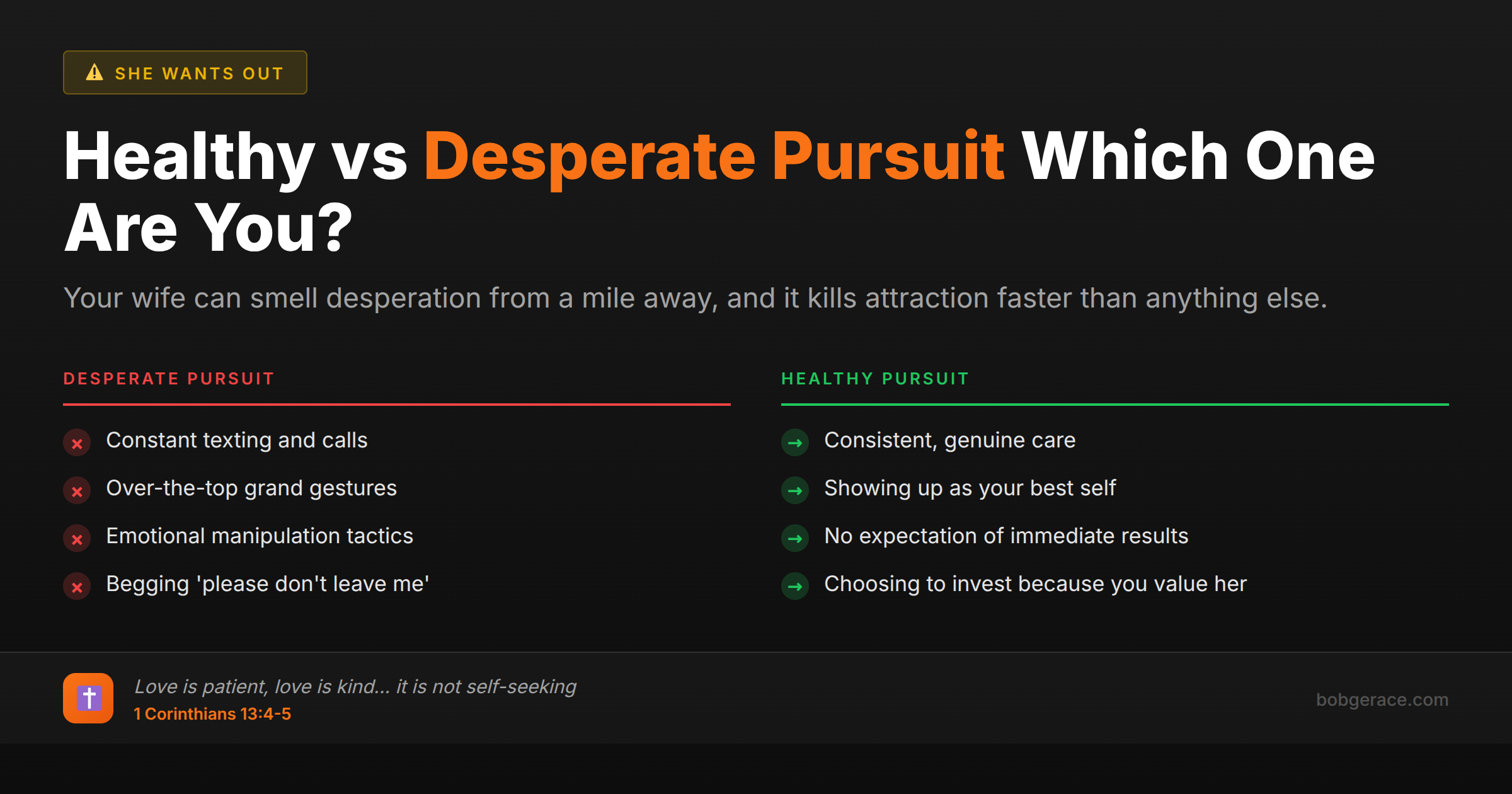
Healthy pursuit comes from a place of strength and genuine care—it's about consistently showing up as your best self without expecting immediate reciprocation. You pursue because you love her, not because you need her validation. Desperate pursuit, on the other hand, reeks of neediness and fear. It's the constant texting, the over-the-top gestures, the emotional manipulation disguised as romance. The difference is motivation. Healthy pursuit says, 'I'm choosing to invest in us because I value what we have.' Desperate pursuit screams, 'Please don't leave me—I'll do anything!' One attracts; the other repels. Your wife can smell desperation from a mile away, and it kills attraction faster than almost anything else.
The Full Picture
Think of healthy pursuit like a confident man asking a woman to dance. He extends his hand, makes eye contact, and if she says no, he nods respectfully and walks away with his dignity intact. Desperate pursuit is like the guy who won't take no for an answer, follows her around the dance floor, and makes everyone uncomfortable.
Healthy pursuit characteristics: • Consistency over intensity - Small, thoughtful gestures regularly rather than grand proclamations • Respect for boundaries - When she needs space, you give it without pouting • Self-improvement focus - You're working on yourself regardless of her response • No strings attached - Your actions aren't transactions expecting immediate returns • Emotional stability - Your mood doesn't depend on her reactions
Desperate pursuit red flags: • Love-bombing - Overwhelming her with attention, gifts, and promises • Boundary violations - Showing up uninvited, excessive calling/texting • Emotional manipulation - Using guilt, threats, or dramatic displays • Transactional thinking - 'I did this, so you owe me that' • Reactive behavior - Your emotional state swings based on her responses
The irony is that desperate pursuit usually comes from genuine love, but it's filtered through fear and insecurity. You're so afraid of losing her that you do exactly what pushes her away. Healthy pursuit requires you to face that fear and choose love over need.
What's Really Happening
From a psychological standpoint, the difference between healthy and desperate pursuit lies in attachment styles and emotional regulation. Healthy pursuit stems from secure attachment—the ability to maintain your sense of self while connecting with another. Desperate pursuit often indicates anxious attachment, where your identity becomes enmeshed with your partner's approval.
Neurologically, desperate pursuit activates the same brain regions as addiction. When your wife pulls away, your brain interprets it as a threat to survival, flooding your system with stress hormones. This triggers fight-or-flight responses that manifest as either pursuing harder (fight) or emotional withdrawal (flight).
The Gottman Institute's research shows that pursuit-distance cycles are among the most damaging patterns in marriage. The more intensely one partner pursues, the more the other distances, creating a negative feedback loop. What's particularly destructive is that desperate pursuit often includes what researchers call 'protest behaviors'—actions designed to regain attention that actually push the partner further away.
Healthy pursuit, conversely, activates the brain's reward centers associated with secure bonding. It releases oxytocin and reduces cortisol levels in both partners. This creates what attachment theorists call a 'secure base'—a relationship dynamic where both people feel safe to be themselves.
The key therapeutic intervention is helping men recognize that their desperate pursuit behaviors are trauma responses, not love expressions. Once we address the underlying fears and insecurities driving the desperation, healthy pursuit becomes possible.
What Scripture Says
Scripture provides a powerful model for healthy pursuit in how Christ pursues the church. Ephesians 5:25 commands, 'Husbands, love your wives, just as Christ loved the church and gave himself up for her.' Notice it doesn't say manipulate, pressure, or demand—it says love sacrificially.
1 Corinthians 13:4-5 defines this love: 'Love is patient, love is kind. It does not envy, it does not boast, it is not proud. It does not dishonor others, it is not self-seeking, it is not easily angered, it keeps no record of wrongs.' This is healthy pursuit—patient, kind, and not self-seeking.
The Proverbs warn against desperate pursuit. Proverbs 25:17 says, 'Seldom set foot in your neighbor's house—too much of you, and they will hate you.' Even good things become destructive when pursued desperately.
Philippians 2:3-4 provides the heart attitude: 'Do nothing out of selfish ambition or vain conceit. Rather, in humility value others above yourselves, not looking to your own interests but each of you to the interests of the others.' Healthy pursuit considers her needs, not just your fears.
1 Peter 3:7 instructs husbands to 'be considerate as you live with your wives, and treat them with respect.' Respect means honoring her autonomy and choices, even when they're painful for you.
The biblical model is pursuing from strength, not weakness—loving because God first loved us (1 John 4:19), not because we need validation or control.
What To Do Right Now
-
1
Stop all excessive communication—limit texts to logistical matters and one genuine, no-expectation message per day maximum
-
2
Identify your desperate behaviors and write them down—excessive gifts, surprise visits, emotional manipulation, or guilt trips
-
3
Create a personal improvement plan that has nothing to do with winning her back—fitness, career, hobbies, spiritual growth
-
4
Practice the 24-hour rule before responding to her emotionally—this prevents reactive, desperate responses
-
5
Replace 'What can I do to make her love me?' with 'How can I become the man she fell in love with?'
-
6
Establish and respect boundaries—if she asks for space, give it without arguing or negotiating
Related Questions
- Should I give her space or fight for her?
- What's the difference between pursuing and chasing?
- How do I fight without pushing her away?
- What is 'anxious protest behavior' and am I doing it?
- How do I show love without activating her withdrawal?
- What's the difference between presence and pressure?
- What is anxious attachment and am I doing it right now?
- What does 'protest behavior' look like and am I doing it?
- How do I pursue without pressuring?
- What is the '180' approach and does it work?
Also find Bob on
Subscribe for weekly videos on Christian marriage.
Pursuit is personal—your marriage isn't generic
You know the theory. But applying it to your specific dynamic—her history, your patterns, what's actually happening in your house—requires a coach who knows your story.
Talk to Bob →