What is the 'attachment dance' and how do I change my steps?
5 min read
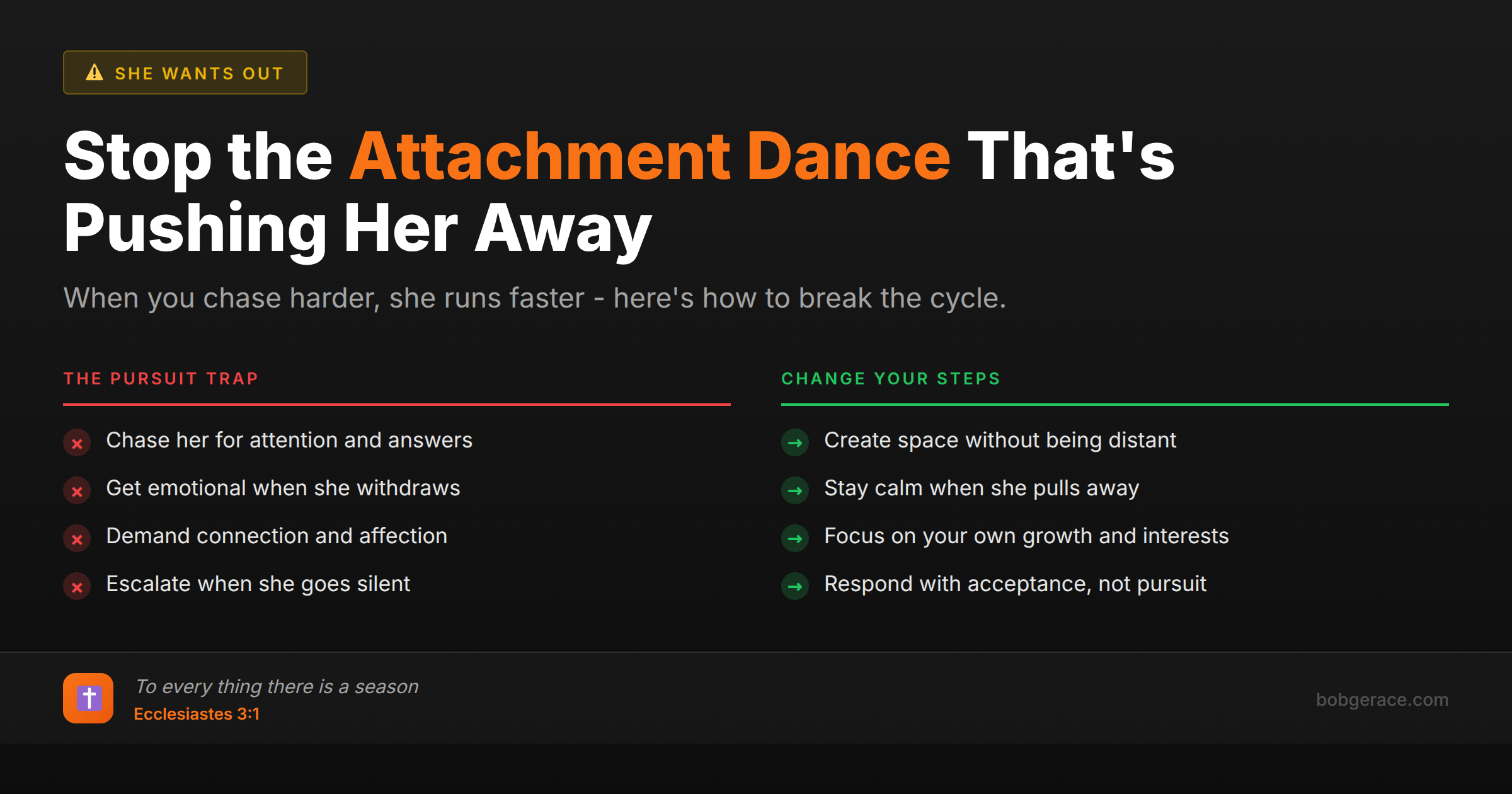
The 'attachment dance' is the destructive pattern where one spouse pursues (chases, demands connection, gets emotional) while the other withdraws (shuts down, pulls away, goes silent). Most men I work with are stuck in this cycle - the harder you chase your wife for attention, affection, or answers, the more she retreats. It's like a dance where you're both stepping on each other's toes. Here's the hard truth: you can't change her steps, but you can change yours. When you stop the frantic pursuit and learn to be emotionally present without being needy, you create space for her to actually move toward you. The key is understanding that your anxiety-driven pursuit triggers her withdrawal, and her withdrawal triggers your pursuit. Someone has to break the cycle, and that someone is you.
The Full Picture
Think of your marriage like a dance floor where you and your wife have been doing the same painful routine for months or years. You pursue, she withdraws. She withdraws, you pursue harder. Round and round it goes, with both of you feeling more disconnected and frustrated.
Here's what pursuit looks like in real life: • Following her around the house trying to talk • Sending multiple texts when she doesn't respond immediately • Asking "What's wrong?" repeatedly when she's quiet • Trying to solve her problems when she just wants space • Getting emotional or angry when she pulls away • Demanding explanations for her behavior
The withdrawal response looks like this: • Going quiet or giving short answers • Spending more time away from home • Focusing excessively on kids, work, or friends • Avoiding physical intimacy • Seeming irritated by your presence • Creating emotional walls
The cruel irony is that both behaviors come from the same place - a desire for connection. You pursue because you want closeness. She withdraws because the pursuit feels overwhelming and she needs space to breathe. Neither of you is the villain here, but you're both trapped in a pattern that's killing your marriage.
Most men don't realize their well-intentioned efforts to connect are actually pushing their wife further away. Your pursuit feels loving to you, but it feels suffocating to her. Her withdrawal feels rejecting to you, but it feels protective to her. Understanding this dynamic is the first step to changing it.
What's Really Happening
The attachment dance is rooted in our fundamental wiring for connection and safety. Research by Dr. Sue Johnson and others in Emotionally Focused Therapy shows that this pursue-withdraw pattern occurs in about 70% of distressed couples, with men typically in the withdrawal position and women pursuing. However, when the marriage reaches crisis levels, these roles often flip.
The neurological reality is fascinating and sobering. When you're in pursuit mode, your sympathetic nervous system is activated - you're in fight-or-flight, driven by attachment panic. Your brain interprets her withdrawal as a threat to your primary bond, triggering desperate attempts to restore connection. Meanwhile, her nervous system is also activated, but in a different way - she's overwhelmed by the intensity and her system shuts down to protect itself.
This creates what we call a 'negative cycle' where each person's coping strategy triggers the other's fears. Your pursuit confirms her fear of being engulfed or controlled. Her withdrawal confirms your fear of abandonment or rejection. Both responses are actually adaptive - they worked in your family of origin or past relationships - but they're toxic to your current marriage.
The good news is that these patterns can be changed, but it requires what we call 'earned security.' This means developing the ability to self-regulate your emotions, tolerate your partner's different attachment needs, and respond rather than react. When one partner breaks the cycle by changing their steps, it creates space for new patterns to emerge.
What Scripture Says
Scripture gives us profound wisdom about healthy relationship dynamics that directly applies to breaking the attachment dance. Ecclesiastes 3:1 reminds us, "To every thing there is a season, and a time to every purpose under the heaven." This includes knowing when to pursue and when to give space.
Proverbs 27:14 warns us, "Whoever blesses his neighbor with a loud voice, rising early in the morning, will be counted as cursing." Even good intentions can become harmful when driven by our anxiety rather than wisdom. Your pursuit, though well-meaning, can feel like a curse to your overwhelmed wife.
The principle of self-control is crucial here. Galatians 5:22-23 tells us, "But the fruit of the Spirit is love, joy, peace, patience, kindness, goodness, faithfulness, gentleness, self-control; against such things there is no law." Notice that love is coupled with self-control, not desperate pursuit.
1 Peter 3:7 instructs husbands to live with their wives "according to knowledge, giving honor to the wife as to the weaker vessel." This doesn't mean she's inferior, but that we must understand and respond to her unique emotional needs with wisdom, not force our agenda.
Perhaps most importantly, Philippians 2:3-4 calls us to "do nothing from selfish ambition or conceit, but in humility count others more significant than yourselves. Let each of you look not only to his own interests, but also to the interests of others." True love considers what she needs, not just what you need from her.
What To Do Right Now
-
1
Recognize your pursuit behaviors by writing down specific examples from the last week when you chased, demanded, or pressured her for connection
-
2
Practice the 24-hour rule: when you feel the urge to pursue, wait 24 hours before taking any action to allow your emotions to settle
-
3
Create physical and emotional space by engaging in your own activities, friendships, and interests without involving her
-
4
Respond to her withdrawal with calm acceptance instead of escalating - say something like 'I can see you need some space right now'
-
5
Focus on becoming emotionally regulated by developing practices like prayer, exercise, or journaling to manage your anxiety
-
6
Initiate positive interactions without agenda - offer help, share something interesting, or express appreciation without expecting anything in return
Related Questions
- What is anxious attachment and am I doing it right now?
- Why does my pursuing make her pull away more?
- What's the pursue-withdraw cycle and how do I stop it?
- What does 'protest behavior' look like and am I doing it?
- She seems cold and detached — is that avoidant attachment?
- What is 'differentiation' and why does it matter now?
- What is 'anxious-avoidant trap' and did we have it?
- How do I pursue without pressuring?
- What does healthy pursuit look like vs. desperate pursuit?
Also find Bob on
Subscribe for weekly videos on Christian marriage.
Your Dance Isn't Everyone's Dance
The pattern in your marriage has its own history, its own triggers. A coach who knows your specific situation can see what you can't see from inside it.
Talk to Bob →