Why does my instinct to pursue backfire?
6 min read
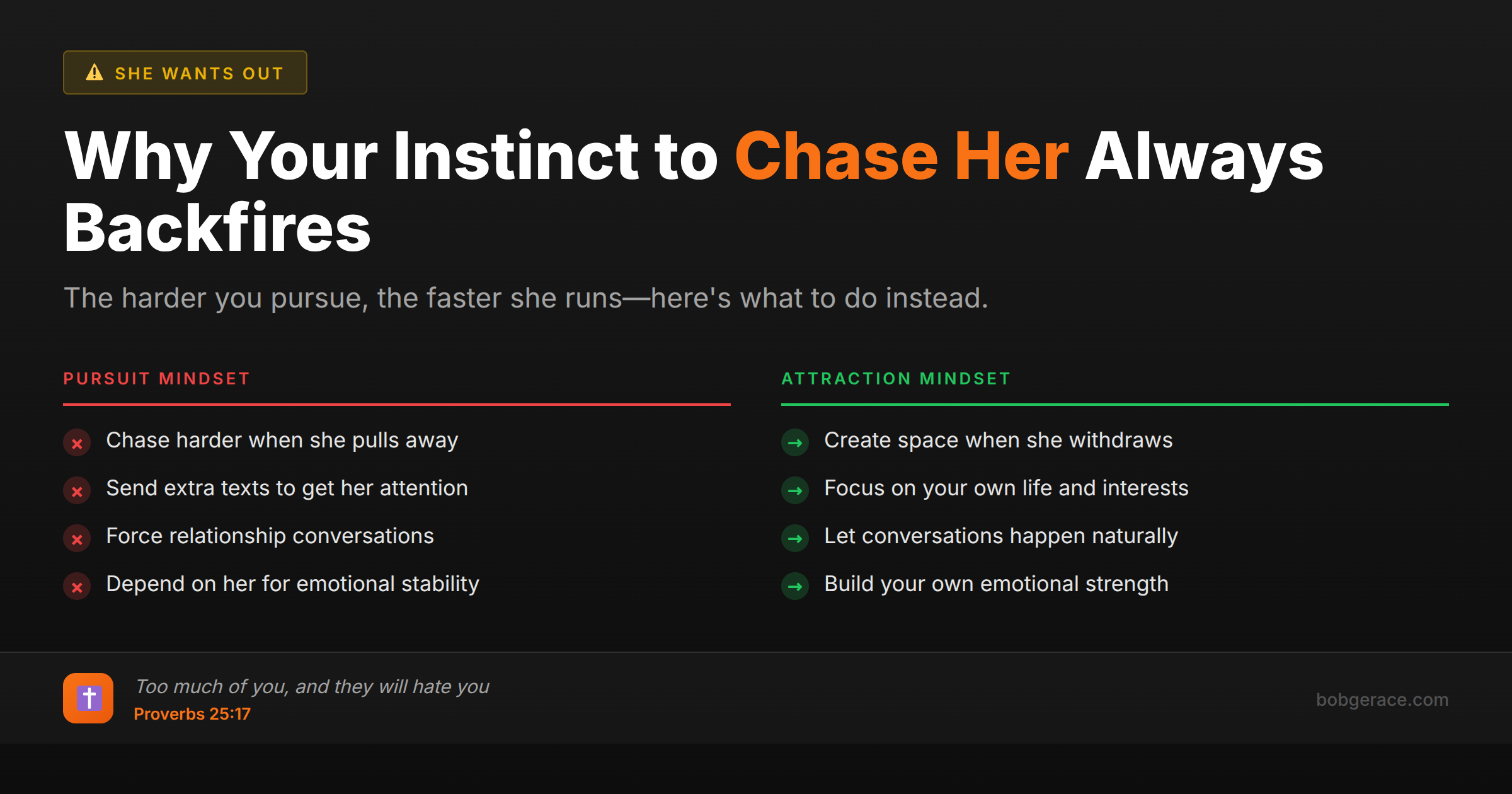
Your instinct to pursue backfires because it creates the exact opposite of what attraction needs to thrive. When your wife pulls back and you respond by chasing harder—through more texts, more conversations about the relationship, more attempts to fix things—you're actually confirming her fears that you're needy and desperate. Attraction requires space to breathe. Think about it: you fell in love when there was mystery, when she didn't have complete access to your every thought and feeling. The moment you start pursuing, you remove that space and mystery. You become predictable, and worse, you signal that your emotional stability depends entirely on her response. This isn't love—it's dependency, and it repels rather than attracts.
The Full Picture
The pursue-distance cycle is one of the most destructive patterns in struggling marriages, yet it feels completely natural. When your wife starts pulling away, every fiber in your being screams "fight for her!" This instinct comes from a good place—you love her and don't want to lose her. But here's what actually happens:
The Cycle Explained: • She pulls back (physically, emotionally, or both) • You sense the distance and panic internally • You pursue harder (more attention, more talking, more "fixing") • She feels suffocated and pulls back further • You interpret this as needing to try harder • The cycle intensifies until she wants out completely
Why This Feels So Right But Goes So Wrong: Your pursuit instinct worked in other areas of your life. In business, persistence pays off. In sports, you push through resistance. But marriage isn't a problem to solve or a goal to achieve—it's a relationship between two people who need space to choose each other freely.
When you pursue, you're essentially saying "I can't be okay unless you respond to me the way I want." This creates massive pressure on her. She stops being your partner and becomes responsible for your emotional regulation. That's not attractive—it's exhausting.
The Real Problem: You're not actually pursuing her—you're pursuing relief from your own anxiety. The texts, the talks, the romantic gestures aren't about her needs; they're about making yourself feel better about the distance. She can sense this immediately, which is why even your "loving" actions feel manipulative to her.
What's Really Happening
From a clinical perspective, pursuit behavior is driven by attachment anxiety—a fear of abandonment that triggers our fight-or-flight response. When your wife creates distance, your nervous system interprets this as a threat to the relationship and activates protest behaviors designed to reestablish connection.
The Neuroscience Behind It: Your brain's attachment system, primarily governed by the amygdala, doesn't distinguish between physical and emotional threats. When she withdraws, your body floods with stress hormones like cortisol and adrenaline. These chemicals impair your prefrontal cortex—the part responsible for rational thinking—making you more likely to act on impulse rather than strategy.
The Anxious-Avoidant Dance: What you're experiencing is a classic anxious-avoidant attachment pattern. Your pursuit increases her need for autonomy, while her distancing increases your need for reassurance. This creates what we call a "negative feedback loop" where each person's coping mechanism triggers the other's fears.
The Paradox of Control: Pursuit is fundamentally about trying to control outcomes, but research consistently shows that attempts to control relationship dynamics actually decrease relationship satisfaction. Studies by Dr. John Gottman reveal that couples stuck in pursue-distance cycles show elevated stress markers and decreased emotional intimacy over time.
Breaking the Pattern: The clinical solution involves developing what we call "earned secure attachment"—learning to self-regulate your anxiety without requiring external validation. This means tolerating the discomfort of distance without trying to fix it immediately. When you can remain calm and attractive despite her withdrawal, you interrupt the cycle and create space for genuine reconnection.
What Scripture Says
Scripture provides profound wisdom about pursuit dynamics, though it may not be what you expect. God's approach to pursuing us is marked by patience, strength, and respect for our free will—never desperation or neediness.
Proverbs 25:17: *"Seldom set foot in your neighbor's house—too much of you, and they will hate you."* Even in relationships, overwhelming someone with your presence creates resentment, not love. God designed relationships to thrive with healthy boundaries and space.
1 Peter 3:1-2: *"Wives, in the same way submit to your husbands. Husbands, in the same way be considerate as you live with your wives, and treat them with respect as the weaker partner and as heirs with you of the gracious gift of life."* The phrase "in the same way" refers back to Christ's example—He never pursued us desperately but drew us with strength and love.
Song of Solomon 2:7: *"Do not arouse or awaken love until it so desires."* This verse speaks to the importance of timing and readiness in love. You cannot force affection or connection; it must develop naturally in its proper season.
Galatians 5:22-23: *"But the fruit of the Spirit is love, joy, peace, forbearance, kindness, goodness, faithfulness, gentleness and self-control."* Notice that self-control is listed as a fruit of the Spirit. Desperate pursuit lacks self-control and doesn't reflect Christ's character.
God pursues us, but never from a place of neediness. His pursuit comes from abundance, strength, and genuine love for our good—not from a desperate need to feel better about Himself. This is the model for how you should "pursue" your wife: from a place of strength and love, not anxiety and need.
What To Do Right Now
-
1
Stop all pursuit behaviors immediately—no extra texts, no relationship talks, no surprise gestures
-
2
Create a daily routine that doesn't revolve around her schedule or mood
-
3
Identify three activities that bring you joy independent of her participation or approval
-
4
Practice the 24-hour rule before responding to any emotional conversation or conflict
-
5
Focus on becoming the man she married—pursue your own interests, friendships, and growth
-
6
When you feel the urge to pursue, pause and ask yourself: 'Is this about her needs or my anxiety?'
Related Questions
- What is 'anxious protest behavior' and am I doing it?
- What does healthy pursuit look like vs. desperate pursuit?
- What is the 'attachment dance' and how do I change my steps?
- How do I show love without activating her withdrawal?
- What's the difference between presence and pressure?
- Should I give her space or fight for her?
- What is anxious attachment and am I doing it right now?
- What does 'protest behavior' look like and am I doing it?
- Why does my pursuing make her pull away more?
- What's the pursue-withdraw cycle and how do I stop it?
Also find Bob on
Subscribe for weekly videos on Christian marriage.
Your Marriage Isn't a Template
Stopping pursuit in your specific situation—with your wife's history, your patterns, your timeline—requires calibration a tool can't give. Talk to a coach who knows your story.
Talk to Bob →