How do I regulate when my body is in fight-or-flight?
5 min read
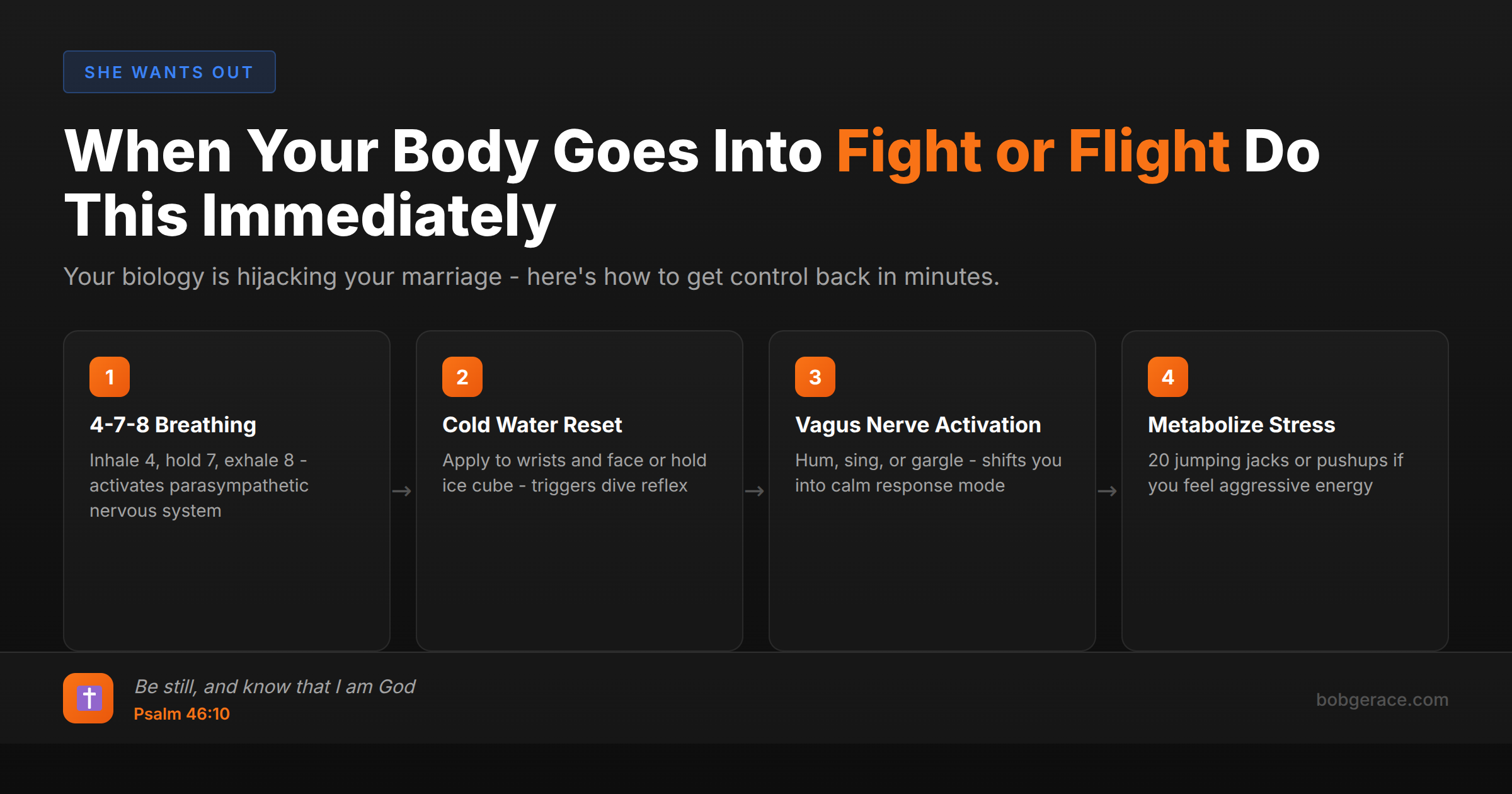
When your body hits fight-or-flight during marital conflict, you need immediate physiological reset techniques before you can think clearly or respond well. Start with the 4-7-8 breathing pattern: inhale for 4 counts, hold for 7, exhale for 8. This activates your parasympathetic nervous system within minutes. Next, engage your vagus nerve by humming, cold water on your wrists, or gentle neck stretches. Your goal isn't to eliminate the activation—it's to bring yourself back to a state where you can choose your response instead of being hijacked by your biology. The faster you learn to recognize the early signs of activation, the easier regulation becomes.
The Full Picture
Your fight-or-flight response served you well when humans faced physical threats, but it's working against you in marital conflict. When your wife says she's unhappy or brings up divorce, your nervous system interprets this as a survival threat—because for many men, losing your family feels like death.
Here's what happens physiologically: Your heart rate spikes, stress hormones flood your system, blood flow redirects from your prefrontal cortex (where rational thinking happens) to your limbs (for fighting or fleeing). This is why you can't think straight, why you say things you regret, or why you shut down completely.
The common mistakes men make: • Trying to "logic" their way out while still activated • Pushing through the activation instead of addressing it • Using alcohol or other substances to numb the response • Immediately jumping into problem-solving mode
What actually works: You must address the physiological activation first. Think of it like trying to have a conversation while a fire alarm is blaring—you can't focus on the words until you turn off the alarm. Your nervous system is that alarm, and you need specific techniques to reset it.
Remember: Your wife can sense when you're dysregulated, even if you think you're hiding it well. She'll respond to your nervous system state more than your words. Learning regulation isn't just about you feeling better—it's about creating safety for both of you.
What's Really Happening
From a neurobiological perspective, fight-or-flight activation involves the sympathetic nervous system releasing norepinephrine and epinephrine while the HPA axis triggers cortisol release. This creates a cascade of physiological changes designed for immediate physical action, not complex relationship navigation.
Research shows that when we're in this activated state, our window of tolerance narrows significantly. The prefrontal cortex—responsible for executive function, empathy, and complex reasoning—goes offline. This is why even the most intelligent men can become reactive or shut down during marital conflict.
Polyvagal Theory helps us understand that we have multiple nervous system responses available. When the sympathetic system is activated, we need to intentionally engage the parasympathetic system through vagal stimulation. The vagus nerve is like a superhighway between your brain and body, and when activated properly, it signals safety.
Clinical observations show that men who learn somatic regulation techniques report: • Better emotional control during difficult conversations • Improved ability to stay present with their partner's emotions • Reduced reactive behaviors that damage the relationship • Increased capacity for genuine empathy and connection
The key insight: This isn't about suppressing or controlling emotions—it's about expanding your capacity to feel them without being overwhelmed. When you're regulated, you can hold space for both your pain and your partner's experience simultaneously.
What Scripture Says
Scripture acknowledges that we face overwhelming circumstances and provides wisdom for managing our internal responses. Psalm 46:10 instructs us to "Be still, and know that I am God." This isn't passive waiting—it's active regulation that allows us to remember God's sovereignty when our nervous system is screaming danger.
Proverbs 14:29 tells us, "Whoever is patient has great understanding, but one who is quick-tempered displays folly." The Hebrew word for patience here implies self-regulation and the ability to extend your fuse. God understands our physiological makeup and calls us to develop mastery over our responses.
2 Timothy 1:7 reminds us that "God has not given us a spirit of fear, but of power, love and sound mind." When you're in fight-or-flight, fear is driving—but God has equipped you with power (self-control), love (connection to others), and sound mind (clear thinking). These require a regulated nervous system to access.
Philippians 4:6-7 provides a practical framework: "Do not be anxious about anything, but in every situation, by prayer and petition, with thanksgiving, present your requests to God. And the peace of God, which transcends all understanding, will guard your hearts and your minds." This describes a nervous system regulation practice—moving from anxiety to gratitude to peace.
God designed your body with the capacity for both activation and regulation. Learning to steward this system well is part of loving your wife as Christ loved the church—with intentionality, sacrifice, and emotional presence rather than reactive chaos.
What To Do Right Now
-
1
Practice 4-7-8 breathing: Inhale through nose for 4, hold for 7, exhale through mouth for 8, repeat 4 times
-
2
Apply cold water to your wrists and face or hold an ice cube to activate your dive reflex and calm your system
-
3
Hum, sing, or gargle to stimulate your vagus nerve and shift into parasympathetic response
-
4
Do 20 jumping jacks or pushups to metabolize stress hormones if you're feeling aggressive energy
-
5
Place one hand on chest, one on belly, and focus on slow belly breathing until heart rate decreases
-
6
Take a 10-minute walk outside while naming 5 things you can see, 4 you can hear, 3 you can touch, 2 you can smell, 1 you can taste
Related Questions
- What's happening in my nervous system right now?
- What is amygdala hijack and how do I get out of it?
- What does 'window of tolerance' mean and why am I outside it?
- What's the neuroscience of shock and why can't I eat/sleep?
- How do I co-regulate when she's dysregulated too?
- How do I stay grounded when everything feels adversarial?
- What is 'betrayal trauma' and do I have it?
- What's happening to my nervous system right now?
- What does nervous system regulation look like?
- How do I self-regulate before I connect?
Also find Bob on
Subscribe for weekly videos on Christian marriage.
Your Body Doesn't Read Scripts
Regulation techniques work—but only when they're calibrated to your specific triggers, your marriage's patterns, and the moments when you actually flood. A coach who knows your story can help you build that precision.
Talk to Bob →