What is amygdala hijack and how do I get out of it?
5 min read
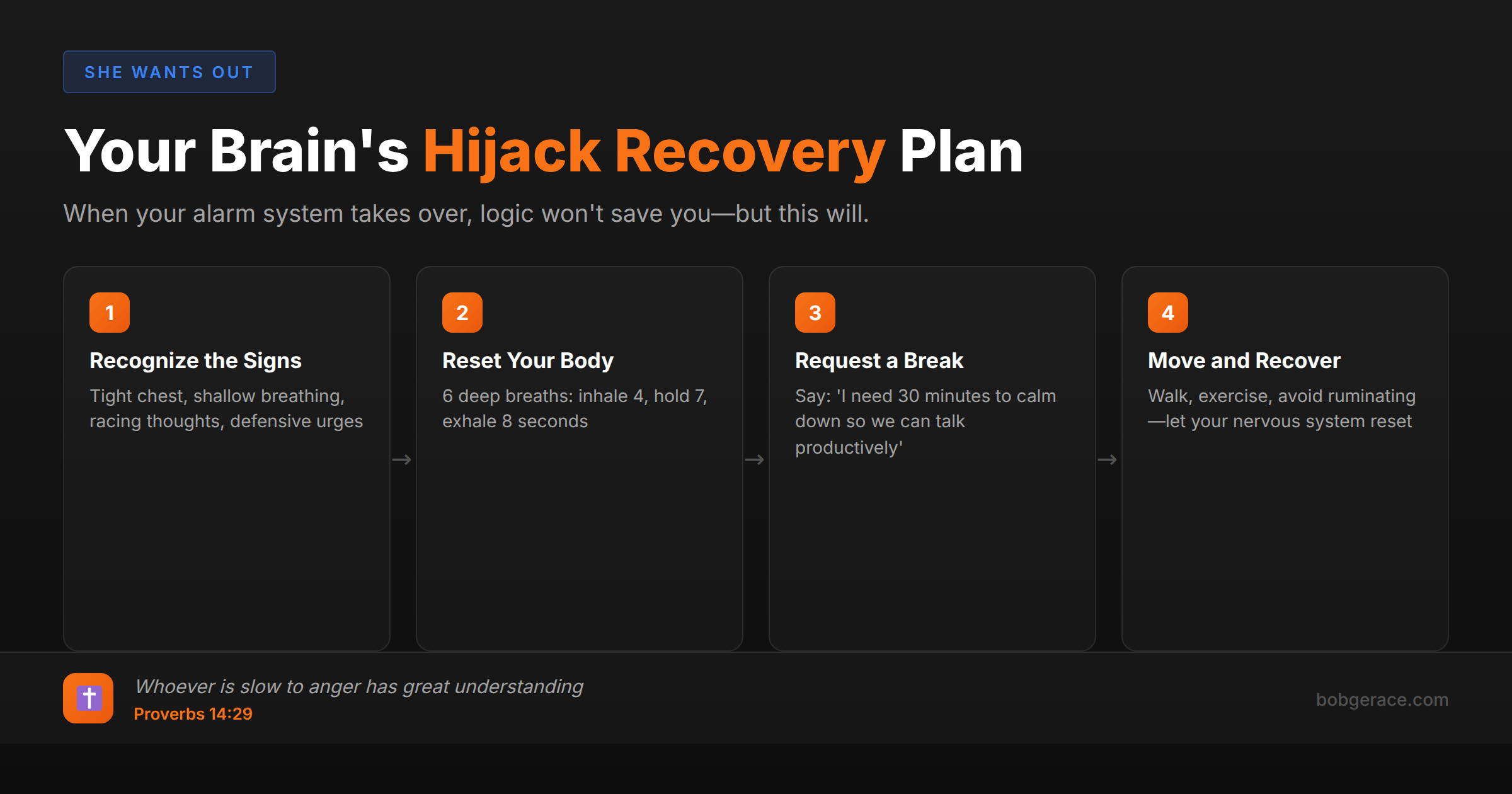
Amygdala hijack is when your brain's alarm system takes control, flooding your body with stress hormones and shutting down your ability to think clearly. In those moments, you're not the rational man you normally are—you're operating from pure survival instinct. This happens constantly in marriage conflicts, and it's probably happening more than you realize. The way out isn't to fight it or power through it. You have to recognize it's happening, then use specific techniques to calm your nervous system. The key is catching it early and having a plan. Most men try to logic their way out, but that's like trying to reason with a smoke detector that's going off. You need to address the physiological response first, then engage your thinking brain.
The Full Picture
Your amygdala is a small, almond-shaped structure in your brain that acts like a smoke detector for danger. When it perceives a threat—real or imagined—it triggers your fight-or-flight response faster than you can think. We're talking milliseconds. One moment you're having a conversation with your wife, the next you're flooded with adrenaline and cortisol, your heart is pounding, and rational thought has left the building.
Here's what's actually happening in your body: • Blood flow redirects from your prefrontal cortex (thinking brain) to your muscles • Your heart rate spikes and breathing becomes shallow • Stress hormones flood your system • Your ability to access memory, empathy, and problem-solving shuts down • You default to primitive responses: attack, defend, or withdraw
In marriage, this often gets triggered by perceived rejection, criticism, or abandonment. Your wife says something that hits a nerve, and suddenly you're not responding as a loving husband—you're responding as a threatened animal. You might lash out, shut down completely, or say things you'll regret later.
The cruel irony? Your amygdala hijack often creates the very outcome you're trying to avoid. You're afraid of losing your wife, so you react defensively, which pushes her further away. She feels unsafe, so she withdraws or escalates, which triggers you even more. It becomes a vicious cycle that can destroy intimacy and trust.
Most men don't recognize they're hijacked until it's too late. They think they're being logical when they're actually being reactive. Learning to identify the early warning signs and having specific strategies to interrupt the cycle is crucial for any man who wants to save his marriage.
What's Really Happening
From a neurobiological perspective, amygdala hijack represents a complete override of your executive functioning. Dr. Daniel Goleman, who coined the term, describes it as an emotional response that is immediate, overwhelming, and disproportionate to the actual trigger. The amygdala processes sensory information 20 milliseconds faster than the neocortex, meaning your emotional brain is already responding before your rational brain even knows what's happening.
In couples therapy, I see this phenomenon constantly. Research by Dr. John Gottman shows that when a person's heart rate exceeds 100 beats per minute during conflict, they become physiologically flooded and incapable of productive dialogue. Their Diffuse Physiological Arousal (DPA) makes it impossible to listen, empathize, or problem-solve effectively.
The neurochemical cascade includes: • Immediate release of epinephrine and norepinephrine • Cortisol flooding within minutes • Suppression of oxytocin and other bonding hormones • Activation of the sympathetic nervous system
What's particularly damaging in relationships is that mirror neurons cause emotional contagion—your partner's nervous system starts to mirror yours. When you're hijacked, you're likely triggering their amygdala too, creating a co-dysregulated state where neither person can access their higher brain functions.
The recovery time is also crucial to understand. Even after the trigger stops, it takes 20-30 minutes for stress hormones to clear your system. This is why 'cooling off' periods are so important. Trying to continue a difficult conversation while flooded is neurologically impossible and relationally destructive.
Effective intervention requires what we call 'top-down' regulation—conscious techniques to activate your parasympathetic nervous system and restore prefrontal cortex function.
What Scripture Says
Scripture acknowledges that we're created as both physical and spiritual beings, and our bodies affect our souls. When we understand amygdala hijack, we can better apply biblical wisdom about anger, self-control, and wise responses.
Proverbs 14:29 tells us, 'Whoever is slow to anger has great understanding, but he who has a hasty temper exalts folly.' The Hebrew word for 'slow' here suggests deliberate restraint—the opposite of an immediate, hijacked response. Being 'slow to anger' requires recognizing when we're getting activated and choosing to pause.
James 1:19 instructs us to 'be quick to hear, slow to speak, slow to anger.' This isn't just good advice—it's neurologically sound. When we're hijacked, we can't truly hear our spouse, and our words become weapons rather than tools for understanding. The order matters: hear first, then speak thoughtfully.
Proverbs 15:1 reminds us that 'a soft answer turns away wrath, but a harsh word stirs up anger.' When you respond from hijack, your words are harsh even if you think you're being reasonable. A truly soft answer comes from a regulated nervous system and a surrendered heart.
Philippians 4:6-7 offers a pathway out: 'Do not be anxious about anything, but in everything by prayer and supplication with thanksgiving let your requests be made known to God. And the peace of God, which surpasses all understanding, will guard your hearts and your minds in Christ Jesus.' This isn't just spiritual—it's practical. Prayer and thanksgiving activate your parasympathetic nervous system.
Galatians 5:22-23 lists self-control as a fruit of the Spirit. Self-control isn't willpower—it's the ability to regulate your internal state so you can respond rather than react. When we're walking in the Spirit, we have access to resources beyond our own strength to manage our responses.
God designed our bodies to protect us, but He also calls us to wisdom and self-control. Learning to manage amygdala hijack is stewarding the body and mind He's given you.
What To Do Right Now
-
1
Notice your early warning signs—tight chest, shallow breathing, racing thoughts, or the urge to defend yourself immediately
-
2
Take 6 deep breaths using the 4-7-8 technique: inhale for 4, hold for 7, exhale for 8 seconds
-
3
Say out loud: 'I'm getting flooded and need a 30-minute break to calm down so we can talk productively'
-
4
Remove yourself physically from the situation and avoid ruminating about who's right or wrong
-
5
Engage in bilateral movement like walking, gentle exercise, or progressive muscle relaxation to discharge the stress energy
-
6
Return to the conversation only when your heart rate is normal and you can genuinely listen to understand, not to win
Related Questions
- What's happening in my nervous system right now?
- How do I regulate when my body is in fight-or-flight?
- What does 'window of tolerance' mean and why am I outside it?
- Why can't I think straight after hearing this?
- What's the neuroscience of shock and why can't I eat/sleep?
- How long does acute stress response last?
- What is 'betrayal trauma' and do I have it?
- What's happening to my nervous system right now?
- How do I function when my body won't calm down?
- I can't control my anger
Also find Bob on
Subscribe for weekly videos on Christian marriage.
Get a Coach Who Knows Your Triggers
You know what sets you off. A coach who hears your actual marriage can help you build a plan for your specific flashpoints—not just theory.
Talk to Bob →