Why can't I think straight after hearing this?
6 min read
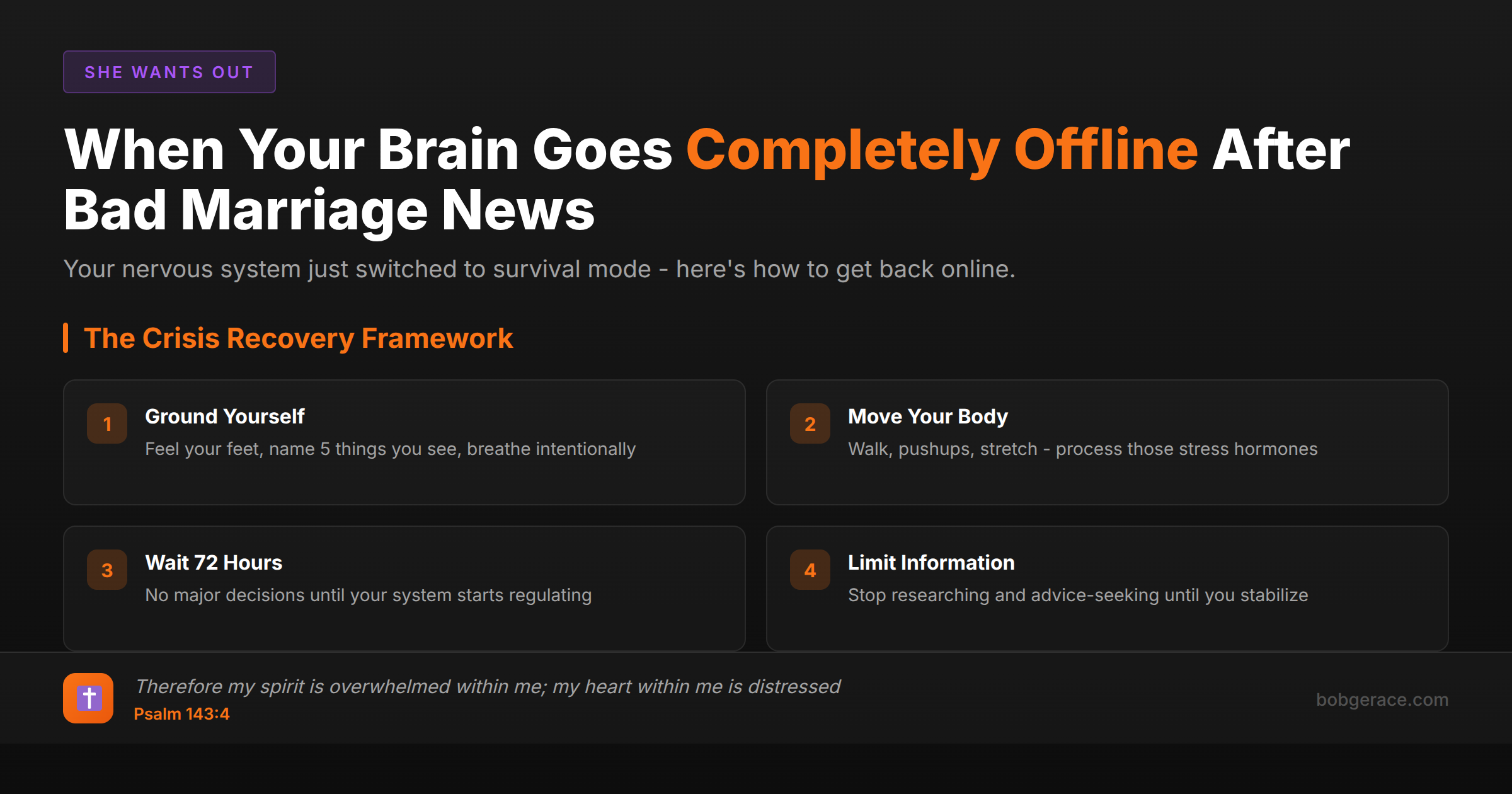
Your brain just shifted into survival mode. When your wife delivered devastating news about your marriage, your nervous system triggered the same response our ancestors had when facing a charging bear - except you can't run from this threat. Your prefrontal cortex, the part responsible for clear thinking and decision-making, went offline while your amygdala flooded your system with stress hormones. This isn't weakness - it's biology. Your body is trying to protect you from a perceived life-threatening situation. The mental fog, inability to focus, and feeling like you're moving through molasses are all normal responses to relationship trauma. Right now, your system is in crisis mode, which means rational thought takes a backseat to basic survival.
The Full Picture
What you're experiencing has a name: acute stress response. When your wife said those words that shattered your world, your nervous system couldn't distinguish between a physical threat and an emotional one. The same biological mechanisms that kept our ancestors alive kick in whether you're facing a lion or facing the collapse of your marriage.
Here's what's happening in your body right now:
• Your heart rate has spiked, possibly staying elevated for hours or days • Stress hormones like cortisol and adrenaline are flooding your system • Your digestive system has essentially shut down (hence the nausea or loss of appetite) • Your sleep patterns are disrupted because your brain thinks you're in danger • Your working memory - the ability to hold and process information - is severely compromised
This explains why you can't remember what she said after those first devastating words, why you're reading the same paragraph over and over, or why you walked into a room and forgot why you came. Your brain has essentially hit the emergency brake on non-essential functions to focus all resources on survival.
Most men try to think their way out of this state, which is like trying to reason with a smoke alarm while the house is on fire. The alarm isn't wrong - it's doing its job. Your nervous system isn't malfunctioning; it's responding exactly as designed to what it perceives as a life-threatening crisis. The problem is that this response, while protective in the short term, becomes destructive if it persists. You can't rebuild your marriage from a place of chronic fight-or-flight.
What's Really Happening
From a neurobiological perspective, you're experiencing what we call relationship trauma. Research shows that threats to our primary attachment relationships activate the same neural pathways as physical danger. Dr. Sue Johnson's work on attachment theory demonstrates that when our secure base is threatened, the brain's alarm system overrides higher-order thinking.
The polyvagal theory explains this perfectly. Your autonomic nervous system has three states: social engagement (where you can think clearly and connect), fight-or-flight (where you're activated but scattered), and freeze (where you shut down completely). Most men cycle between fight-or-flight and freeze after receiving devastating relationship news.
The neurochemistry is working against you: elevated cortisol impairs hippocampal function, making it hard to form new memories or access existing ones coherently. Meanwhile, decreased activity in the prefrontal cortex means your executive functions - planning, reasoning, impulse control - are operating at maybe 30% capacity.
This isn't permanent damage, but recovery requires intentional nervous system regulation. The trauma literature shows that talking alone won't resolve this - you need embodied practices that signal safety to your nervous system. This might include breathing techniques, physical movement, or grounding exercises.
What's particularly challenging for men is that our cultural conditioning tells us to "think our way out" of problems. But you can't think your way out of a nervous system response. The pathway back to clear thinking runs through the body, not around it.
What Scripture Says
Scripture acknowledges that overwhelming circumstances can leave us unable to think clearly. In Psalm 143:4, David writes, "Therefore my spirit is overwhelmed within me; my heart within me is distressed." Even this man after God's own heart experienced seasons where his mental and emotional capacity was compromised by crisis.
Isaiah 26:3 promises, "You will keep him in perfect peace, whose mind is stayed on You, because he trusts in You." This isn't about positive thinking - it's about anchoring your scattered thoughts on the unchanging character of God when your circumstances feel chaotic. Your mind needs a fixed point when everything else is spinning.
Philippians 4:6-7 provides a practical pathway: "Be anxious for nothing, but in everything by prayer and supplication, with thanksgiving, let your requests be made known to God; and the peace of God, which surpasses all understanding, will guard your hearts and minds through Christ Jesus." Notice it says His peace will guard your mind - acknowledging that your mind needs protection during crisis.
2 Timothy 1:7 reminds us that "God has not given us a spirit of fear, but of power and of love and of sound mind." The "sound mind" here is *sophronismos* in Greek, meaning mental discipline and self-control. This suggests that clarity of thought is something we receive from God, not something we manufacture through willpower.
Proverbs 27:14 warns against making major decisions when we're not thinking clearly: "Like a city whose walls are broken through is a person who lacks self-control." Your nervous system response has temporarily broken down your normal defenses and decision-making capacity. Recognizing this is wisdom, not weakness.
What To Do Right Now
-
1
Ground yourself physically - feel your feet on the floor, name 5 things you can see, 4 you can touch, 3 you can hear
-
2
Breathe intentionally using 4-7-8 breathing: inhale for 4, hold for 7, exhale for 8, repeat 4 times
-
3
Avoid making any major decisions for at least 72 hours while your nervous system begins to regulate
-
4
Move your body - take a walk, do pushups, or stretch to help process the stress hormones
-
5
Limit information intake - stop researching, reading articles, or seeking advice until you can think more clearly
-
6
Reach out to one trusted friend or counselor who can help you process without giving premature advice
Related Questions
- She dropped the bomb — what do I do in the next 24 hours?
- What's happening in my nervous system right now?
- What is amygdala hijack and how do I get out of it?
- How do I regulate when my body is in fight-or-flight?
- What does 'window of tolerance' mean and why am I outside it?
- What's the neuroscience of shock and why can't I eat/sleep?
- What is 'betrayal trauma' and do I have it?
- Why do I feel like I'm going to die?
- What's happening to my nervous system right now?
- How do I function when my body won't calm down?
Also find Bob on
Subscribe for weekly videos on Christian marriage.
Your Marriage Needs a Clear Head
A coach who knows your specific situation can help you regain clarity while your nervous system is still in crisis mode. You don't have to figure out the next right move alone.
Talk to Bob →