What does 'window of tolerance' mean and why am I outside it?
6 min read
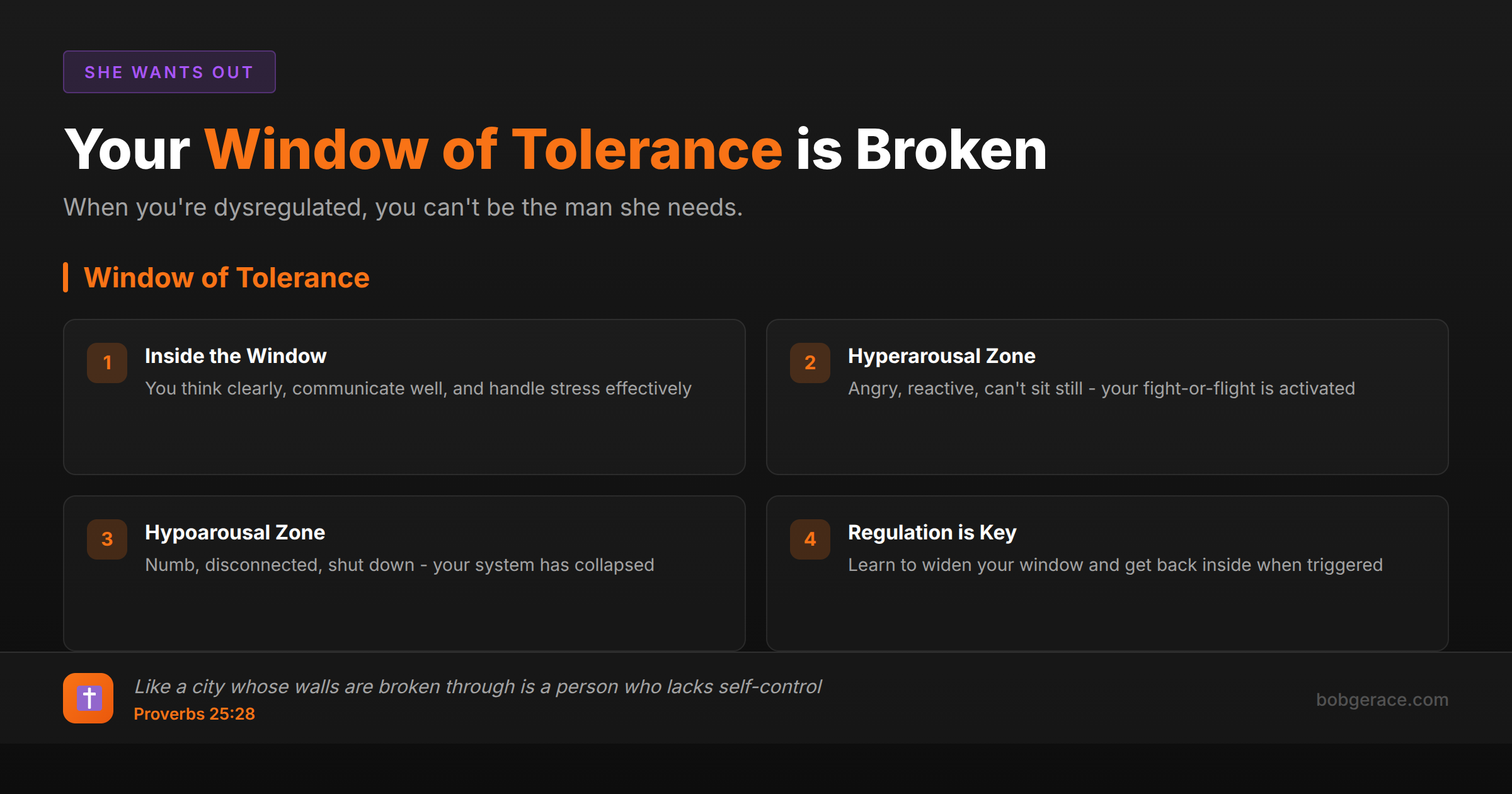
Your 'window of tolerance' is the zone where you can handle stress, conflict, and intense emotions without completely losing it or shutting down. Think of it as your emotional bandwidth - when you're inside this window, you can think clearly, communicate effectively, and make good decisions even when things are tough. Right now, with your marriage falling apart, you're likely living outside this window most of the time. You're either in hyperarousal (angry, reactive, can't sit still) or hypoarousal (numb, disconnected, can't feel anything). This isn't weakness - it's your nervous system responding to threat. But staying outside your window is sabotaging any chance of saving your marriage because you can't be the man she needs when you're dysregulated.
The Full Picture
Your window of tolerance was first described by psychiatrist Dan Siegel, and it's the key to understanding why you keep screwing up even when you desperately want to get it right. When you're inside your window, you can:
• Listen to your wife's complaints without getting defensive • Feel hurt without lashing out or shutting down • Think before you speak • Stay present during difficult conversations • Access empathy and compassion
When you're outside your window, you're either:
Hyperaroused (above your window): Racing heart, can't think straight, saying things you regret, pacing, arguing, interrupting, getting loud, or having panic attacks.
Hypoaroused (below your window): Feeling numb, can't access emotions, withdrawing, sleeping too much, feeling hopeless, or completely shutting down during conversations.
Here's what most guys don't realize: your window shrinks under chronic stress. The ongoing crisis in your marriage has been steadily narrowing your ability to cope. Things that wouldn't have bothered you before now send you into fight-or-flight mode.
The cruel irony? The more dysregulated you become, the more you push your wife away. She sees you either as volatile and unsafe or checked out and unavailable. Neither version feels like a man she can trust or reconnect with.
Your window didn't shrink overnight, and it won't expand overnight. But understanding this concept is the first step toward becoming the regulated, grounded man your marriage needs you to be.
What's Really Happening
From a neurobiological perspective, your window of tolerance represents the optimal zone of arousal where your prefrontal cortex (executive functioning) can effectively regulate your limbic system (emotional brain). When you're outside this window, you're essentially operating from a survival state.
Research shows that chronic relationship distress creates sustained activation of the sympathetic nervous system. Your brain interprets marital conflict as a survival threat, flooding your system with stress hormones like cortisol and adrenaline. Over time, this dysregulates your autonomic nervous system and narrows your window significantly.
The polyvagal theory, developed by Dr. Stephen Porges, explains why you might oscillate between hypervigilance and shutdown. Your vagus nerve, which regulates your nervous system, becomes dysregulated under chronic stress. You lose access to your 'social engagement system' - the neurological state that allows for connection, communication, and emotional attunement.
Neuroplasticity research offers hope: your nervous system can be retrained. Practices like mindfulness, somatic awareness, and grounding techniques actually reshape neural pathways. Studies show that men who learn nervous system regulation see significant improvements in relationship satisfaction and emotional availability.
The key insight: you can't think your way out of nervous system dysregulation. This requires body-based interventions that work with your autonomic nervous system directly. Cognitive strategies alone won't expand your window - you need to address the physiological foundation first.
Recognizing when you're outside your window becomes a crucial skill. The earlier you catch dysregulation, the faster you can implement regulation strategies and stay emotionally available to your wife.
What Scripture Says
Scripture speaks directly to the importance of self-regulation and emotional stability. Proverbs 25:28 tells us, *'Like a city whose walls are broken through is a person who lacks self-control.'* Your window of tolerance is essentially your emotional walls - when they're breached, you become vulnerable and defenseless.
James 1:19-20 instructs, *'My dear brothers and sisters, take note of this: Everyone should be quick to listen, slow to speak and slow to become angry, because human anger does not produce the righteousness that God desires.'* This is only possible when you're operating within your window of tolerance, where you can actually hear and respond thoughtfully.
Jesus himself modeled perfect emotional regulation. Even under extreme stress - betrayal, false accusations, torture - He remained within His window. 1 Peter 2:23 describes how *'When they hurled their insults at him, he did not retaliate; when he suffered, he made no threats. Instead, he entrusted himself to him who judges justly.'*
Galatians 5:22-23 lists self-control as a fruit of the Spirit: *'But the fruit of the Spirit is love, joy, peace, forbearance, kindness, goodness, faithfulness, gentleness and self-control.'* Notice that self-control comes last - it's the foundation that allows all other fruits to flourish.
Psalm 46:10 offers the ultimate regulation strategy: *'Be still, and know that I am God.'* This isn't passive resignation but active grounding in God's sovereignty. When you're dysregulated, stillness becomes your pathway back to your window.
God designed your nervous system, and He provides the resources for regulation. Your window of tolerance isn't just a psychological concept - it's part of how He created you to handle life's challenges while remaining connected to Him and others.
What To Do Right Now
-
1
Learn your warning signs - notice racing heart, tight chest, clenched jaw, or sudden numbness before you're completely dysregulated
-
2
Practice the 4-7-8 breathing technique - inhale for 4, hold for 7, exhale for 8 to activate your parasympathetic nervous system
-
3
Use the 5-4-3-2-1 grounding method - name 5 things you see, 4 you hear, 3 you feel, 2 you smell, 1 you taste
-
4
Take timeouts during heated conversations - say 'I need 20 minutes to regulate' and actually use the time to calm down
-
5
Get your body moving daily - exercise, walk, stretch, or do pushups to discharge stress hormones naturally
-
6
Create a regulation toolkit - identify 3-5 specific activities that reliably bring you back into your window and practice them daily
Related Questions
- What's happening in my nervous system right now?
- What is amygdala hijack and how do I get out of it?
- How do I regulate when my body is in fight-or-flight?
- How do I co-regulate when she's dysregulated too?
- What's the neuroscience of shock and why can't I eat/sleep?
- How long does acute stress response last?
- What is 'betrayal trauma' and do I have it?
- What's happening to my nervous system right now?
- What does chronic anger do to my nervous system?
- What does nervous system regulation look like?
Also find Bob on
Subscribe for weekly videos on Christian marriage.
Your Window. Your Marriage. Your Story.
A coach who knows your specific situation can help you stay regulated when it matters most. You don't have to keep guessing what works for you.
Talk to Bob →