What role do circumstances play?
6 min read
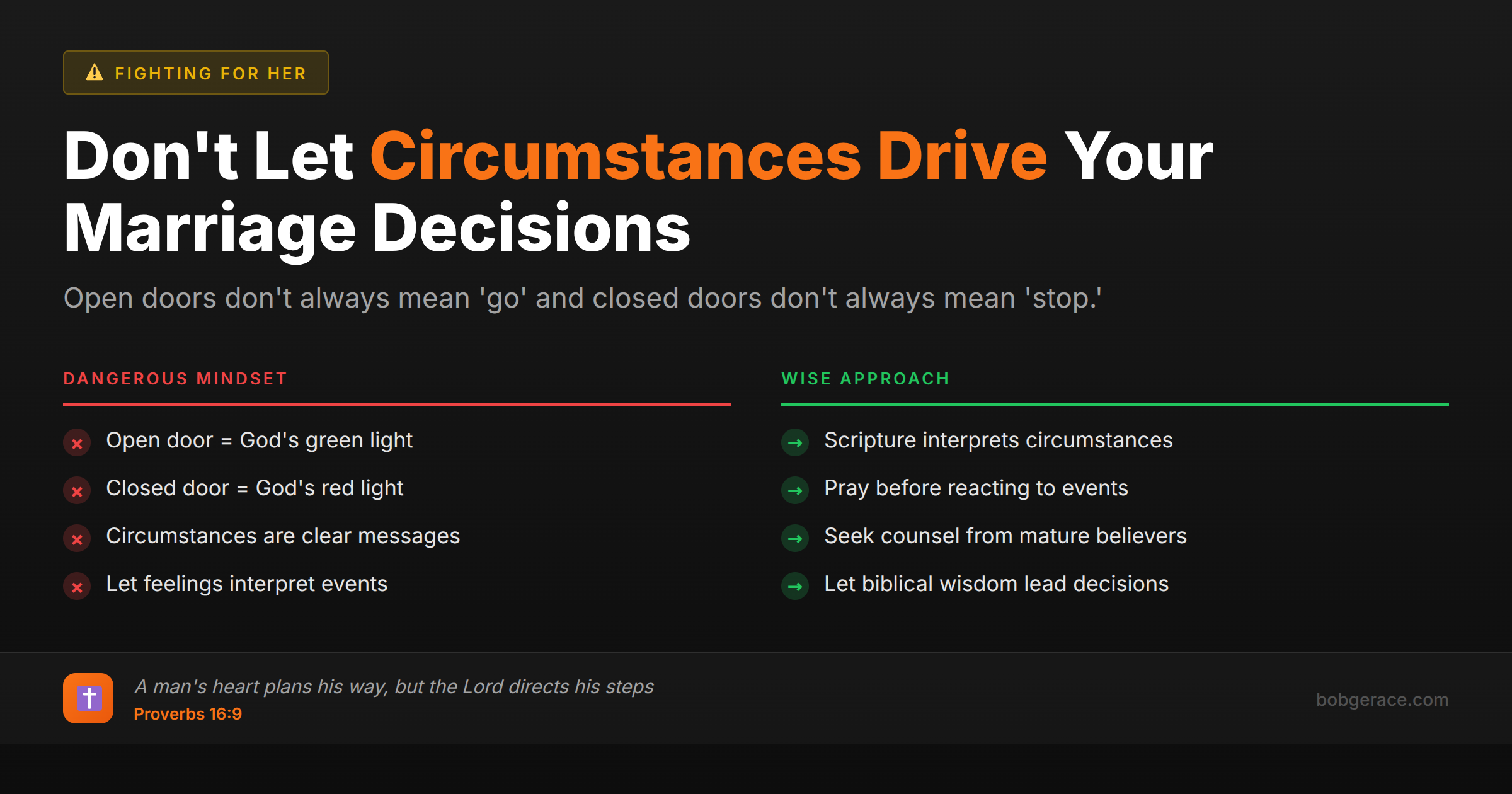
Circumstances are one factor in discernment, but they're never the primary factor. God sometimes opens doors, and sometimes He closes them - but open doors don't automatically mean 'go' and closed doors don't always mean 'stop.' The danger comes when we let circumstances drive our decisions instead of using them to confirm what God has already spoken through His Word and His Spirit. In marriage coaching, I see couples make major mistakes by reading too much into circumstances or ignoring them completely. The key is balance: circumstances should confirm biblical wisdom, not replace it. When you're facing a decision in your marriage, look at what's happening around you, but filter everything through Scripture and prayer first.
The Full Picture
Circumstances are like traffic lights - they can guide your timing, but they shouldn't determine your destination. God uses circumstances as one tool in His communication toolkit, but it's never the only tool and rarely the most important one.
The Problem with Circumstance-Driven Decisions
Too many Christians treat circumstances like a magic 8-ball. Door opens? Must be God's will. Money comes in? Green light from heaven. Someone says 'no'? Obviously God is closing this path. This approach leads to spiritual whiplash and poor decision-making.
In marriage, this looks like couples who think every conflict means they're 'not meant to be together' or spouses who interpret financial stress as God telling them to give up on their relationship. It's reactive living, not discerning living.
The Biblical Balance
Scripture shows us that circumstances matter, but context matters more. Paul faced closed doors in Asia Minor (Acts 16:6-7), but he didn't just sit there waiting for circumstances to change - he actively sought God's direction and moved forward when clarity came.
Three Types of Circumstances to Consider:
1. Confirming circumstances - These align with what God has already shown you through His Word and prayer 2. Redirecting circumstances - These suggest a change in timing or approach, not necessarily destination 3. Testing circumstances - These challenge your commitment and reveal your true motivations
The key is learning which type you're facing and responding appropriately instead of just reacting emotionally.
What's Really Happening
From a psychological perspective, our interpretation of circumstances is heavily influenced by our cognitive biases and emotional state. What we call 'reading circumstances' is often our brain trying to make sense of complex situations by finding patterns - even when no meaningful patterns exist.
Confirmation Bias in Spiritual Discernment
People tend to interpret circumstances in ways that confirm what they already want to believe. If someone wants to leave their marriage, every conflict becomes 'evidence' that God wants them out. If they want to stay, they'll dismiss serious red flags as 'just a test.'
Anxiety and Circumstantial Interpretation
Anxious individuals often catastrophize neutral circumstances, seeing closed doors everywhere. Conversely, people in denial minimize obvious warning signs. Neither approach leads to healthy discernment.
The Neuroscience of Decision-Making
Our brains process emotional information faster than rational information. This means our first interpretation of circumstances is usually emotional, not spiritual. Taking time to slow down and engage the prefrontal cortex - through prayer, reflection, and counsel - leads to better discernment.
Healthy Circumstantial Assessment
Mature discernment involves acknowledging your emotional response to circumstances while not being controlled by it. Ask yourself: 'Am I interpreting this situation based on fear, hope, or objective reality?' This self-awareness creates space for genuine spiritual discernment rather than emotional reaction disguised as 'hearing from God.'
What Scripture Says
Scripture gives us clear principles for how circumstances fit into discernment:
God Controls Circumstances *"A man's heart plans his way, but the Lord directs his steps"* (Proverbs 16:9). God is sovereign over your circumstances, but that doesn't mean every circumstance is a direct message from Him.
Wisdom Interprets Circumstances *"The simple believes every word, but the prudent considers well his steps"* (Proverbs 14:15). Don't just react to circumstances - evaluate them through biblical wisdom.
Circumstances Test Character *"Count it all joy when you fall into various trials, knowing that the testing of your faith produces patience"* (James 1:2-3). Sometimes difficult circumstances aren't redirections - they're opportunities for growth.
Open Doors Need Discernment *"For a great and effective door has opened to me, and there are many adversaries"* (1 Corinthians 16:9). Paul saw open doors and opposition as potentially coexisting. Don't assume every open door is from God or every closed door is His 'no.'
Circumstances + Wisdom = Discernment *"I will instruct you and teach you in the way you should go; I will guide you with My eye"* (Psalm 32:8). God's guidance comes through His Word, His Spirit, and yes, sometimes through circumstances - but always filtered through biblical wisdom.
The Ultimate Test Does your interpretation of circumstances lead you toward greater faithfulness to God's revealed will in Scripture? If not, you're probably misreading the signs.
What To Do Right Now
-
1
Write down the circumstances you're trying to interpret - be specific and factual, not emotional
-
2
Identify what Scripture clearly says about your situation before interpreting any circumstances
-
3
Ask yourself: 'What do I want these circumstances to mean?' - acknowledge your bias
-
4
Seek counsel from mature believers who know both you and God's Word well
-
5
Pray for wisdom to distinguish between confirming, redirecting, and testing circumstances
-
6
Move forward with the biblical principle that's clearest, using circumstances to refine timing and approach
Related Questions
- How do I discern God's will for my marriage?
- What role does Scripture play in discernment?
- What role does wise counsel play?
- How do I distinguish my desires from God's direction?
- What if godly people disagree on what I should do?
- How do I hear God when I'm in crisis?
- How do I know God's will in this?
- What if God tells me to stay and she still leaves?
- How do I discern between my will and God's will?
- Is there peace available before resolution?
Also find Bob on
Subscribe for weekly videos on Christian marriage.
Stuck Reading the Signs in Your Marriage?
You don't have to keep guessing what circumstances mean for your specific situation. Bob works with guys who need a second set of eyes on what's actually happening—and what to do next.
Talk to Bob →