What role does Scripture play in discernment?
6 min read
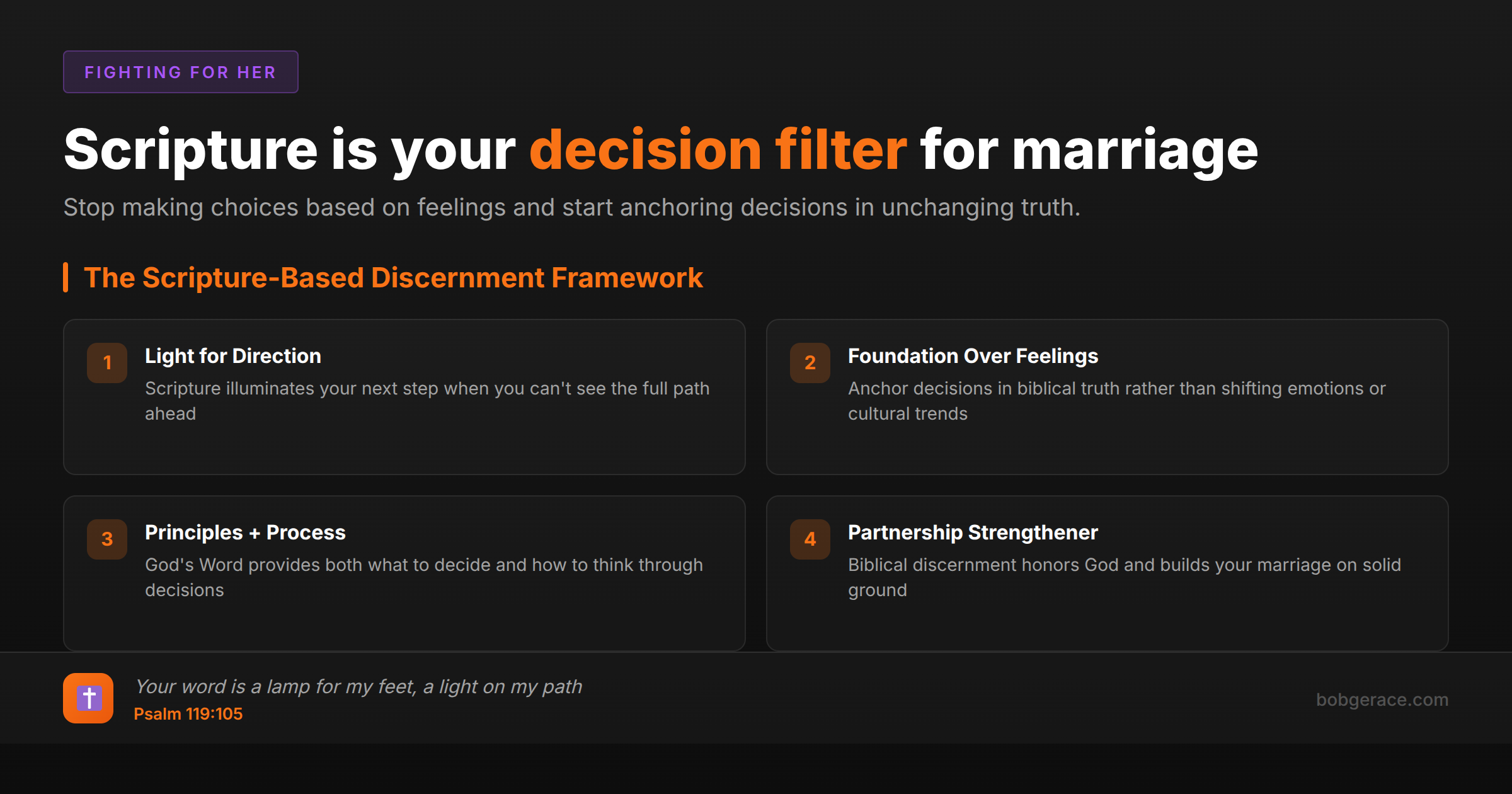
Scripture serves as the foundational blueprint for all godly discernment. It's not just a reference book you check occasionally—it's the lens through which you evaluate every decision, relationship, and direction in your marriage. God's Word provides both the principles and the process for making wise choices that honor Him and strengthen your relationship. When you root your discernment in Scripture, you're anchoring your decisions in unchanging truth rather than shifting emotions or cultural trends. The Bible doesn't just tell you what to think—it teaches you how to think biblically about the complex situations you face as a married couple.
The Full Picture
Here's what most couples miss: Scripture isn't just about finding the "right" Bible verse for your situation. It's about developing a biblical worldview that shapes how you approach every decision in your marriage.
Think of Scripture as your marriage's operating system. Just like your phone needs an OS to run properly, your marriage needs biblical principles to function as God designed. When you make decisions without this foundation, you're essentially flying blind.
Scripture provides three essential elements for discernment:
First, it gives you unchanging principles. While circumstances change, God's character and His design for marriage remain constant. When you're facing a tough decision about finances, parenting, or career moves, Scripture provides the non-negotiable principles that should guide your choice.
Second, it offers practical wisdom through real stories of real people making real decisions. The Bible isn't a theoretical textbook—it's filled with case studies of marriages, families, and individuals navigating complex situations. You can learn from David's failures, Solomon's wisdom, and the early church's decision-making processes.
Third, Scripture trains your spiritual senses. Hebrews 5:14 talks about having your senses trained by practice to distinguish good from evil. Regular time in God's Word doesn't just give you information—it develops your ability to recognize God's voice and detect spiritual counterfeits.
The goal isn't to become a biblical scholar who can quote chapter and verse. The goal is to become so familiar with God's heart and ways that biblical thinking becomes your default mode.
What's Really Happening
From a clinical perspective, couples who integrate Scripture into their decision-making process demonstrate significantly better outcomes in conflict resolution and long-term relationship satisfaction. This isn't just about religious practice—it's about having a shared framework for processing life's complexities.
What I observe in my practice is that couples without a biblical foundation for discernment often fall into decision-making patterns that create ongoing tension. They might rely heavily on emotions in the moment, defer to whoever feels more strongly about an issue, or get stuck in analysis paralysis because they have no clear criteria for evaluation.
Scriptural discernment provides what psychologists call "cognitive scaffolding"—a structured way of thinking through problems that reduces anxiety and increases confidence in decision-making. When couples know they're operating from shared biblical principles, they experience less fear about making the "wrong" choice and more unity in the process.
I've also noticed that couples who regularly engage with Scripture together develop better communication patterns. The process of discussing biblical passages and their application naturally builds skills in listening, perspective-taking, and collaborative problem-solving. They learn to ask better questions: "What does this reveal about God's character?" "How does this align with biblical priorities?" "What would love look like in this situation?"
The neurological benefits are significant too. Regular Scripture engagement actually rewires the brain for hope, gratitude, and resilience—all crucial components of a healthy marriage.
What Scripture Says
God's Word is crystal clear about the role of Scripture in discernment and decision-making:
"Your word is a lamp for my feet, a light on my path." (Psalm 119:105) Scripture illuminates the way forward when you can't see clearly. It doesn't always show you the entire journey, but it gives you enough light for the next step.
"All Scripture is God-breathed and is useful for teaching, rebuking, correcting and training in righteousness, so that the servant of God may be thoroughly equipped for every good work." (2 Timothy 3:16-17) Notice that "every good work" includes the good work of building a godly marriage. Scripture equips you for every situation you'll face.
"Trust in the Lord with all your heart and lean not on your own understanding; in all your ways submit to him, and he will make your paths straight." (Proverbs 3:5-6) This is the heart of biblical discernment—trusting God's revealed wisdom over your own limited perspective.
"But when he, the Spirit of truth, comes, he will guide you into all the truth." (John 16:13) The Holy Spirit uses Scripture to guide you into truth. This isn't just intellectual knowledge—it's practical guidance for real-life decisions.
"The simple believe anything, but the prudent give thought to their steps." (Proverbs 14:15) Biblical discernment requires intentional thought guided by God's Word, not just going with your gut or following popular opinion.
"How can a young person stay on the path of purity? By living according to your word." (Psalm 119:9) God's Word keeps you on the right path in every area of life, including marriage.
What To Do Right Now
-
1
Establish a daily rhythm of reading Scripture together, even if it's just five minutes over morning coffee
-
2
Before making any significant decision, ask "What biblical principles apply to this situation?"
-
3
Create a list of key Bible verses that speak to common marriage decisions (finances, parenting, conflict, priorities)
-
4
When facing a complex choice, spend time in prayer asking God to reveal relevant Scripture passages
-
5
Join or start a couples' Bible study to learn from how other godly marriages apply Scripture
-
6
Keep a journal of how God has used His Word to guide your marriage decisions as a testimony of His faithfulness
Related Questions
- How do I discern God's will for my marriage?
- What role does wise counsel play?
- What role do circumstances play?
- How do I distinguish my desires from God's direction?
- What if godly people disagree on what I should do?
- How do I hear God when I'm in crisis?
- Does God want me to stay in this marriage?
- How do I know God's will in this?
- What does Scripture say about divorce?
- How do I pray through this?
Also find Bob on
Subscribe for weekly videos on Christian marriage.
Ready to Apply This to Your Marriage?
Scripture gives you the framework. A coach helps you work it into your specific situation—the actual decisions you're facing, the patterns in your relationship, the places you're stuck.
Talk to Bob →