What's the difference between explaining and defending?
5 min read
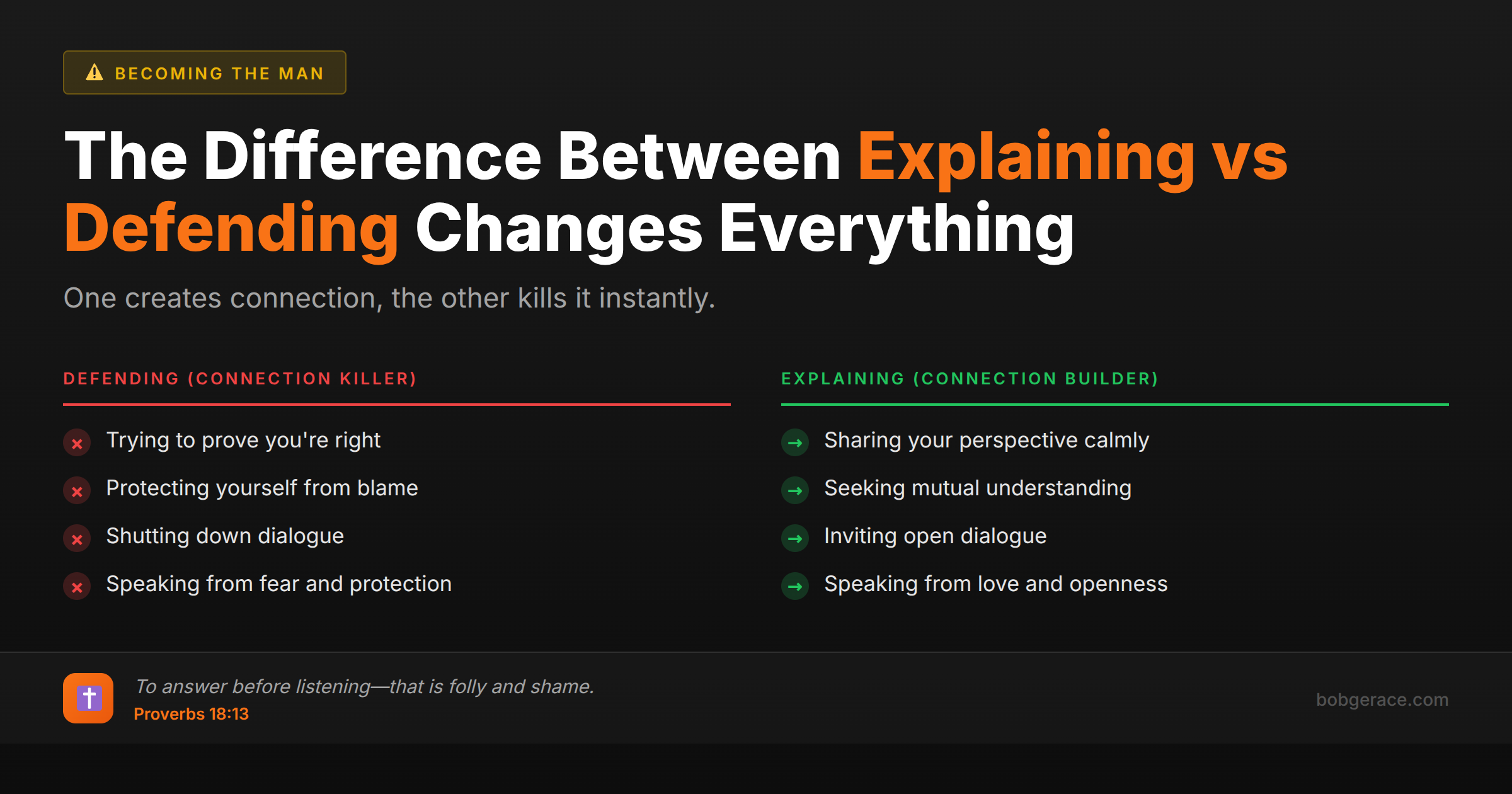
Explaining seeks understanding while defending seeks protection. When you explain, you're sharing information to help your spouse understand your perspective, actions, or feelings without trying to prove you're right or justify behavior. Your tone remains calm and your goal is connection. Defending, however, is a protective reaction where you're trying to ward off criticism, prove your innocence, or justify your actions to avoid blame. The energy is completely different - explaining invites dialogue while defending shuts it down. The difference isn't always in the words you use, but in your heart posture and the emotional energy behind those words.
The Full Picture
Here's what most couples miss: the same words can be either an explanation or a defense, depending on what's driving them. When your spouse brings up an issue and you respond with 'I was stuck in traffic,' that could be a simple explanation of facts, or it could be a defensive wall you're throwing up to protect yourself from criticism.
Explaining comes from a secure place. You're not threatened by your spouse's concern or question. You genuinely want them to understand what happened, how you were thinking, or what you were feeling. There's no urgency to prove anything - just a desire to share information that might help them see the fuller picture.
Defending comes from a threatened place. Even if the threat isn't real, your nervous system has kicked into protection mode. You feel accused, criticized, or misunderstood, so you start building a case for your innocence. The energy shifts from 'let me help you understand' to 'let me prove I'm not wrong.'
Your spouse can feel this difference immediately, even if they can't articulate it. When you're explaining, they feel invited into your world. When you're defending, they feel pushed away by an invisible wall. This is why the same conversation can either bring you closer together or drive you further apart - it all depends on whether you're explaining or defending.
The tricky part? You can slip from explaining into defending mid-sentence without even realizing it. It often happens when you sense your spouse isn't buying your explanation, so you unconsciously shift into building a stronger case.
What's Really Happening
From a clinical perspective, this distinction maps directly onto our nervous system responses. Explaining engages the ventral vagal system - the part of our autonomic nervous system associated with safety, connection, and social engagement. When we feel safe, we can share openly without needing to protect ourselves.
Defending activates the sympathetic nervous system - our fight-or-flight response. Even in low-level defensiveness, we're in a mild state of threat detection. Our bodies are preparing to ward off danger, which in this case is perceived criticism or rejection from our spouse.
This physiological difference explains why defending actually prevents the very connection you're trying to protect. When your nervous system perceives threat, it prioritizes safety over connection. You literally cannot access the brain regions responsible for empathy, curiosity, and collaborative problem-solving while you're in a defensive state.
The attachment implications are significant. Partners with anxious attachment styles often interpret explanations as defenses because they're hypervigilant to signs of disconnection. Partners with avoidant styles may slip into defending when they feel their autonomy or competence is being questioned. Understanding your attachment triggers helps you recognize when you're shifting from explaining to defending.
The good news is that awareness creates choice. Once you understand the physiological difference, you can learn to pause when you feel that defensive energy rising and consciously choose to return to explanation mode.
What Scripture Says
Scripture consistently calls us toward openness and humility rather than self-protection and defensiveness. Proverbs 18:13 warns us: 'To answer before listening—that is folly and shame.' Defending often means we've stopped listening and started protecting ourselves from what we think our spouse is saying.
James 1:19 gives us the perfect framework: 'Everyone should be quick to listen, slow to speak and slow to become angry.' When we're explaining, we can be slow to speak because we're not threatened. When we're defending, we're quick to speak because we feel under attack.
Philippians 2:3-4 cuts to the heart of the issue: 'Do nothing out of selfish ambition or vain conceit. Rather, in humility value others above yourselves, not looking to your own interests but each of you to the interests of the others.' Defending is fundamentally about protecting our own interests - our reputation, our sense of being right, our comfort. Explaining can be an act of love that serves your spouse's need to understand.
1 Peter 5:6 reminds us: 'Humble yourselves, therefore, under God's mighty hand, that he may lift you up in due time.' True humility doesn't need to defend itself constantly. It can rest in God's opinion rather than fighting for human approval.
Proverbs 27:5-6 shows us that love sometimes brings difficult conversations: 'Better is open rebuke than hidden love. Wounds from a friend can be trusted.' When your spouse raises a concern, they may be offering you the 'faithful wounds' of someone who loves you. Defending prevents you from receiving this gift.
What To Do Right Now
-
1
Check your body. Notice if your jaw is clenched, shoulders are raised, or chest feels tight. These are signs you've shifted into defending mode.
-
2
Pause and breathe. Take three deep breaths to re-engage your ventral vagal system and move out of fight-or-flight mode.
-
3
Ask yourself: 'What am I trying to protect right now?' Usually it's your sense of being right, good, or competent. Name the fear driving the defense.
-
4
Shift your goal from being understood to understanding. Say 'Help me understand what you're really concerned about here.'
-
5
Share information without urgency. If explanation is needed, offer it calmly without the energy of needing your spouse to accept it.
-
6
Practice the phrase: 'You might be right about that.' This disarms your own defensive system and shows your spouse they're safe to share concerns with you.
Related Questions
Ready to Break the Defensiveness Cycle?
Learning to explain instead of defend is a game-changer for your marriage. Get personalized strategies for your specific patterns.
Work With Me →