What would help her ventral vagal (social engagement)?
6 min read
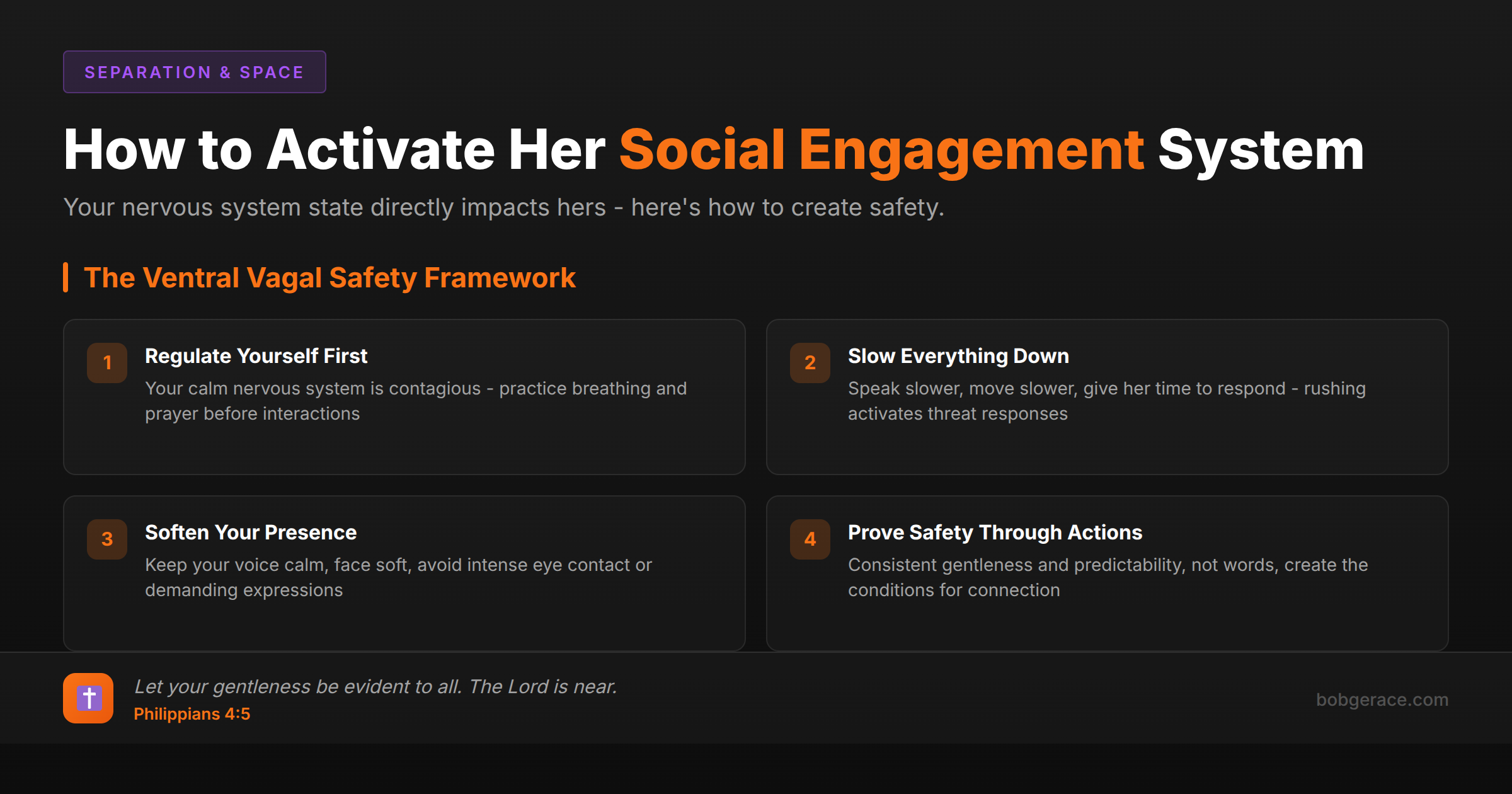
To help her ventral vagal system (social engagement) come online, you need to create consistent safety and co-regulation. This means slowing down your approach, speaking in calm tones, maintaining non-threatening body language, and proving through actions - not words - that you're a safe person to connect with. The ventral vagal state is where connection happens, but she can't force herself there. It requires felt safety, predictability, and co-regulation with someone who is already calm and regulated. Your nervous system state directly impacts hers, so your own regulation becomes the foundation for her healing.
The Full Picture
When your wife is checked out, her nervous system has moved away from ventral vagal activation - the state where social engagement, connection, and intimacy are possible. Think of the ventral vagal system as the "green light" of her nervous system. When it's active, she feels safe, curious, and open to relationship.
But here's what most men miss: you can't think your way into ventral vagal activation. It's not a cognitive choice. It's a nervous system state that emerges when specific conditions are met. She needs to feel safe at a body level, not just hear that she's safe.
The ventral vagal system responds to: - Predictable, calm presence - Non-threatening facial expressions and body language - Prosody (tone, rhythm, and melody of speech) - Co-regulation with someone who is already regulated - Consistent safety over time
When she's been in fight/flight (sympathetic) or shutdown (dorsal vagal) for extended periods, her system has adapted to protect her. The ventral vagal state feels vulnerable because it's the state where she opens up to connection - and connection is where she got hurt.
This means recovery isn't linear. She might have moments where she seems more open, then retreat again. That's not failure - that's her nervous system testing whether safety is consistent or just temporary. Your job isn't to rush this process, but to become the kind of consistent, regulated presence that makes ventral vagal activation feel genuinely safe for her.
What's Really Happening
The ventral vagal complex is the newest part of our autonomic nervous system, evolutionarily speaking. It's what allows us to engage socially, feel curious about our partner, and experience intimacy without threat. When this system is online, the face becomes animated, the voice has prosody, and there's a genuine capacity for connection.
What I see consistently in couples work is that men often try to talk their wives into ventral vagal activation. They explain, reassure, and promise change. But the ventral vagal system doesn't respond to words - it responds to felt experience. Her nervous system is asking: "Is this person actually safe? Can I predict their responses? Do their actions match their words over time?"
The key factor most couples miss is co-regulation. The ventral vagal system comes online most easily in the presence of someone else who is already there. If you're anxious, demanding, or dysregulated while trying to "help" her feel safe, you're actually contributing to her nervous system staying in protection mode.
This is why I always work with the pursuing partner first. Your nervous system state is contagious. When you can maintain genuine calm, curiosity, and non-attachment to her response, you become a co-regulating presence. Over time, her system begins to remember what safety feels like. But this process requires patience and consistency - two things that anxious husbands struggle with most.
What Scripture Says
Scripture consistently emphasizes the power of creating safety through our presence and actions, not just our words. This aligns perfectly with what we know about ventral vagal activation.
"Let your gentleness be evident to all. The Lord is near." (Philippians 4:5) Gentleness isn't weakness - it's strength under control. When you approach your wife with consistent gentleness, you're creating the conditions where her nervous system can feel safe enough to engage socially.
"A gentle answer turns away wrath, but a harsh word stirs up anger." (Proverbs 15:1) The tone, pace, and quality of your voice directly impacts her nervous system. Harsh tones activate threat responses, while gentle tones support ventral vagal activation.
"Above all else, guard your heart, for everything you do flows from it." (Proverbs 4:23) Your internal state - what's happening in your own nervous system - flows out and impacts hers. If you're internally anxious, demanding, or frustrated, that energy will be felt regardless of your words.
"Be completely humble and gentle; be patient, bearing with one another in love." (Ephesians 4:2) Patience and gentleness over time create the predictable safety that allows the ventral vagal system to come online. This isn't about being passive - it's about being consistently safe.
"The Lord your God is with you, the Mighty Warrior who saves. He will take great delight in you; in his love he will no longer rebuke you, but will rejoice over you with singing." (Zephaniah 3:17) God's presence with us is calming, delighting, and rejoicing. This is the kind of presence that supports nervous system healing.
"Let us then approach God's throne of grace with confidence, so that we may receive mercy and find grace to help us in our time of need." (Hebrews 4:16) Safety allows us to approach with confidence. When your wife feels genuinely safe with you, she can begin to open up without fear of judgment or retaliation.
What To Do Right Now
-
1
Regulate yourself first - Practice breathing techniques, prayer, or other calming activities before interactions. Your calm nervous system is contagious.
-
2
Slow everything down - Speak slower, move slower, and give her more time to respond. Rushing activates threat responses.
-
3
Focus on your tone and facial expressions - Keep your voice calm and your face soft. Avoid intense eye contact or demanding expressions.
-
4
Practice non-attachment to outcomes - Approach interactions with curiosity rather than agenda. Let her responses be what they are without trying to change them.
-
5
Create predictable safety - Be consistent in your responses and actions. Avoid sudden changes in mood or behavior that could feel threatening.
-
6
Offer presence without pressure - Spend time near her without expecting conversation or connection. Let her nervous system get used to your regulated presence.
Related Questions
- What is 'dorsal vagal' state?
- Is she in shutdown, not choosing coldness?
- What signals threat to her nervous system?
- What does safety look like to her nervous system?
- How do I co-regulate with someone who won't engage?
- How do I become a safe presence again?
- What does emotional co-regulation look like?
- How do I become a safe emotional presence?
- What does 'holding space' actually mean?
- What does nervous system regulation look like?
Also find Bob on
Subscribe for weekly videos on Christian marriage.
Your Marriage Needs Your Specific Situation
Co-regulation isn't theory—it's calibrated to how she responds, what triggers her, and where your marriage actually is right now. A coach who knows your story helps you adjust in real time.
Talk to Bob →