What signals threat to her nervous system?
6 min read
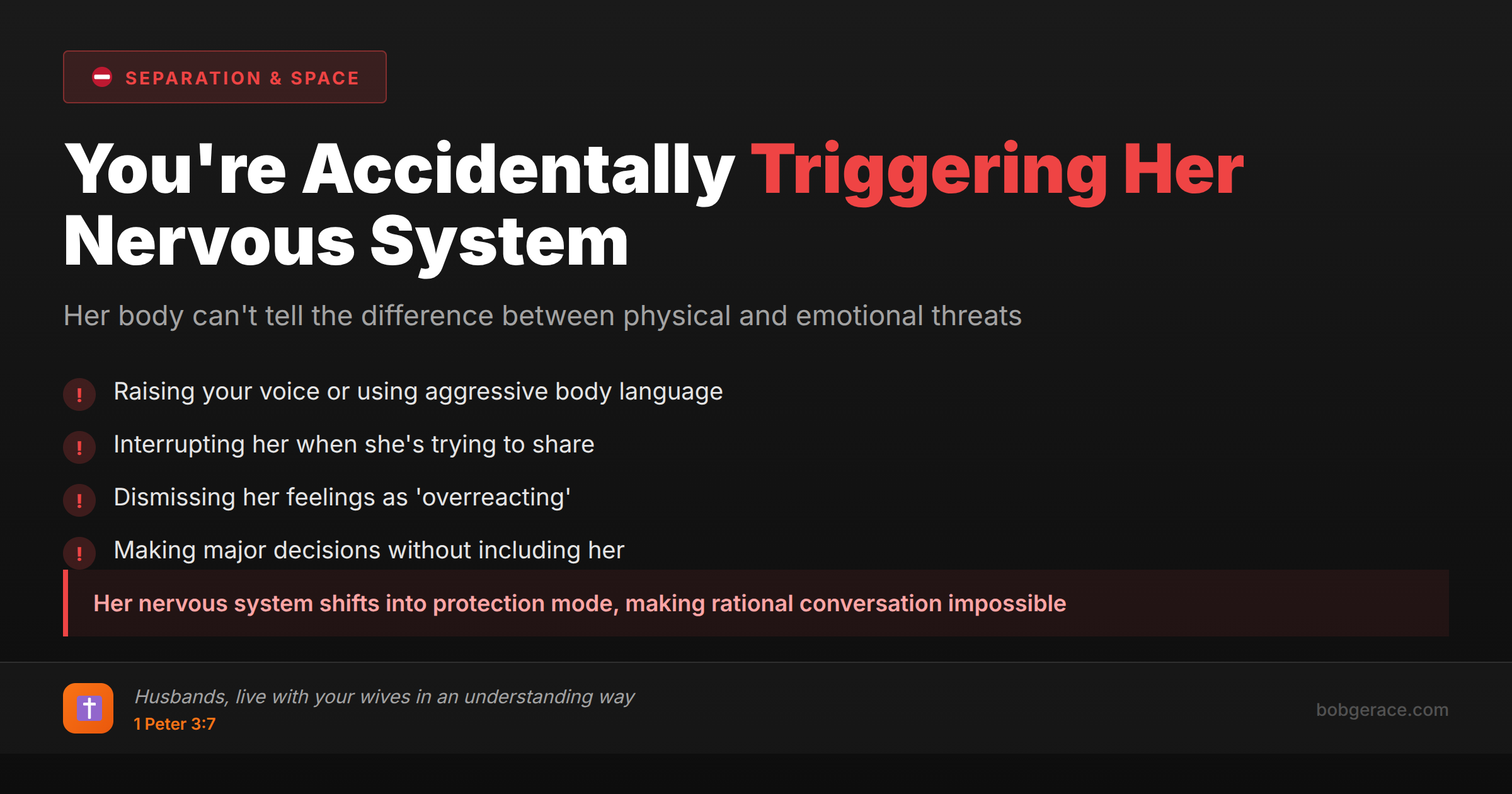
Her nervous system interprets threat through both obvious and subtle signals. Raised voices, aggressive body language, and criticism activate her fight-or-flight response immediately. But less obvious triggers include interrupting her, dismissing her feelings, making unilateral decisions, or even your tone when you're stressed about work. The key insight: her nervous system doesn't distinguish between physical and emotional threats. When she feels unheard, controlled, or criticized, her body responds as if she's in actual danger. This explains why logical conversations can suddenly become emotional - her nervous system has shifted into protection mode, making rational discussion nearly impossible.
The Full Picture
Your wife's nervous system is constantly scanning for safety or threat in your relationship. This isn't conscious - it's happening automatically, beneath her awareness. Understanding what triggers her threat response is crucial because once activated, her ability to connect, communicate, and feel close to you shuts down.
Primary Threat Signals:
- Tone and volume changes - Even slight irritation in your voice can signal danger - Dismissive body language - Eye rolling, turning away, checking your phone - Interrupting or talking over her - This signals her voice doesn't matter - Making decisions without input - Feels like loss of control and partnership - Criticism disguised as help - "You should have..." or "Why didn't you..." - Bringing up past failures - Creates feeling of being constantly judged
Subtle Threat Signals:
- Coming home stressed and immediately venting without checking in with her - Making jokes at her expense, especially in front of others - Comparing her to other women (your mother, friends' wives, etc.) - Withdrawing affection when you're upset about something unrelated - Using logic to dismiss her emotional experiences - Rushing her through conversations when she needs to process
Here's what most men miss: your stress becomes her threat. When you're overwhelmed with work, finances, or other pressures, and you bring that energy home without awareness, her nervous system reads it as danger in the relationship. She doesn't know if you're upset with her or something else - she just knows something feels wrong and unsafe.
What's Really Happening
From a polyvagal perspective, women's nervous systems are generally more sensitive to relational threats due to evolutionary and neurobiological factors. Her vagus nerve - the main highway of her nervous system - is constantly assessing: "Am I safe with this person?"
When threat is detected, her autonomic nervous system activates one of three responses: fight (arguing, defending, attacking), flight (withdrawing, getting busy, avoiding), or freeze (shutting down, going numb, checking out). What looks like her being "difficult" or "overreacting" is actually her nervous system trying to protect her.
The most damaging threats are often the subtle, repeated ones - what we call "micro-threats." A dismissive tone here, an interrupted conversation there, a decision made without her input. These accumulate in her nervous system like deposits in a threat bank account. Eventually, even small triggers can cause big reactions because her system is already overwhelmed.
Here's the clinical reality: you cannot logic someone out of a nervous system response. When she's activated, her prefrontal cortex (rational thinking) goes offline. This is why trying to reason with her when she's upset often backfires spectacularly. Her nervous system needs to feel safe before her thinking brain can re-engage.
The hopeful news: nervous systems are highly adaptive. Consistent experiences of safety can rewire her threat responses. But this requires you to become aware of your impact on her nervous system and make intentional changes to how you show up in the relationship.
What Scripture Says
Scripture calls husbands to create safety, not threat, in their marriages. God's design for marriage includes the husband as protector and covering, which includes protecting her from unnecessary stress and threat responses.
"Husbands, live with your wives in an understanding way, showing honor to the woman as the weaker vessel, since they are heirs with you of the grace of life, so that your prayers may not be hindered." - 1 Peter 3:7
The word "understanding" here means intimate knowledge - you're called to study your wife and understand what creates safety versus threat for her specifically.
"Let no corrupting talk come out of your mouths, but only such as is good for building up, as fits the occasion, that it may give grace to those who hear." - Ephesians 4:29
Your words have power to build up or tear down her sense of safety. Every conversation is an opportunity to signal safety or threat.
"Be angry and do not sin; do not let the sun go down on your anger." - Ephesians 4:26
Unresolved anger and tension create chronic threat states. God calls you to address conflicts quickly and completely.
"Above all, keep loving one another earnestly, since love covers a multitude of sins." - 1 Peter 4:8
Love that covers means creating safety even when things aren't perfect. Your consistent, patient love helps regulate her nervous system.
"A soft answer turns away wrath, but a harsh word stirs up anger." - Proverbs 15:1
Your tone and approach directly impact whether her nervous system feels safe or threatened.
"Bear one another's burdens, and so fulfill the law of Christ." - Galatians 6:2
This includes bearing the burden of being mindful of your impact on her nervous system, even when it feels unfair or excessive.
What To Do Right Now
-
1
Monitor your tone and energy - Before speaking, especially when stressed, take a breath and soften your voice. Your tone sets the entire tone for safety or threat.
-
2
Ask before advising - Instead of jumping into fix-it mode, ask "Do you want me to listen or help you solve this?" This prevents her nervous system from interpreting your help as criticism.
-
3
Check in when you come home - Transition from work stress before engaging. Ask how her day was before sharing yours. Let your nervous system regulate before influencing hers.
-
4
Validate her emotional experience - When she's upset, start with "That makes sense" or "I can see why you'd feel that way" before trying to problem-solve or defend yourself.
-
5
Include her in decisions - Even small decisions that affect her. Ask her input on plans, purchases, and changes. This signals partnership, not control.
-
6
Practice repair quickly - When you realize you've triggered her threat response, immediately acknowledge it: "I can see my tone just made you feel unsafe. I'm sorry. Can we start over?"
Related Questions
- What is 'dorsal vagal' state?
- Is she in shutdown, not choosing coldness?
- What does safety look like to her nervous system?
- What do I do that activates her defense?
- How do I become a safe presence again?
- What would help her ventral vagal (social engagement)?
- What is 'amygdala hijack' and how do I interrupt it?
- How do I regulate my own system?
- What does emotional co-regulation look like?
- How do I become a safe emotional presence?
Also find Bob on
Subscribe for weekly videos on Christian marriage.
Ready to Apply This to Your Marriage?
Understanding nervous system threat is one thing. Knowing which signals YOUR wife is reading from YOU—and how to recalibrate in real time—requires a coach who knows your specific situation.
Talk to Bob →