Why does feedback activate threat response?
6 min read
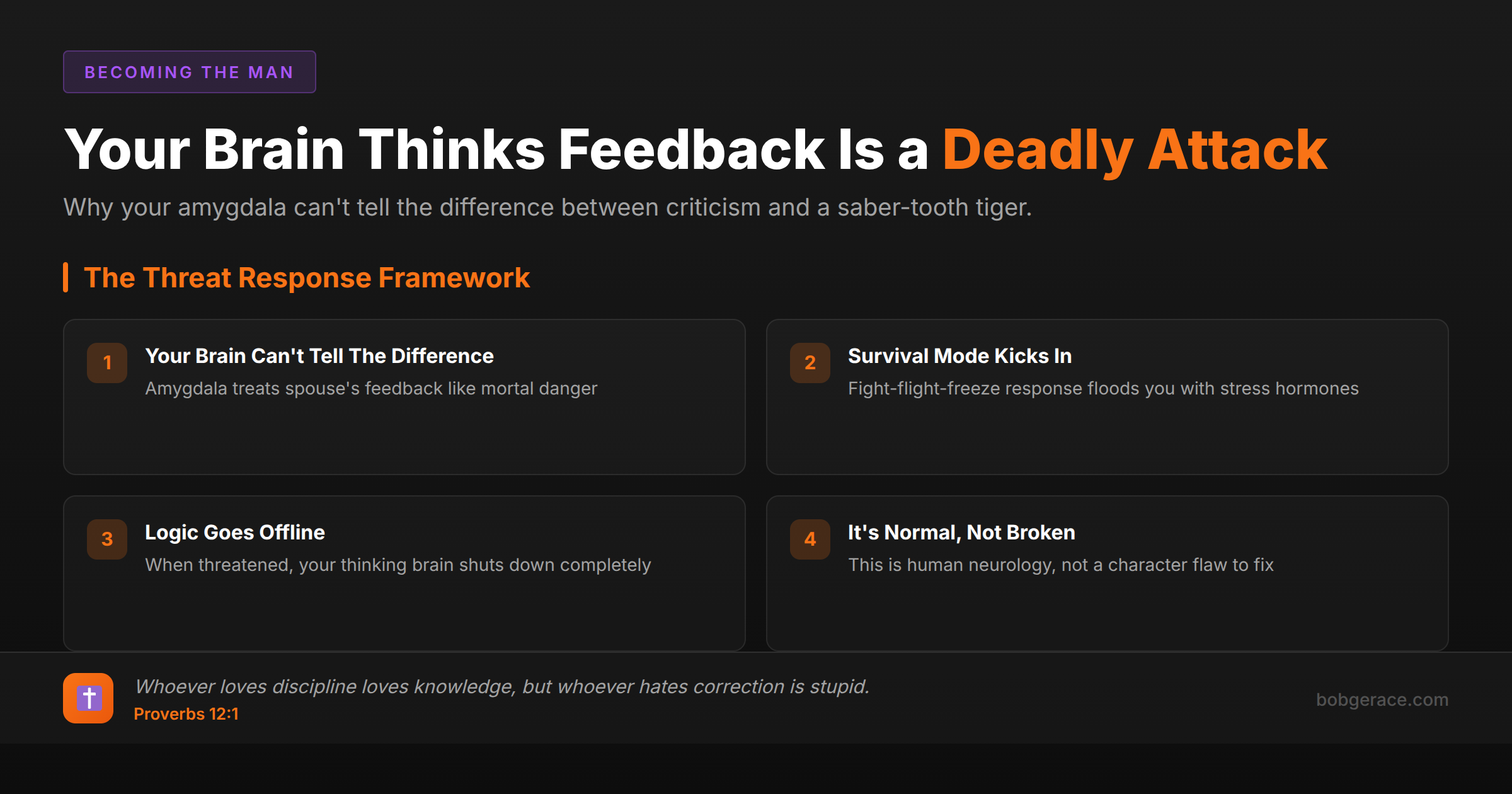
Your brain activates threat response to feedback because it's wired for survival, not intimacy. When your spouse offers feedback, your amygdala - the brain's alarm system - can't distinguish between a saber-tooth tiger and criticism about leaving dishes in the sink. Both trigger the same fight-flight-freeze response that kept our ancestors alive. This happens because feedback often feels like rejection or abandonment, which our brain interprets as life-threatening. Your nervous system floods with stress hormones, your heart rate spikes, and logical thinking goes offline. Understanding this isn't about making excuses - it's about recognizing that your defensive reactions are normal human neurology, not character flaws.
The Full Picture
Your brain's threat response to feedback isn't a bug - it's a feature that's been keeping humans alive for millennia. The problem is that this ancient wiring doesn't serve modern marriage well.
The Neuroscience Behind the Reaction
When feedback comes your way, your brain processes it through the amygdala before it reaches your prefrontal cortex (the thinking brain). The amygdala asks one question: "Am I safe?" Feedback often triggers a "no" response because:
- It challenges your sense of competence - It feels like rejection or criticism - It activates shame (which the brain reads as social death) - It threatens your sense of being "good enough"
Why This Happens So Fast
Your threat response activates in milliseconds, long before conscious thought kicks in. This is why you might find yourself getting defensive before you even know what your spouse is really saying. Your body is already flooded with stress hormones, your heart rate has spiked, and your rational thinking has gone offline.
The Marriage Impact
This creates a vicious cycle. Your defensive reaction makes your spouse feel unheard, so they escalate their feedback (often into criticism or contempt). This confirms your brain's assessment that you're under attack, intensifying your threat response. Soon you're both in full defensive mode, and the original feedback gets lost in the chaos.
The Good News
Understanding this process is the first step to changing it. You're not broken, weak, or fundamentally flawed. You're human, with a human brain doing exactly what it was designed to do. The key is learning to work with your neurology, not against it.
What's Really Happening
From a clinical perspective, what we're seeing is your attachment system and threat detection system working in overdrive. Your brain has learned to associate feedback with danger based on past experiences - often going back to childhood.
The Attachment Angle
If you grew up with critical parents, unpredictable caregivers, or experienced early rejection, your nervous system learned that feedback equals threat. Your brain literally wired itself to protect you from what felt dangerous then. Now, when your spouse offers feedback, those same neural pathways activate.
The Shame Connection
Shame is the emotion that most often triggers threat response to feedback. Shame tells us we're fundamentally flawed, unloveable, or not enough. When feedback activates shame, your brain interprets this as social death - which, for our tribal ancestors, often meant actual death.
Polyvagal Theory in Action
Your autonomic nervous system responds to feedback through what Dr. Stephen Porges calls the "polyvagal response." You might go into sympathetic activation (fight or flight) or dorsal shutdown (freeze or withdraw). Neither state allows for the calm, connected communication that healthy feedback requires.
The Path Forward
Healing happens through creating new neural pathways. This requires understanding your triggers, learning to regulate your nervous system, and gradually teaching your brain that feedback from your spouse is connection, not threat. It takes time and intentional practice, but your brain's neuroplasticity means change is absolutely possible.
What Scripture Says
Scripture acknowledges our human tendency to resist correction while calling us to something higher. God's Word provides both understanding and a path forward.
Wisdom Welcomes Correction
*"Whoever loves discipline loves knowledge, but whoever hates correction is stupid."* - Proverbs 12:1
This isn't about being harsh with yourself. It's recognizing that wisdom sees feedback as a gift, even when our flesh resists it.
God's Perfect Love Casts Out Fear
*"There is no fear in love. But perfect love drives out fear, because fear has to do with punishment. The one who fears is not made perfect in love."* - 1 John 4:18
Your threat response is fundamentally about fear - fear of rejection, abandonment, or not being enough. God's perfect love provides the security your nervous system needs to receive feedback without fear.
Transformation Through Renewal
*"Do not conform to the pattern of this world, but be transformed by the renewing of your mind."* - Romans 12:2
Your defensive patterns can be transformed. This happens through renewing your mind with truth about who you are in Christ and how love actually works.
The Goal: Teachable Hearts
*"The way of fools seems right to them, but the wise listen to advice."* - Proverbs 12:15
*"Plans fail for lack of counsel, but with many advisers they succeed."* - Proverbs 15:22
*"Let the wise listen and add to their learning, and let the discerning get guidance."* - Proverbs 1:5
God's design is for us to be teachable, to receive input from others (especially our spouse) as a pathway to growth and wisdom.
What To Do Right Now
-
1
Recognize your early warning signs - Notice physical sensations (tight chest, clenched jaw, racing heart) that signal threat response before it fully activates
-
2
Practice the pause - When you feel defensive rising, take three deep breaths and say internally: 'My brain thinks I'm in danger, but I'm actually safe with my spouse'
-
3
Name it to tame it - Tell your spouse: 'I'm feeling defensive right now. Can you give me a moment to regulate so I can really hear you?'
-
4
Ground yourself physically - Feel your feet on the floor, relax your shoulders, and soften your jaw to signal safety to your nervous system
-
5
Listen for the heart behind the words - Ask yourself: 'What is my spouse really trying to tell me? What do they need from me?'
-
6
Respond instead of react - Once regulated, engage with curiosity: 'Help me understand what you're experiencing' or 'What would be most helpful right now?'
Related Questions
Ready to Break the Defensive Cycle?
Understanding your threat response is just the beginning. Let's work together to rewire these patterns and create the connected marriage you both want.
Work With Me →