What happens in my brain when I feel criticized?
6 min read
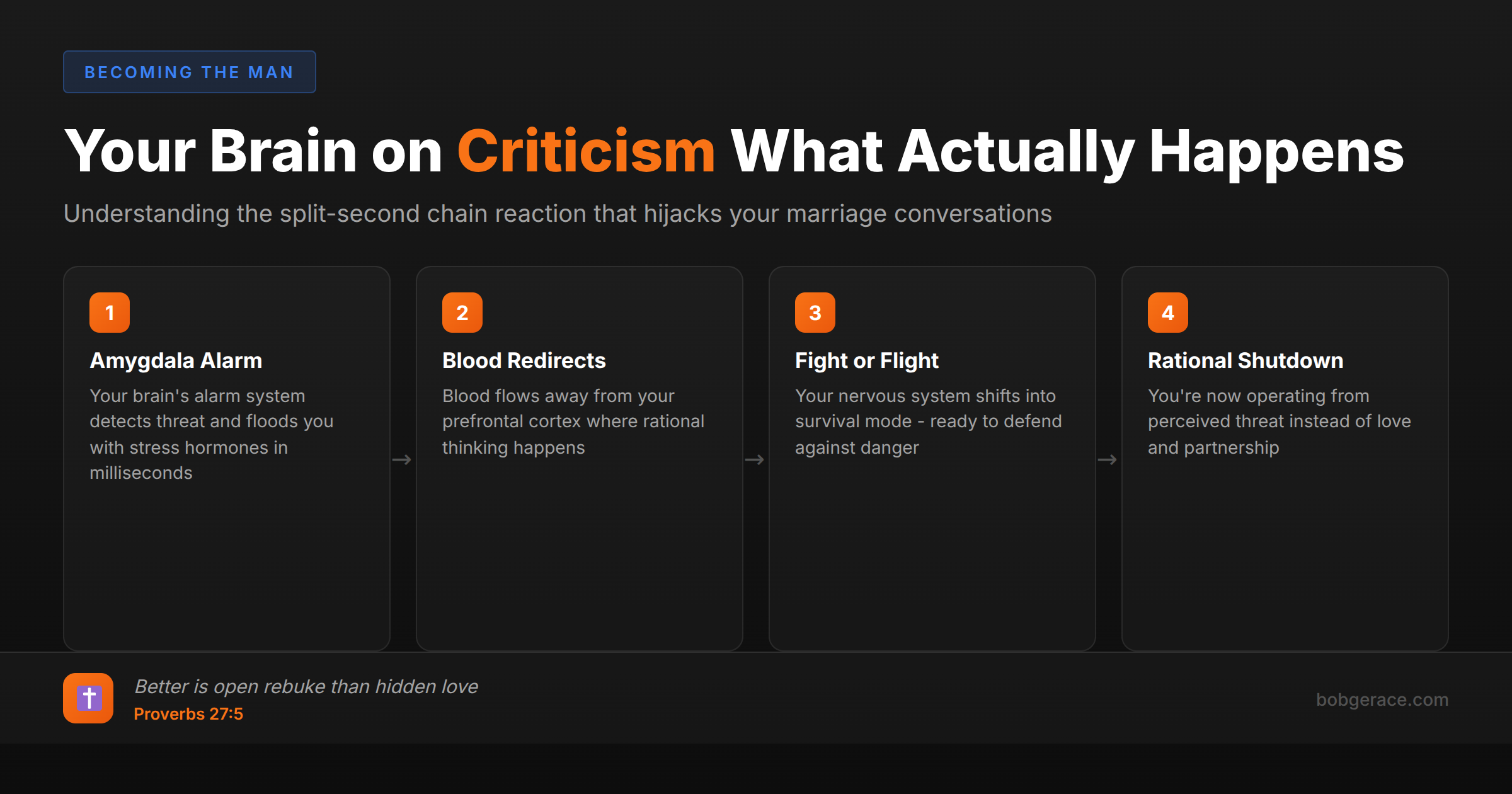
When you feel criticized, your brain's amygdala—the alarm system—detects a threat and triggers a cascade of stress hormones like cortisol and adrenaline. This happens in milliseconds, before your rational thinking brain can even process what's really being said. Your nervous system shifts into fight, flight, or freeze mode, preparing your body to defend against danger. This ancient survival mechanism doesn't distinguish between a saber-toothed tiger and your spouse's feedback about the dishes. Your heart rate spikes, blood flows away from your prefrontal cortex (where rational thinking happens), and you're suddenly operating from a place of perceived threat rather than love and partnership.
The Full Picture
Your brain is wired for survival, not for healthy marriage conversations. When criticism hits—real or perceived—you're dealing with millions of years of evolutionary programming designed to keep you alive.
Here's what's actually happening: Your amygdala acts like a smoke detector, constantly scanning for threats. When it perceives criticism, it sounds the alarm before your prefrontal cortex (your thinking brain) can evaluate whether the threat is real. This creates what neuroscientists call an "amygdala hijack."
The hypothalamus releases stress hormones—cortisol and adrenaline flood your system. Your sympathetic nervous system kicks in: heart rate increases, breathing becomes shallow, muscles tense, and blood flow shifts away from your digestive system and rational thinking centers toward your large muscle groups.
Meanwhile, your hippocampus (memory center) goes offline, which is why you might not remember exactly what was said during heated moments. Your brain literally can't form clear memories when it's in threat mode.
The vagus nerve, which controls your body's rest-and-digest response, gets suppressed. This is why it's so hard to feel connected, empathetic, or loving when you're feeling criticized—your nervous system is preparing for battle, not for bonding.
This isn't weakness or failure—it's biology. But understanding this gives you power to change your response. Your brain has neuroplasticity, meaning you can literally rewire these patterns with practice and intentionality.
What's Really Happening
In my practice, I see couples trapped in what I call the "criticism-defense loop," and neuroscience helps us understand why this pattern is so stubborn and destructive.
When your brain perceives criticism, it activates the same neural pathways as physical pain. Studies using fMRI scans show that social rejection and criticism light up the anterior cingulate cortex and the anterior insula—the exact same regions activated by physical injury. Your brain literally experiences criticism as a wound.
This explains why defensive responses feel so automatic and intense. Your dorsal anterior cingulate cortex is screaming "danger!" while your anterior insula processes the emotional pain. Meanwhile, activity in your medial prefrontal cortex—responsible for empathy and perspective-taking—decreases significantly.
The fascinating part is how quickly this happens. Dr. John Gottman's research shows that once your heart rate hits 100 beats per minute, you're physiologically flooded. At this point, your parasympathetic nervous system (rest and digest) is completely offline, and genuine listening or problem-solving becomes neurologically impossible.
Here's the hopeful news: neuroplasticity means these patterns aren't permanent. Through practices like mindfulness, self-compassion, and somatic awareness, you can strengthen your prefrontal cortex's ability to regulate the amygdala. You can literally grow new neural pathways that support connection rather than protection.
The key is recognizing that your defensive response isn't a character flaw—it's your nervous system doing exactly what it was designed to do. But with awareness and practice, you can teach your brain a new way to respond.
What Scripture Says
God's Word speaks directly to how we handle correction and conflict, acknowledging both our human tendencies and God's design for growth through relationships.
Proverbs 27:5-6 reminds us: *"Better is open rebuke than hidden love. Faithful are the wounds of a friend; profuse are the kisses of an enemy."* Even God's design acknowledges that correction can feel like wounding—but there's purpose in it.
Proverbs 15:32 challenges our defensive responses: *"Whoever ignores instruction despises himself, but he who listens to reproof gains intelligence."* Your brain's threat response might be automatic, but Scripture calls you to something higher—the wisdom that comes through receiving correction.
James 1:19 gives us the antidote to amygdala hijack: *"Know this, my beloved brothers: let every person be quick to hear, slow to speak, slow to anger."* This isn't just good advice—it's a neurological prescription for staying in your prefrontal cortex instead of your fight-or-flight response.
Proverbs 19:11 speaks to the power of self-regulation: *"Good sense makes one slow to anger, and it is his glory to overlook an offense."* The "good sense" Scripture refers to is exactly what happens when your thinking brain stays online instead of being hijacked by your emotional brain.
Ephesians 4:26-27 acknowledges that anger happens but gives boundaries: *"Be angry and do not sin; do not let the sun go down on your anger, and give no opportunity to the devil."* Even righteous anger needs to be processed through your prefrontal cortex, not your amygdala.
Philippians 2:3-4 calls us beyond our biological programming: *"Do nothing from selfish ambition or conceit, but in humility count others more significant than yourselves. Let each of you look not only to his own interests, but also to the interests of others."* This is only possible when we're not in survival mode.
God designed your brain's protective mechanisms, but He also calls you to growth that transcends those automatic responses.
What To Do Right Now
-
1
Notice your early warning signs - Learn to recognize the physical sensations before you're fully flooded: tension in your jaw, shallow breathing, or heat in your chest.
-
2
Use the 6-second rule - Neurochemically, the initial flood of stress hormones peaks and begins to recede within 6 seconds. Count slowly and breathe deeply.
-
3
Activate your vagus nerve - Take long, slow exhales (longer than your inhales), splash cold water on your face, or do gentle neck rolls to engage your parasympathetic nervous system.
-
4
Name what's happening - Say out loud: "I'm feeling criticized and my brain is in protection mode." This activates your prefrontal cortex and creates space between you and the reaction.
-
5
Ask for a pause - Tell your spouse: "I want to hear you, but I need 20 minutes to get my nervous system regulated first." Then actually use that time to calm down.
-
6
Practice the curious question - Instead of defending, ask: "Help me understand what you need from me" or "What would feel supportive to you right now?" This shifts your brain from threat-detection to problem-solving mode.
Related Questions
- Why does feedback feel like attack?
- What is 'rejection sensitivity' neurologically?
- How do I stay in prefrontal cortex during conflict?
- What does 'pause before responding' do neurologically?
- What's happening in my brain when I rage?
- What is 'amygdala hijack' and how do I interrupt it?
- What is 'betrayal trauma' and do I have it?
- What's happening to my nervous system right now?
- How do I not lose my mind right now?
Also find Bob on
Subscribe for weekly videos on Christian marriage.
Your Brain Under Fire Needs a Coach
Understanding the amygdala is one thing. Staying regulated when your wife brings up the dishes again—that's where a coach who knows your specific triggers makes the difference.
Talk to Bob →