What is 'automaticity' and how do behaviors become automatic?
6 min read
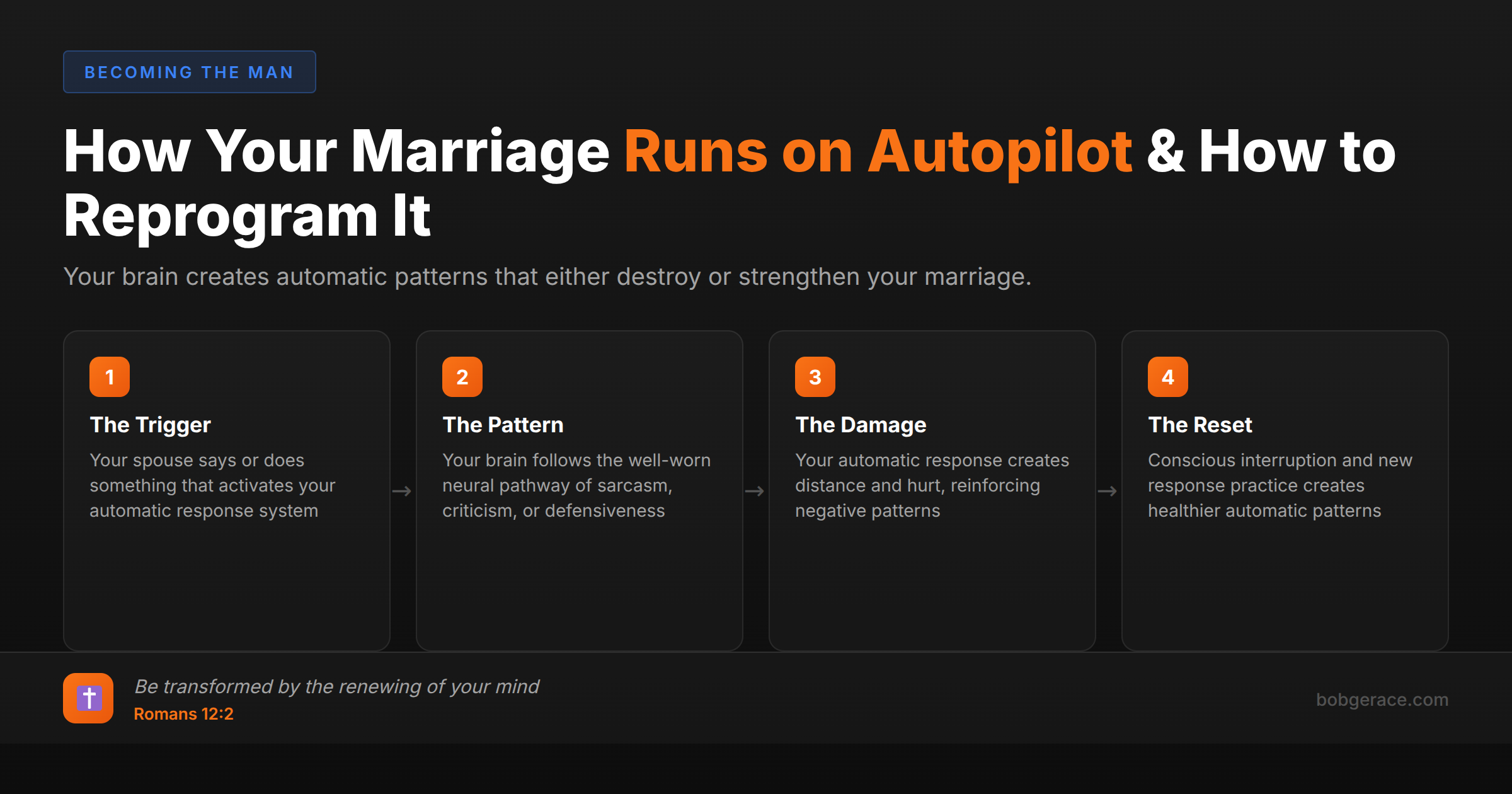
Automaticity is your brain's way of turning repeated behaviors into effortless habits that run without conscious thought. When you do something repeatedly, your brain creates neural pathways that become stronger each time, eventually requiring minimal mental energy to execute. In marriage, this explains why you might automatically respond to your spouse with sarcasm, defensiveness, or criticism - even when you don't want to. These responses became automatic through repetition. The good news? Understanding automaticity means you can intentionally create new, healthier patterns through consistent practice and conscious effort.
The Full Picture
Think of automaticity like a path through the woods. The first time someone walks through, they have to push through branches, step over logs, and carefully navigate. But after hundreds of people walk the same route, you get a clear, easy path that requires no thought to follow.
Your brain works the same way. Every time you repeat a behavior - whether it's brushing your teeth, driving to work, or responding defensively when your spouse raises a concern - you're strengthening that neural pathway. Eventually, these behaviors become so automatic that they happen before your conscious mind even realizes it.
This process involves several brain regions working together. The prefrontal cortex (your conscious decision-maker) is heavily involved when learning new behaviors. But as actions become automatic, control shifts to the basal ganglia, which handles routine behaviors with minimal conscious input.
Here's what makes this challenging in marriage: Many of your automatic responses were formed during times of stress, conflict, or emotional activation. Your brain essentially learned, "When this situation happens, this response keeps me safe." So now, whenever similar situations arise, that same response fires automatically.
The formation of automatic behaviors follows a predictable pattern: cue, routine, reward. Your spouse raises their voice (cue), you shut down emotionally (routine), and you avoid further conflict in the moment (reward). This cycle reinforces itself until the response becomes completely automatic.
Understanding this isn't about making excuses for harmful behaviors - it's about recognizing why change feels so difficult and why willpower alone isn't enough. Breaking automaticity requires consistent, intentional practice of new responses until they become the new automatic pattern.
What's Really Happening
From a clinical perspective, automaticity explains why couples often feel trapped in destructive cycles despite their genuine desire to change. The behaviors that cause the most damage in relationships are often the most automatic ones - criticism, defensiveness, stonewalling, or contempt.
Research shows that it takes an average of 66 days to form a new automatic habit, but breaking an existing automatic pattern while replacing it with a new one can take even longer. This is why couples need patience with themselves and each other during the change process.
The neuroplasticity principle gives us hope: your brain can form new pathways at any age. However, the old pathways don't disappear - they just become less dominant. This means that during times of stress, fatigue, or emotional overwhelm, you might default back to old automatic responses.
What I see clinically is that couples who successfully change automatic patterns do three things consistently: First, they develop awareness of their triggers and early warning signs. Second, they practice new responses during calm moments, not just during conflict. Third, they create environmental supports that make the new behavior easier and the old behavior harder.
The key insight for couples is that automatic behaviors aren't character flaws - they're learned responses that can be unlearned. But this requires moving from unconscious reactivity to conscious choice, which takes time, practice, and often professional support to navigate effectively.
What Scripture Says
Scripture speaks directly to the concept of automatic patterns, particularly regarding the transformation of our minds and hearts. Romans 12:2 calls us to "be transformed by the renewing of your mind," acknowledging that our default patterns of thinking and responding need intentional change.
Ephesians 4:22-24 describes this process: "Put off your old self, which is being corrupted by its deceitful desires; to be made new in the attitude of your minds; and to put on the new self, created to be like God in true righteousness and holiness." This isn't just about changing behavior - it's about rewiring our automatic responses to reflect Christ's character.
The Bible recognizes that we develop automatic patterns of sin. Jeremiah 13:23 asks, "Can an Ethiopian change his skin or a leopard its spots? Neither can you do good who are accustomed to doing evil." This verse acknowledges how deeply ingrained our patterns can become, but it's not hopeless - it's a call to rely on God's transforming power.
Galatians 5:16 gives us the solution: "Walk by the Spirit, and you will not gratify the desires of the flesh." Walking by the Spirit is about developing new automatic responses that align with God's character - patience instead of anger, kindness instead of harshness, self-control instead of reactivity.
Philippians 4:8 provides a blueprint for renewing our automatic thought patterns: "Whatever is true, whatever is noble, whatever is right, whatever is pure, whatever is lovely, whatever is admirable - if anything is excellent or praiseworthy - think about such things." This isn't just positive thinking - it's about training our minds to automatically focus on what builds up rather than what tears down.
God doesn't expect us to change automatic patterns through willpower alone. Philippians 2:13 reminds us that "it is God who works in you to will and to act in order to fulfill his good purpose." He provides both the desire and the power to develop new patterns that honor Him and bless our marriages.
What To Do Right Now
-
1
Identify your most destructive automatic response pattern in your marriage - write down the specific trigger, your typical response, and what happens next
-
2
Choose one specific new response you want to practice instead, and rehearse it mentally during calm moments throughout the day
-
3
Create a physical cue that can interrupt your automatic response - like taking three deep breaths or placing your hand on your heart
-
4
Practice the new response in low-stakes situations first, building the neural pathway when you're not emotionally activated
-
5
Ask your spouse to help you by pointing out (kindly) when you slip into the old automatic pattern, creating accountability
-
6
Track your progress for 30 days, celebrating small wins and adjusting your approach based on what you learn about your patterns
Related Questions
- What are 'neural pathways' and why do patterns persist?
- What is 'habit loop' and how do I interrupt it?
- Why does willpower fail under stress?
- What does it take to build new neural pathways?
- How do I change patterns that feel hardwired?
- How long does real change actually take?
- Why do old patterns come back when I'm triggered?
- What is 'neuroplasticity' and how do I leverage it?
- What is 'white-knuckling' vs. real transformation?
Also find Bob on
Subscribe for weekly videos on Christian marriage.
Your patterns aren't the textbook version
You know how automaticity works. A coach helps you see which specific loops are running in your marriage—and builds the reps that rewire them.
Talk to Bob →