Why does willpower fail under stress?
6 min read
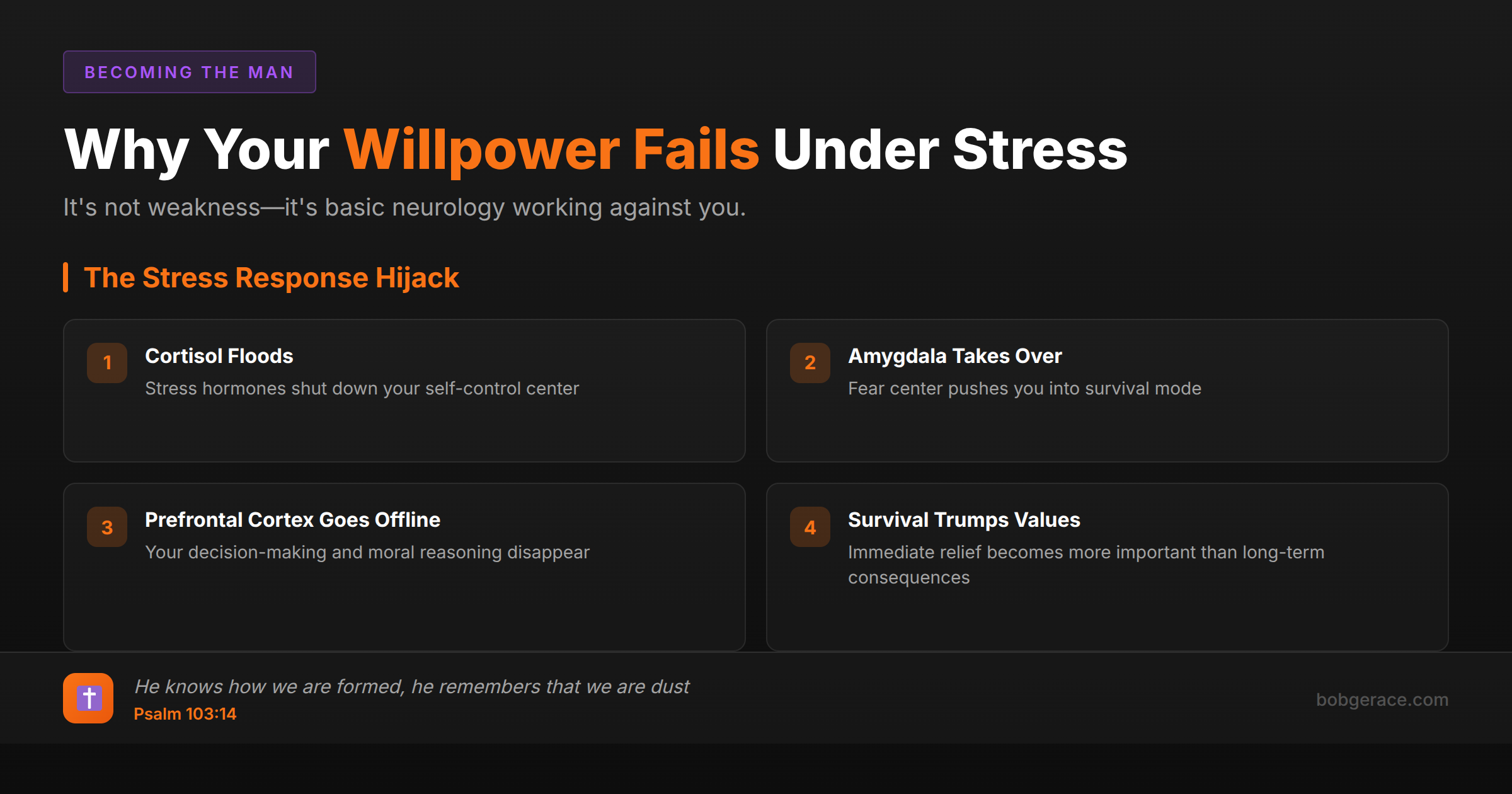
Willpower fails under stress because your brain literally hijacks your decision-making capacity. When stress hormones like cortisol flood your system, they shut down the prefrontal cortex—the part of your brain responsible for self-control, planning, and moral reasoning. Meanwhile, your amygdala (the fear center) takes over, pushing you into survival mode where immediate relief trumps long-term consequences. This isn't a character flaw—it's basic human neurology. Your brain prioritizes survival over values when it perceives threat. In marriage, this means the very moments when you most need wisdom and restraint are exactly when your brain is least equipped to provide them. Understanding this biological reality is the first step toward building better systems that work with your brain, not against it.
The Full Picture
Think of willpower like a muscle that gets fatigued—except it's more like a computer that gets its power cord yanked out. When stress hits, your brain doesn't just get tired; it literally changes which systems are online.
The Stress Response Cascade: When your brain perceives threat (real or imagined), it triggers a cascade of neurochemical changes. Stress hormones like cortisol and adrenaline flood your system, designed to help you fight a bear or run from danger. But in modern marriage, the "threats" are things like financial pressure, conflict with your spouse, or feeling criticized.
Your prefrontal cortex—the CEO of your brain—goes offline. This is the part that normally helps you pause, consider consequences, and choose responses aligned with your values. Meanwhile, your limbic system takes over, prioritizing immediate relief over long-term wisdom.
Why This Matters in Marriage: This explains why you can promise yourself you won't lose your temper, withdraw, or make that sarcastic comment—then do it anyway the moment things get heated. It's why financial stress makes you more likely to make impulsive purchases. It's why relationship conflict makes you want to escape into work, screens, or other distractions.
The Willpower Myth: Our culture teaches that strong people have strong willpower. But neuroscience reveals that successful people don't have better willpower—they build better systems. They create environments and practices that work with their brain's natural patterns instead of fighting against them.
What's Really Happening
In my practice, I see couples beating themselves up for willpower failures without understanding the neurobiological reality. When I explain the stress-willpower connection, it's often the first time they realize they're not broken—they're human.
The Depletion Effect: Research shows that self-control draws from a limited resource. Every decision you make, every impulse you resist, every stressor you manage depletes this reservoir. By evening, when many couples finally connect, your willpower tank is already empty. This is why you can be patient with coworkers all day but snap at your spouse over dinner.
Chronic Stress Changes Everything: When couples live in chronic stress—financial pressure, parenting demands, relationship tension—their brains adapt by keeping the stress response system chronically activated. This means the prefrontal cortex is consistently under-resourced, making willpower failures more frequent and recovery slower.
The Shame Spiral: Here's what makes it worse: when you fail to live up to your own standards, shame creates additional stress, further depleting your willpower. You get caught in a cycle where moral failure creates the exact brain state that makes more moral failure likely.
What Actually Helps: Successful couples learn to work with their neurology. They identify high-stress periods and lower their expectations for complex decision-making. They create external structure when internal structure is compromised. They practice self-compassion, which actually restores willpower faster than self-criticism. Most importantly, they stop trying to white-knuckle their way through and start building sustainable systems.
What Scripture Says
Scripture doesn't ignore the reality of human weakness—it acknowledges it and provides a framework for working with our limitations while relying on God's strength.
God Knows Our Frame: *"He knows how we are formed, he remembers that we are dust."* (Psalm 103:14) God isn't surprised by your willpower failures. He designed you as a finite being with real limitations. Understanding your neurology isn't making excuses—it's stewarding the brain God gave you with wisdom.
Strength in Weakness: *"But he said to me, 'My grace is sufficient for you, for my power is made perfect in weakness.'"* (2 Corinthians 12:9) Your willpower limitations aren't obstacles to God's work—they're opportunities to experience His strength. When you reach the end of your own capacity, you're positioned to discover supernatural resources.
The Spirit's Help: *"In the same way, the Spirit helps us in our weakness."* (Romans 8:26) The Holy Spirit doesn't condemn you for stress responses—He helps you in them. This includes giving you wisdom to create better systems and providing supernatural self-control when your natural reserves are depleted.
Practical Wisdom: *"The simple believe anything, but the prudent give thought to their steps."* (Proverbs 14:15) Biblical wisdom includes understanding how you function and planning accordingly. It's prudent to recognize that you're more vulnerable to poor choices under stress and to build safeguards accordingly.
Renewal and Rest: *"Come to me, all you who are weary and burdened, and I will give you rest."* (Matthew 11:28) Jesus offers rest that goes beyond physical sleep—it's the deep restoration that comes from knowing you're loved regardless of your performance.
What To Do Right Now
-
1
Identify your stress triggers - List the top 3 situations where you consistently struggle with self-control in your marriage
-
2
Lower the bar during high stress - When you're under pressure, commit to basic kindness rather than demanding peak performance from yourself
-
3
Create external structure - Build systems and boundaries that don't depend on willpower (like automatic savings or phone-free zones)
-
4
Practice the pause - When stressed, take 3 deep breaths to help your prefrontal cortex come back online before responding
-
5
Schedule recovery time - Build regular periods of genuine rest into your week to replenish your willpower reserves
-
6
Replace shame with curiosity - When you fail, ask 'What was happening in my brain?' instead of 'What's wrong with me?'
Related Questions
Ready to Build Systems That Actually Work?
Stop fighting your brain and start working with it. Let's create sustainable strategies for your unique situation.
Get Help Now →