What is the Book of Job teaching?
6 min read
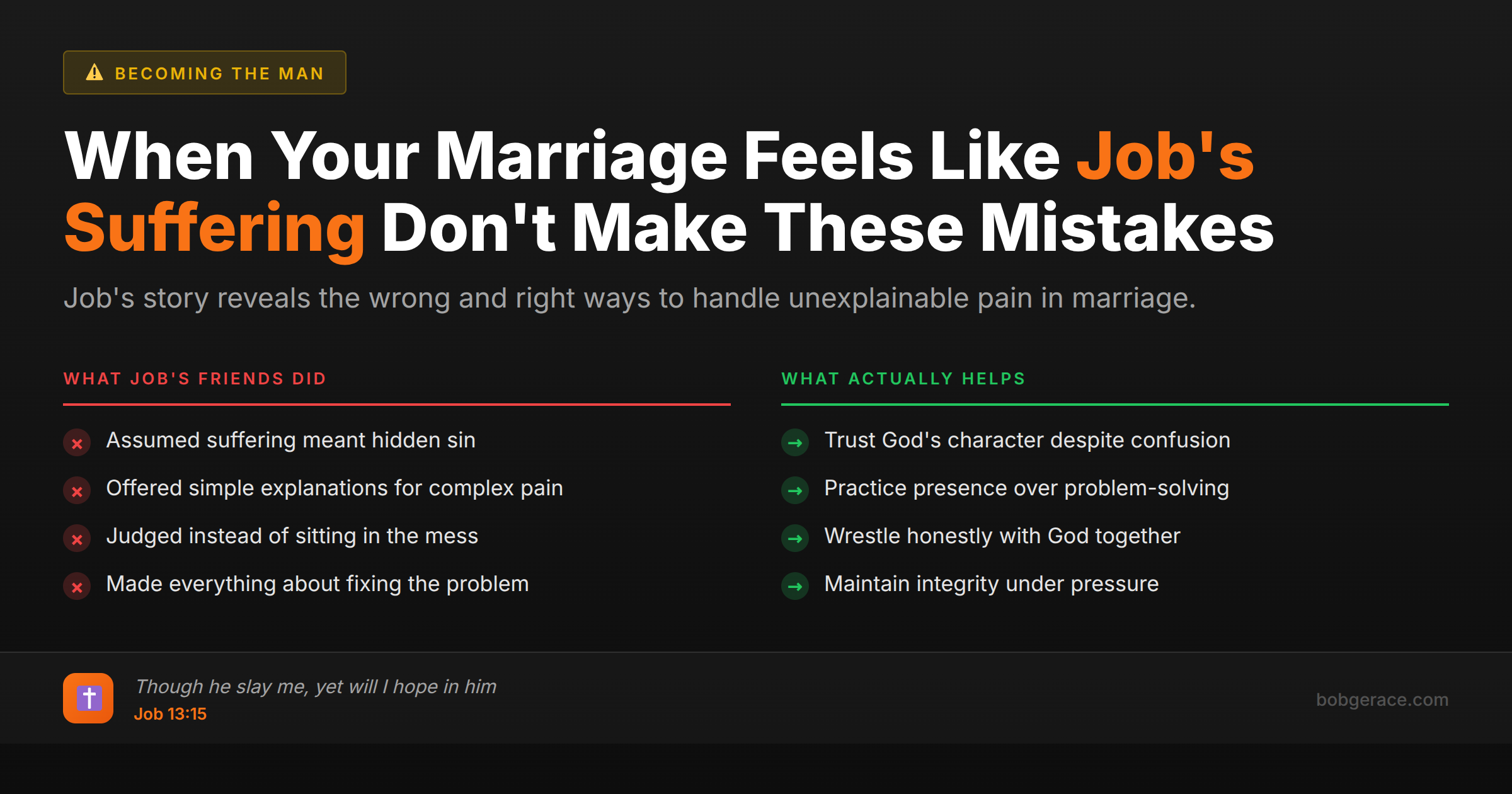
The Book of Job teaches us that suffering isn't always punishment for sin, and that God's ways often transcend our human understanding. Job, a righteous man, loses everything yet maintains his faith despite not knowing why. The book reveals that sometimes we suffer not because we've done wrong, but because we live in a fallen world where pain is inevitable. For marriages, Job's story shows us that trials can either drive us toward God or away from Him. The key lesson isn't that we'll always understand our circumstances, but that we can trust God's character even when His purposes remain hidden. Job ultimately encounters God personally and finds peace not in explanations, but in relationship.
The Full Picture
The Book of Job tackles one of humanity's oldest questions: Why do good people suffer? This isn't just an academic exercise—it's the cry of every spouse watching their marriage crumble despite their best efforts, every parent losing a child, every faithful person facing inexplicable hardship.
Job was blameless and upright, yet lost his children, wealth, and health in rapid succession. His friends insisted he must have sinned, reflecting the common belief that suffering always results from wrongdoing. Job knew better. He maintained his innocence while wrestling with profound questions about God's justice.
The book unfolds in several movements: Job's initial loss and faithful response, his wife's bitter counsel to "curse God and die," his friends' misguided attempts at comfort through accusation, Job's passionate defense of his integrity, and ultimately God's overwhelming response from the whirlwind.
What's revolutionary about Job is that it dismantles simplistic theology. Life isn't a cosmic vending machine where good input guarantees good output. Sometimes the most faithful people experience the deepest pain. Sometimes marriages built on biblical principles still face devastating challenges.
The book doesn't provide easy answers but instead invites us into mystery and relationship. Job never learns about the cosmic conversation between God and Satan that initiated his trials. He doesn't get explanations—he gets encounter. In the end, Job declares, "My ears had heard of you but now my eyes have seen you."
For couples navigating marriage difficulties, Job teaches that faithfulness doesn't guarantee smooth sailing, but it does guarantee God's presence in the storm. Sometimes our greatest growth comes not through answered prayers but through deepened relationship with the One who allows the questions to remain while drawing us closer to Himself.
What's Really Happening
From a therapeutic perspective, Job demonstrates several crucial psychological and relational dynamics that apply directly to marriage counseling. First, we see the profound impact of secondary trauma—how Job's wife and friends' responses to his suffering created additional layers of pain. This mirrors what happens in struggling marriages when external voices amplify rather than alleviate distress.
Job's friends exemplify what we call toxic positivity and premature problem-solving. Instead of sitting with Job in his pain, they immediately moved to diagnosis and cure. Healthy marriage relationships require the capacity to bear witness to suffering without immediately rushing to fix or explain it away. Sometimes the most healing thing we can do is simply remain present with our spouse's pain.
The book also illustrates post-traumatic growth—the phenomenon where individuals develop greater resilience, deeper relationships, and expanded worldview through surviving significant adversity. Job emerges from his trials with greater intimacy with God and renewed perspective on what truly matters. Many couples I work with discover that their marriage's greatest challenges become catalysts for unprecedented intimacy and strength.
Crucially, Job maintains his agency throughout his ordeal. He doesn't passively accept platitudes but actively wrestles with his circumstances. Healthy coping involves engagement, not resignation. In marriage, this means couples can honor their pain while actively working toward healing, refusing both denial and despair.
Finally, Job's restoration comes through relationship and community. His healing involves not just material blessing but renewed connection with family and friends. Marriage recovery similarly requires both individual growth and relational repair, often supported by wise community that can offer presence without premature solutions.
What Scripture Says
Scripture consistently acknowledges that suffering and faithfulness can coexist. Job 1:1 establishes Job's character: "This man was blameless and upright; he feared God and shunned evil." Yet this righteous man faced devastating loss, proving that personal holiness doesn't immunize us from hardship.
Job 13:15 captures the heart of biblical faith under pressure: "Though he slay me, yet will I hope in him; I will surely defend my ways to his face." This isn't passive resignation but active trust that refuses to abandon God even when circumstances seem to contradict His goodness. In marriage, this translates to maintaining commitment to biblical principles even when outcomes disappoint.
Job 38:4 begins God's response: "Where were you when I laid the earth's foundation? Tell me, if you understand." God doesn't provide explanations but reveals His transcendence and sovereignty. Sometimes in marriage, we must trust God's character when His methods remain mysterious.
James 5:11 reflects on Job's legacy: "We consider blessed those who have persevered. You have heard of Job's perseverance and have seen what the Lord finally brought about. The Lord is full of compassion and mercy." God's ultimate purpose involves our good, even when the process is painful.
Romans 8:28 echoes this truth: "And we know that in all things God works for the good of those who love him, who have been called according to his purpose." This doesn't mean all things are good, but that God works within all circumstances for ultimate good.
Job 42:5 records Job's final testimony: "My ears had heard of you but now my eyes have seen you." True resolution comes not through intellectual understanding but through deepened relationship with God, who meets us in our darkest moments.
What To Do Right Now
-
1
Reject simple cause-and-effect thinking - Stop assuming marriage problems always indicate personal failure or lack of faith
-
2
Practice presence over problem-solving - Learn to sit with your spouse's pain without immediately trying to fix or explain it
-
3
Maintain your integrity under pressure - Continue doing what's right even when circumstances discourage faithfulness
-
4
Wrestle honestly with God - Bring your questions and frustrations directly to Him rather than stuffing or avoiding them
-
5
Seek community that offers presence - Find friends who can bear witness to your struggle without rushing to premature solutions
-
6
Look for God's character in the chaos - Focus on who God is rather than demanding explanations for what He allows
Related Questions
- Why does God allow marital suffering?
- What is the difference between God's will and God's permission?
- What does 'all things work together for good' mean?
- Is suffering always discipline?
- What is the purpose of pain in God's economy?
- How do I trust a God who let this happen?
- Is God punishing me?
- Is my suffering redemptive?
- How do I know God's will in this?
- Does God care about my marriage?
Also find Bob on
Subscribe for weekly videos on Christian marriage.
Bring Your Story to a Coach
You're not Job, and your marriage isn't a parable. A coach who knows your specific situation can help you apply what's true without guessing alone.
Talk to Bob →