Is suffering always discipline?
6 min read
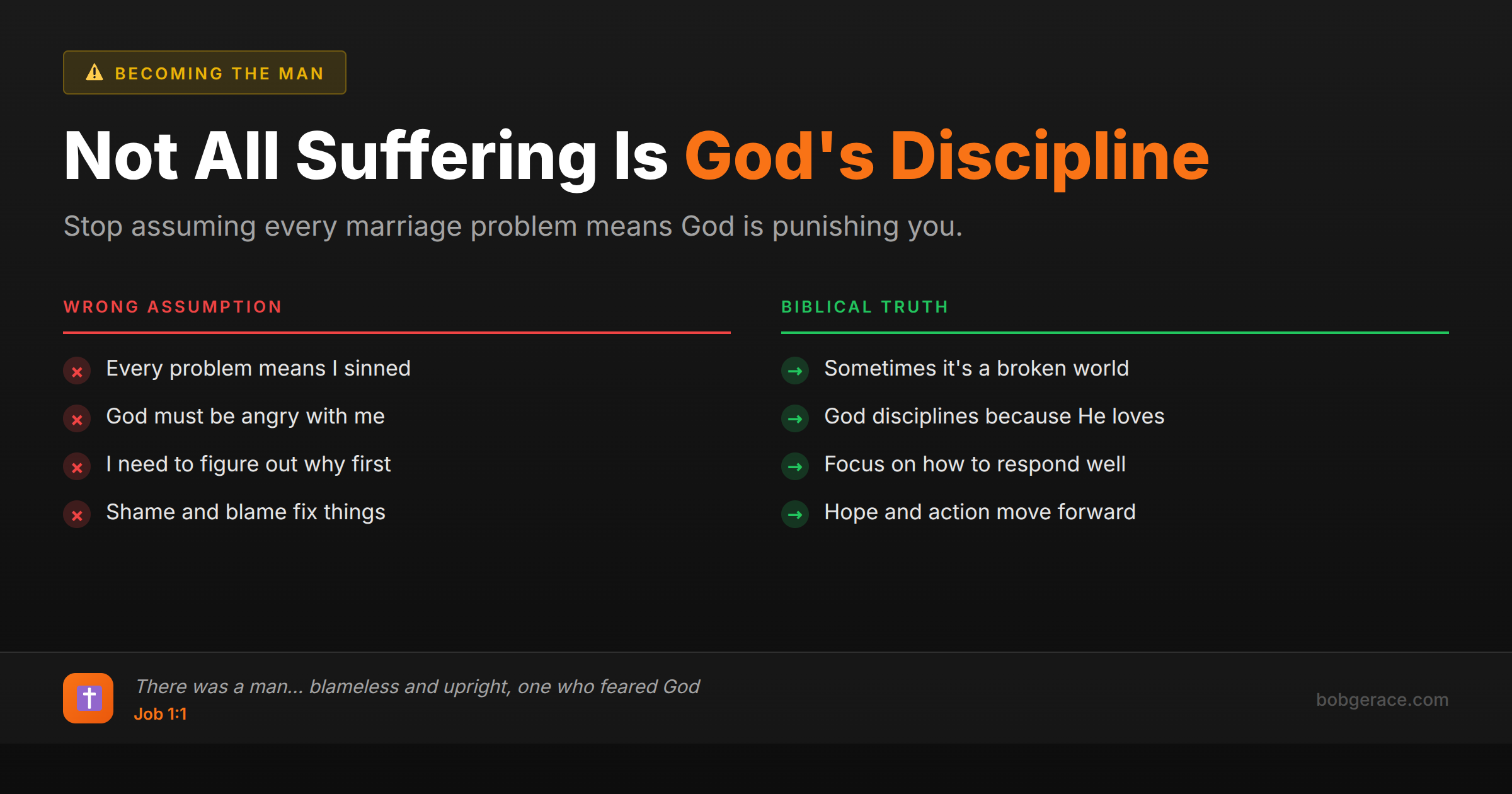
No, suffering is not always discipline from God. While Scripture clearly teaches that God does discipline His children (Hebrews 12:6), suffering serves multiple purposes in the Christian life. Sometimes it's for our growth, sometimes it's a consequence of living in a broken world, and sometimes it's to bring glory to God through our response. The key isn't determining why you're suffering, but how you'll respond to it. In marriage, this distinction matters because wrongly assuming all problems are God's discipline can lead to shame, blame, and spiritual paralysis instead of the hope and action that move relationships forward.
The Full Picture
Here's what most Christians get wrong about suffering: they assume it's always about something they did wrong. That's not biblical thinking—that's religious guilt masquerading as spirituality.
Suffering has multiple sources and purposes in Scripture:
- Natural consequences of living in a fallen world (Romans 8:22) - Divine discipline for correction and growth (Hebrews 12:5-11) - Spiritual warfare and opposition to God's purposes (Ephesians 6:12) - Testing and refinement of faith (1 Peter 1:6-7) - Opportunities to display God's power and glory (John 9:1-3) - Preparation for future ministry and compassion (2 Corinthians 1:3-4)
In marriage, this matters enormously. When couples assume every conflict, financial struggle, or season of disconnection is God's discipline, they often become passive victims instead of active participants in their healing. They wait for God to remove the suffering instead of asking how He wants them to respond to it.
The healthiest couples I work with understand this distinction. They don't waste energy trying to figure out if their struggles are "discipline" or "testing" or "warfare." Instead, they focus on responding with faith, wisdom, and action regardless of the source.
This doesn't mean ignoring genuine sin or areas needing repentance. It means approaching suffering with the same heart God has—one that sees beyond the immediate pain to the deeper work He's doing in and through your marriage.
What's Really Happening
From a therapeutic perspective, the belief that all suffering equals divine discipline creates what we call "learned helplessness"—a psychological state where people stop taking healthy action because they believe they're powerless to change their circumstances.
I see this frequently with Christian couples who've been taught that marital struggles are always the result of spiritual failure. They become hyper-focused on finding the "sin" causing their problems instead of developing practical relationship skills. This creates a cycle: they experience normal marital challenges, assume it's discipline, become paralyzed by spiritual introspection, fail to take constructive action, and then experience more problems as a result.
Healthier couples understand what researchers call "attribution theory"—how we explain the causes of events affects our emotional and behavioral responses. When couples attribute every difficulty to divine discipline, they often respond with shame, withdrawal, or spiritual performance rather than connection, communication, and collaborative problem-solving.
The most resilient couples I work with practice what I call "faithful pragmatism." They honor God's sovereignty while taking personal responsibility for their choices and actions. They pray and seek wisdom, but they also learn communication skills, set healthy boundaries, and make practical changes. They understand that God often works through natural means—including therapy, education, and intentional relationship practices—rather than only supernatural intervention.
This balanced approach reduces anxiety, increases hope, and empowers couples to be active partners with God in their healing process.
What Scripture Says
Scripture gives us multiple examples of suffering that isn't disciplinary:
Job's suffering wasn't caused by his sin, but was permitted to display God's faithfulness: *"There was a man in the land of Uz whose name was Job, and that man was blameless and upright, one who feared God and turned away from evil"* (Job 1:1). God Himself declared Job righteous before his trials began.
Jesus clarified that not all suffering indicates wrongdoing: *"And his disciples asked him, 'Rabbi, who sinned, this man or his parents, that he was born blind?' Jesus answered, 'It was not that this man sinned, or his parents, but that the works of God might be displayed in him'"* (John 9:2-3).
Paul's thorn wasn't discipline but a tool for spiritual maturity: *"So to keep me from becoming conceited because of the surpassing greatness of the revelations, a thorn was given me in the flesh, a messenger of Satan to harass me, to keep me from becoming conceited"* (2 Corinthians 12:7).
Peter teaches that some suffering comes simply from doing good: *"But even if you should suffer for righteousness' sake, you will be blessed. Have no fear of them, nor be troubled"* (1 Peter 3:14).
James explains that testing produces spiritual maturity: *"Count it all joy, my brothers, when you meet trials of various kinds, for you know that the testing of your faith produces steadfastness"* (James 1:2-3).
Paul reveals suffering's redemptive purpose: *"Blessed be the God and Father of our Lord Jesus Christ, the Father of mercies and God of all comfort, who comforts us in all our affliction, so that we may be able to comfort those who are in any affliction"* (2 Corinthians 1:3-4).
What To Do Right Now
-
1
Stop trying to decode why you're suffering and start asking how God wants you to respond to it
-
2
Examine your marriage for genuine areas needing repentance, but don't assume every problem indicates sin
-
3
Take practical action alongside your prayers—God often works through natural means and wisdom
-
4
Focus on character development and spiritual growth regardless of suffering's source or purpose
-
5
Seek godly counsel and professional help when needed instead of waiting for supernatural intervention
-
6
Remember that faithful response to suffering—not perfect understanding of its cause—pleases God
Related Questions
- Why does God allow marital suffering?
- What is the difference between God's will and God's permission?
- What does 'all things work together for good' mean?
- What is the purpose of pain in God's economy?
- Does God cause marital crisis or allow it?
- Is my suffering redemptive?
- Is God punishing me?
- How do I trust a God who let this happen?
- What is the Book of Job teaching?
- Does God want me to stay in this marriage?
Also find Bob on
Subscribe for weekly videos on Christian marriage.
Your Marriage Needs More Than Theory
A coach who knows your specific story can help you discern what's actually happening in your relationship and what faithful response looks like for you right now.
Talk to Bob →