How do I respond to escalation without escalating?
5 min read
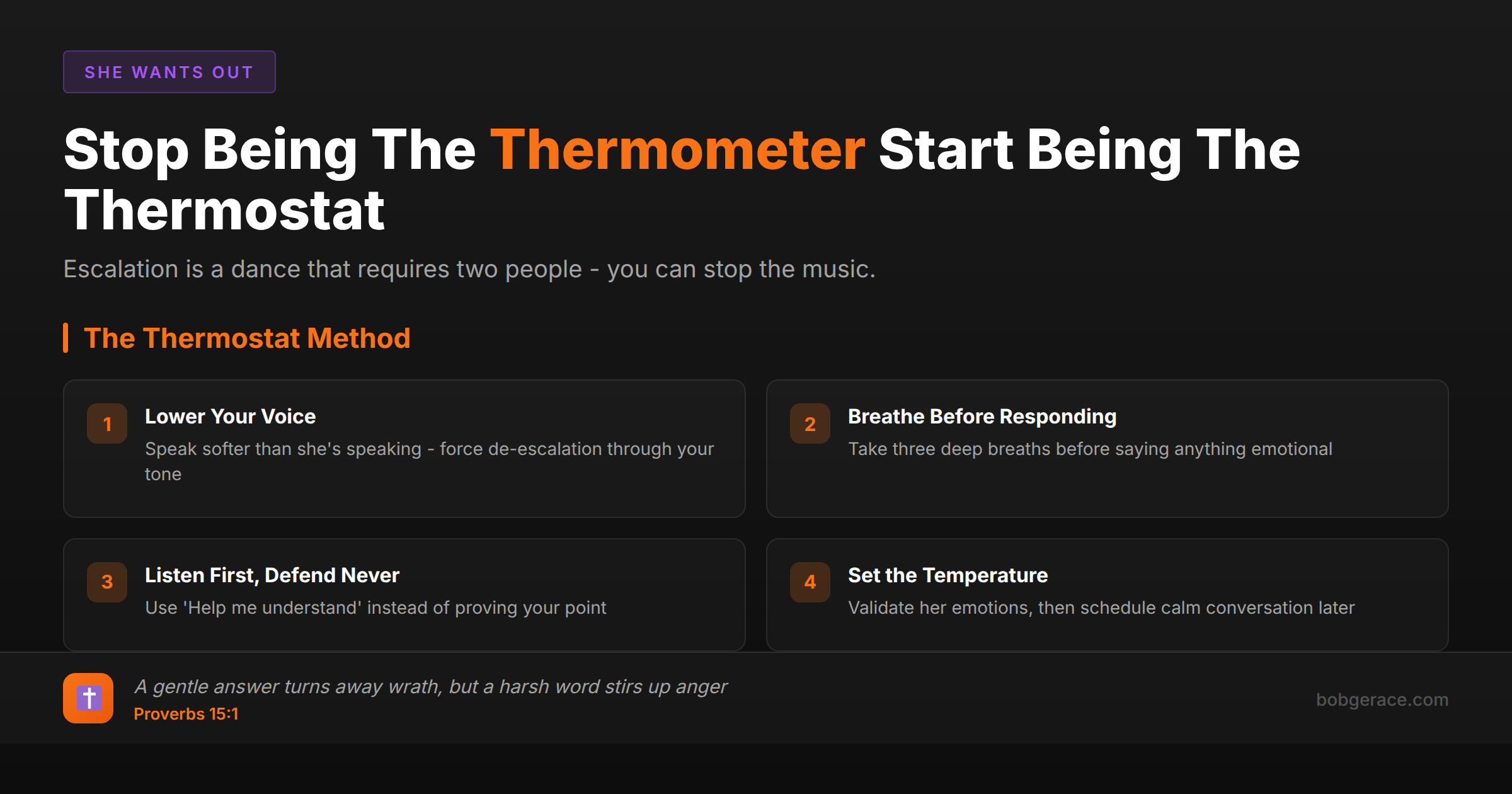
When your wife escalates, your natural instinct is to match her energy or defend yourself. But here's the truth: escalation is a dance that requires two people. You can stop the dance by refusing to participate. The key is to lower your voice, slow your breathing, and resist the urge to prove your point in that moment. This doesn't mean you become a doormat or stuff your feelings. It means you recognize that heated emotions make productive conversation impossible. Your job is to become the thermostat, not the thermometer. You set the temperature instead of just reflecting it back. This takes incredible strength and self-control, but it's often the circuit breaker that saves your marriage.
The Full Picture
Escalation is predictable. It follows the same pattern every time: trigger, emotional spike, reaction, counter-reaction, explosion. Most men get caught in this cycle because they focus on being right instead of being effective. You see your wife getting upset and your brain goes into defense mode. You either fight back or shut down, both of which pour gasoline on the fire.
The escalation trap is thinking that you have to respond in the moment. Your wife says something that feels unfair, and you feel this urgency to correct the record immediately. But here's what I've learned from hundreds of marriages: the middle of escalation is never the time for truth-telling or problem-solving.
Common mistakes men make: • Trying to logic their way out of emotional conversations • Matching her volume and intensity • Bringing up past grievances as ammunition • Using phrases like "you always" or "you never" • Explaining why she shouldn't feel what she's feeling
The power of de-escalation isn't just about avoiding fights. When you consistently respond to her escalation with calm strength, you're showing her a different way to engage. You're modeling emotional regulation. You're creating safety in the relationship. Most importantly, you're breaking generational patternss that probably played out in both your families growing up.
This is leadership. Real masculine leadership isn't about winning arguments or having the last word. It's about creating an environment where both people can be heard and understood. When you refuse to escalate, you're taking responsibility for the emotional climate of your marriage.
What's Really Happening
From a neurological perspective, escalation triggers our amygdala - the brain's alarm system. When this happens, the prefrontal cortex (our reasoning center) goes offline. This is why logical arguments during heated moments are ineffective. Your wife's escalation often stems from feeling unheard, unsafe, or disconnected.
Research shows that it takes approximately 20 minutes for stress hormones to metabolize after emotional activation. This is why immediate problem-solving rarely works. The Gottman Institute's research identifies four horsemen of relationship apocalypse: criticism, contempt, defensiveness, and stonewalling. Escalation typically involves at least two of these patterns.
Attachment theory provides crucial insight here. When your wife escalates, she may be experiencing attachment panic - a primal fear of abandonment or disconnection. Your calm, consistent presence during these moments can actually rewire her nervous system over time, creating new neural pathways associated with safety and security.
The physiological component cannot be ignored. During escalation, both partners experience increased heart rate, elevated cortisol, and muscle tension. Your ability to regulate your own nervous system through controlled breathing, grounding techniques, and mindful awareness creates what we call "co-regulation" - your calm nervous system helps regulate hers.
Trauma-informed perspective: Many escalation patterns are rooted in childhood experiences. When you respond with consistent emotional safety rather than reactivity, you're providing a corrective emotional experience that can heal old wounds.
What Scripture Says
Scripture gives us a clear blueprint for responding to escalation. Proverbs 15:1 tells us, "A gentle answer turns away wrath, but a harsh word stirs up anger." This isn't just good advice - it's a spiritual principle about the power of our response to transform situations.
James 1:19 instructs us to be "quick to listen, slow to speak and slow to become angry." Notice the order: listen first, speak second, anger last. Most men reverse this order during conflict. We get angry first, speak second, and listen last (if at all).
Proverbs 17:14 warns that "Starting a quarrel is like breaching a dam; so drop the matter before a dispute breaks out." This verse recognizes that we have a choice point before escalation takes over. We can choose to engage differently.
Ephesians 4:26-27 says, "In your anger do not sin: Do not let the sun go down while you are still angry, and do not give the devil a foothold." This acknowledges that anger itself isn't sin, but what we do with it can be. Escalation gives the enemy a foothold in our marriages.
1 Peter 3:7 calls husbands to treat their wives "with respect as the weaker partner and as heirs with you of the gracious gift of life, so that nothing will hinder your prayers." This isn't about physical weakness - it's about recognizing that our wives may be more emotionally sensitive, and we're called to honor that sensitivity rather than bulldoze through it.
Galatians 5:22-23 reminds us that self-control is a fruit of the Spirit. De-escalation is actually a spiritual discipline that develops our character and reflects Christ's nature.
What To Do Right Now
-
1
Lower your voice deliberately - speak softer than she's speaking
-
2
Take three deep breaths before responding to anything emotional
-
3
Use phrases like 'Help me understand' instead of 'You're wrong'
-
4
Create physical space if needed - 'I need a moment to process this'
-
5
Validate her emotions before addressing the content - 'I can see you're really upset'
-
6
Set a specific time to revisit the conversation - 'Let's talk about this at 7pm when we're both calmer'
Related Questions
- How do I slow the process without obstructing?
- How do I protect myself without escalating?
- What's the difference between fighting for marriage and fighting in court?
- How do I stay grounded when everything feels adversarial?
- How do I not let lawyers poison what's left?
- How do I show up as my best self when the system incentivizes my worst?
- How do I hear her without defending myself?
- How do I stay in prefrontal cortex during conflict?
- What does non-defensive response look like?
- How do I hold tension without collapsing or attacking?
Also find Bob on
Subscribe for weekly videos on Christian marriage.
Your Marriage Has Its Own Pattern
A coach who knows your specific triggers and your wife's escalation style can help you interrupt the cycle before it starts. You don't have to figure out every fight alone.
Talk to Bob →