What does 'leaning out' behavior look like?
6 min read
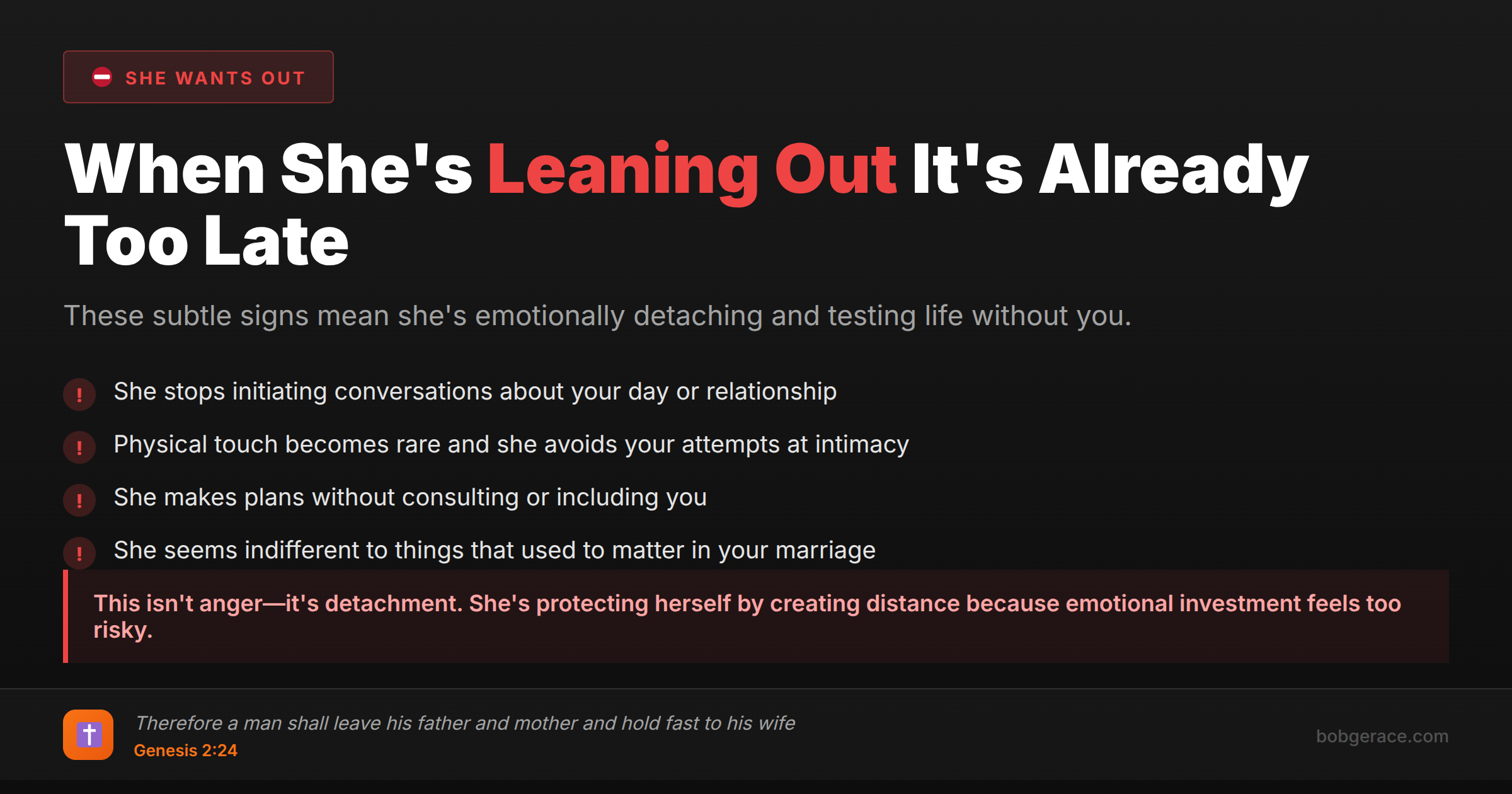
Leaning out is when your wife starts pulling back emotionally, physically, and mentally from the marriage. It's not dramatic—it's gradual and often subtle. You'll notice she stops initiating conversations, avoids physical touch, makes plans without including you, and seems indifferent to things that used to matter to her about your relationship. This isn't the silent treatment or anger—it's worse. It's detachment. She's protecting herself by creating distance because staying emotionally invested feels too risky or painful. When a wife leans out, she's often testing what life might feel like without you, even if she hasn't consciously decided to leave yet.
The Full Picture
Leaning out behavior manifests in multiple areas of your marriage, and recognizing these patterns is crucial for understanding where you stand.
Emotional Withdrawal: • She stops sharing her day, thoughts, or feelings with you • Conversations become purely functional—schedules, kids, logistics • She no longer seeks your opinion on decisions big or small • Her responses are short, polite, but lacking warmth or engagement • She stops getting upset about things that used to bother her about you
Physical Distance: • Minimal physical affection—no casual touches, hugs, or kisses • She creates physical space on the couch, in bed, or while walking • Sexual intimacy becomes rare or feels obligatory when it happens • She avoids situations where physical closeness might naturally occur
Social and Practical Separation: • She makes plans without consulting you or including you • She develops new friendships or strengthens existing ones where you're not involved • She handles finances, household decisions, or parenting choices independently • She talks about 'her' future plans rather than 'our' plans • She becomes more invested in work, hobbies, or activities outside the marriage
The Danger Zone: The most concerning aspect of leaning out is that it often looks peaceful on the surface. There's less conflict because she's stopped fighting for the relationship. Many men mistake this for improvement, but it's actually the opposite. When she stops caring enough to fight, she's emotionally preparing for life without you.
This behavior typically develops over months or years of feeling unheard, undervalued, or emotionally neglected. By the time you recognize it, she may have already grieved the loss of the marriage in her heart.
What's Really Happening
From a clinical perspective, leaning out represents a protective psychological mechanism called emotional detachment. When someone experiences chronic disappointment or emotional injury in their primary relationship, their nervous system begins to adapt by reducing emotional investment as a form of self-preservation.
Research on attachment theory shows us that this withdrawal pattern often develops when an individual's bids for connection are consistently ignored or rejected. Dr. John Gottman's work demonstrates that when emotional bids go unmet, partners begin to 'turn away' from each other, creating what he calls emotional distance and isolation.
Neurologically, what's happening is fascinating and concerning. The brain starts to rewire itself to expect disappointment rather than connection from the spouse. The neural pathways associated with seeking comfort and intimacy from their partner begin to weaken, while pathways associated with self-reliance and emotional independence strengthen.
This process typically follows a predictable pattern: protest (fighting for the relationship), then despair (depression and sadness about the state of the marriage), and finally detachment (emotional numbing and withdrawal). By the time a wife is exhibiting leaning out behaviors, she's likely in the detachment phase.
What makes this particularly challenging is that the leaning out spouse often reports feeling relief from this emotional distance. The constant cycle of hope and disappointment has ended, replaced by a sense of emotional safety through disconnection. This neurobiological shift means that re-engaging requires significant intentional effort and often professional intervention to rebuild those damaged neural pathways of connection and trust.
What Scripture Says
Scripture speaks directly to the importance of emotional and physical closeness in marriage, and warns against the dangers of emotional withdrawal.
Genesis 2:24 tells us, "Therefore a man shall leave his father and mother and hold fast to his wife, and they shall become one flesh." This oneness isn't just physical—it's emotional and spiritual unity. When a wife leans out, this fundamental design is being violated, often because that unity has been neglected or damaged.
Malachi 2:14 reminds us that God is a witness to our marriage covenant: "She is your companion and your wife by covenant." The word 'companion' implies active partnership and emotional connection. Leaning out behavior signals that this companionship has been lost.
1 Corinthians 7:3-4 instructs both spouses: "The husband should give to his wife her conjugal rights, and likewise the wife to her husband. For the wife does not have authority over her own body, but the husband does. Likewise the husband does not have authority over his own body, but the wife does." This mutual giving extends beyond physical intimacy to emotional availability and presence.
Ephesians 5:25 commands husbands to "love your wives as Christ loved the church and gave himself up for her." Christ's love is pursuing, sacrificial, and persistent. When a wife leans out, it's often because she hasn't experienced this kind of love consistently.
Ecclesiastes 4:12 warns us that "a threefold cord is not quickly broken," but also implies that a two-strand cord is vulnerable. When emotional connection is severed, the marriage becomes fragile.
God's design for marriage includes both partners actively pursuing oneness. Leaning out behavior, while understandable as a protective response, moves against this design and requires intentional effort to restore the connection God intended.
What To Do Right Now
-
1
Document specific behaviors you've observed without confronting her yet—you need clarity on the full scope
-
2
Stop trying to force connection through grand gestures or dramatic conversations that will likely push her further away
-
3
Begin consistently doing small, thoughtful things that demonstrate attentiveness without expecting immediate response or appreciation
-
4
Create safe opportunities for low-pressure interaction—cooking together, walking, or shared activities without relationship talk
-
5
Address any obvious issues in your own behavior that may have contributed to her withdrawal—anger, neglect, criticism, or emotional unavailability
-
6
Seek professional help immediately if leaning out behaviors have been present for more than a few months—this pattern rarely reverses without intervention
Related Questions
- What stage of decision is she in?
- How do I read her actions vs. her words?
- What is 'the point of no return' and is she past it?
- Why is she creating facts on the ground?
- Is this still a negotiation or is this execution?
- What does her involving others mean?
- What is 'emotional disengagement'?
- Is her shutdown protective or permanent?
- What are Gottman's signs of 'turning away'?
Also find Bob on
Subscribe for weekly videos on Christian marriage.
Your Marriage Needs a Coach Today
Leaning out doesn't reverse on its own—and the next 30 days matter. Bob works with men whose wives are already detaching. He'll calibrate to where your marriage actually is right now.
Talk to Bob →