Why did God say 'it's not good for man to be alone'?
6 min read
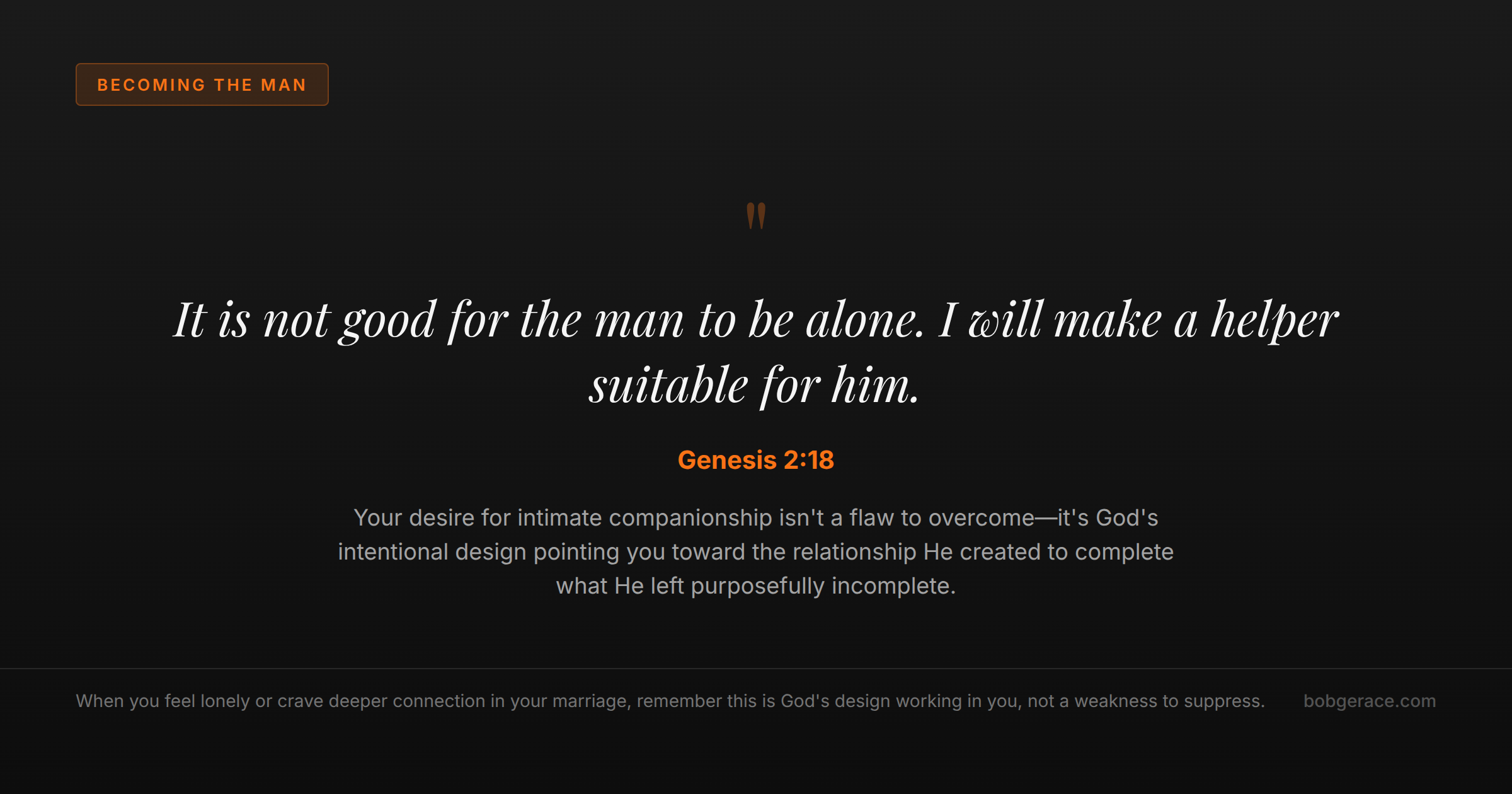
When God declared in Genesis 2:18 that 'it is not good for man to be alone,' He wasn't making a casual observation—He was revealing something fundamental about human nature and His divine design. This statement comes after God had repeatedly called His creation 'good,' making this the first time something was declared 'not good.' God wasn't caught off guard or fixing a mistake. He was highlighting that humans are created for relationship, intimacy, and companionship. This divine assessment points to our inherent need for connection that goes beyond friendship or casual relationship. God designed marriage as the primary earthly relationship that mirrors the intimate communion He desires with us. The Hebrew word 'alone' here suggests incompleteness—not inadequacy, but a designed incompleteness that finds its fulfillment in the union of marriage, ultimately pointing us toward our need for God Himself.
The Full Picture
Understanding why God said 'it's not good for man to be alone' requires us to see the bigger theological picture. This wasn't God scrambling to fix a design flaw—it was God revealing His intentional plan for human flourishing and spiritual growth.
The Context of Creation
Up to this point in Genesis, everything God created was declared 'good.' The light was good, the separation of waters was good, the dry land was good—everything was functioning according to God's perfect design. But then comes this jarring statement: 'It is not good for man to be alone.'
This wasn't because Adam was defective or because God made a mistake. Adam was perfect, living in unbroken fellowship with his Creator. Yet God Himself identified that something was missing from the human experience.
The Hebrew Understanding
The Hebrew word translated 'alone' is *lebaddo*, which implies isolation and incompleteness. It's not just about being by yourself—it's about lacking something essential for full human experience. God was highlighting that humans, unlike the animals, were created for a unique type of companionship that would complete and enhance their existence.
God's Intentional Design
God could have created Eve simultaneously with Adam, but He chose to create Adam first, let him experience his incompleteness, and then provide the solution. This teaches us that the desire for companionship isn't weakness—it's part of God's perfect design. The longing for deep, intimate relationship is wired into our DNA because we're made in the image of a relational God.
This divine assessment reveals that marriage isn't just a social construct or human invention—it's God's solution to human aloneness and His pathway for us to experience earthly intimacy that points to our ultimate relationship with Him.
What's Really Happening
From a psychological and clinical perspective, God's statement about man's aloneness reveals profound truths about human development and mental health that we're only now beginning to fully understand through research.
Attachment Theory and Divine Design
What's remarkable is how closely God's design aligns with what we now know about human attachment needs. Secure attachment—formed through consistent, responsive relationships—is fundamental to psychological well-being. God wasn't just providing companionship; He was establishing the framework for secure human attachment that would be essential for emotional regulation, identity formation, and overall mental health.
Neurological Implications
Recent neuroscience research confirms that humans are literally wired for connection. Our brains develop optimally in the context of secure relationships. The stress-response system, emotional regulation centers, and even our capacity for empathy are all shaped by our relational experiences. God's assessment that aloneness wasn't good aligns perfectly with what we now understand about how isolation affects brain development and function.
The Completion Dynamic
Psychologically, what God was addressing wasn't Adam's inadequacy but rather the human need for what we might call 'relational completion.' This isn't codependency—it's the healthy recognition that humans thrive when they have secure, intimate bonds. The marriage relationship provides a unique context for emotional safety, vulnerability, and growth that can't be replicated in other relationships.
Clinical Applications
In my practice, I consistently see how marital health directly impacts individual mental health. When couples learn to provide secure attachment for each other—offering consistency, responsiveness, and emotional safety—both partners experience improved anxiety management, better emotional regulation, and increased resilience. God's design for marriage as the solution to human aloneness wasn't just about companionship—it was about creating the optimal environment for human psychological flourishing.
What Scripture Says
Scripture provides a rich theological framework for understanding God's heart behind His declaration about human aloneness.
Genesis 2:18 - *'The Lord God said, "It is not good for the man to be alone. I will make a helper suitable for him."'*
This foundational verse establishes that God Himself identified the problem and provided the solution. The Hebrew word for 'helper' (*ezer*) is the same word used to describe God as our helper—it implies strength, support, and complementarity, not inferiority.
Genesis 1:27 - *'So God created mankind in his own image, in the image of God he created them; male and female he created them.'*
Being made in God's image means we reflect His relational nature. The Trinity exists in perfect relationship—Father, Son, and Holy Spirit in eternal communion. Our need for relationship mirrors this divine reality.
Ecclesiastes 4:12 - *'Though one may be overpowered, two can defend themselves. A cord of three strands is not quickly broken.'*
This passage reveals the strength that comes from unity and partnership. Marriage isn't just about emotional fulfillment—it's about creating a stronger, more resilient unit that can better serve God's purposes.
1 Corinthians 11:11 - *'Nevertheless, in the Lord woman is not independent of man, nor is man independent of woman.'*
Paul reinforces the complementary design of marriage—we need each other not out of weakness, but by divine design.
Ephesians 5:31-32 - *'For this reason a man will leave his father and mother and be united to his wife, and the two will become one flesh. This is a profound mystery—but I am talking about Christ and the church.'*
The ultimate revelation: marriage is a living picture of Christ's relationship with the church. Our need for marital companionship points to our deeper need for relationship with God Himself.
What To Do Right Now
-
1
Acknowledge that your desire for companionship and intimacy isn't weakness—it's God's design working in you
-
2
If you're married, thank your spouse for being God's answer to your aloneness and express specific appreciation
-
3
Identify areas where you've been trying to be completely self-sufficient instead of embracing healthy interdependence
-
4
Pray and ask God to help you understand His heart behind creating marriage as the solution to human aloneness
-
5
If single, use this understanding to prepare yourself to be God's answer to someone else's aloneness
-
6
Study Genesis 2:18-25 this week and ask God to show you His design for companionship in your specific situation
Related Questions
- What does Scripture say about brotherhood?
- What did Jesus model with the disciples?
- What is 'iron sharpening iron'?
- What does 'confess your sins to one another' mean?
- What is the theology of community?
- What is 'bearing one another's burdens'?
- What does 'love your wife as Christ loves the church' mean?
- What is the Genesis 1-2 creation pattern?
- What happened to marriage at the Fall?
- What does redemption do to marriage roles?
Also find Bob on
Subscribe for weekly videos on Christian marriage.
Ready to apply this to your marriage?
Understanding God's design is one thing. Building it into your actual relationship—with your wife, your history, your specific patterns—is another. That's where a coach who knows your story helps.
Talk to Bob →