Why does my pursuing make her pull away more?
6 min read
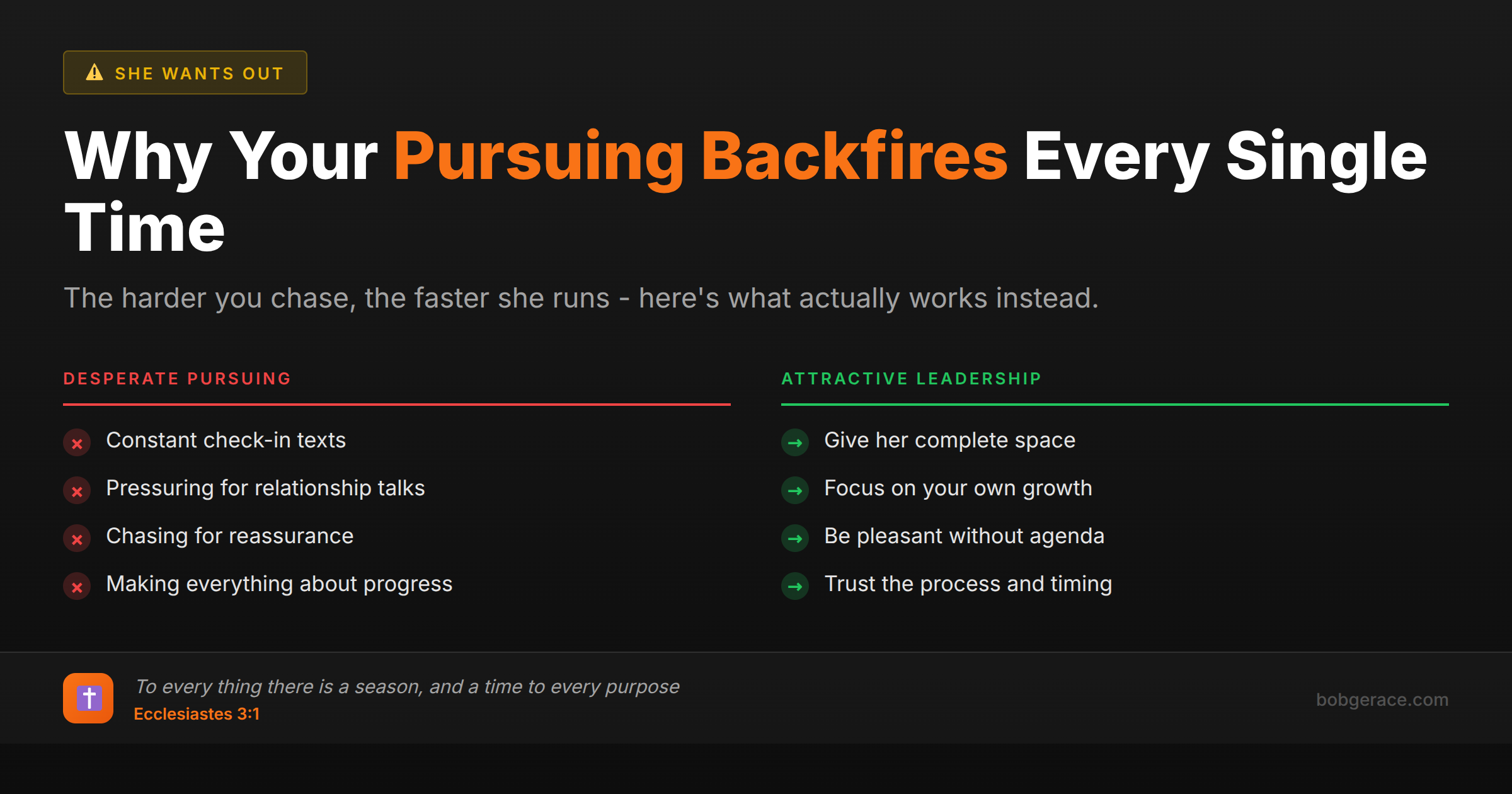
Your pursuing makes her pull away because you've triggered her fight-or-flight response. When someone feels cornered or overwhelmed, their nervous system activates a protective mechanism that creates distance. Every text, conversation attempt, or gesture of affection feels like pressure when she's already flooded. This creates what therapists call the pursue-withdraw cycle. The more you chase, the more unsafe she feels. The more unsafe she feels, the more she withdraws. The more she withdraws, the more panic you feel, so you pursue harder. It's a downward spiral that destroys the very connection you're trying to save. The counterintuitive truth is this: space creates safety, and safety creates the possibility for connection. Your pursuit, no matter how well-intentioned, is communicating desperation rather than love.
The Full Picture
Think about what happens when someone chases you when you don't want to be chased. Your body tenses up. Your heart rate increases. You look for escape routes. This is exactly what's happening in your marriage, except the stakes feel life-or-death for both of you.
The Pursue-Withdraw Cycle Explained:
• Your panic drives pursuit - When you sense her pulling away, your attachment system goes into overdrive • Her overwhelm drives withdrawal - Your pursuit feels suffocating when she's already emotionally flooded • The cycle intensifies - Each response triggers more of the opposite behavior • Connection becomes impossible - Both people are operating from fear, not love
Most men don't realize they're pursuing. They think they're being loving, attentive, or fighting for their marriage. But pursuing can look like: - Constant check-in texts throughout the day - Trying to have "the talk" repeatedly - Overcompensating with gifts, flowers, or grand gestures - Following her around the house - Asking "Are we okay?" multiple times a week - Initiating physical affection when she's clearly not receptive
Here's what she experiences: Every interaction feels loaded with your need for reassurance. She can't breathe without feeling like she's either giving you hope or crushing your spirit. The pressure is enormous, and it makes authentic connection impossible.
The cruel irony: The behavior that feels most natural when you're scared of losing someone is the exact behavior that pushes them away. Your pursuit is evidence of your fear, and fear repels. It doesn't attract.
What's Really Happening
From a neurobiological perspective, the pursue-withdraw pattern is a trauma response playing out in real-time. When your wife perceives pursuit as pressure or threat, her amygdala hijacks her prefrontal cortex. She literally cannot think clearly or access positive feelings about the relationship.
Attachment theory explains this dynamic through the lens of our early bonding experiences. Anxious attachment (often the pursuer) craves closeness but fears abandonment. Avoidant attachment (often the withdrawer) values independence but fears engulfment. When stress hits the marriage, these patterns become exaggerated.
Research by Dr. John Gottman shows that successful couples maintain a 5:1 ratio of positive to negative interactions. But in the pursue-withdraw cycle, every interaction becomes negatively charged because it's driven by dysregulation rather than genuine connection.
The nervous system science: When someone is in a state of hypervigilance or collapse (both trauma responses), they cannot access the social engagement system that allows for bonding. Your wife's withdrawal isn't personal—it's neurobiological. Her brain is protecting her from what it perceives as threat.
Polyvagal theory teaches us that safety must be established before connection is possible. The pursuit behavior, while motivated by love, signals danger to a dysregulated nervous system. This is why backing off isn't giving up—it's creating the neurobiological conditions necessary for her system to calm down.
The most effective intervention is often counter-intuitive: regulated presence without agenda. This means being emotionally stable in your own body while giving her complete freedom to be where she is emotionally.
What Scripture Says
Scripture gives us profound wisdom about pursuing relationships with the right heart and methods. Ecclesiastes 3:1 reminds us, "To every thing there is a season, and a time to every purpose under the heaven." Sometimes the season calls for stepping back, not pressing forward.
1 Corinthians 13:4-5 teaches us that "Love is patient, love is kind... it is not self-seeking." When our pursuit is driven by our own need for reassurance rather than her well-being, we're not operating in love—we're operating in fear. True love considers what serves the other person, even when it's uncomfortable for us.
Proverbs 25:17 offers direct wisdom: "Withdraw thy foot from thy neighbour's house; lest he be weary of thee, and so hate thee." Even in close relationships, presence must be invited, not imposed. Overwhelming someone with our presence, even with good intentions, can breed resentment.
Isaiah 30:15 speaks to the power of restraint: "In returning and rest shall ye be saved; in quietness and in confidence shall be your strength." Sometimes the strongest thing we can do is be still and trust God rather than frantically trying to control outcomes.
Matthew 7:6 warns us not to cast our pearls before swine—meaning don't offer your most precious gifts when the recipient isn't in a place to receive them. Your love and attention are pearls. When she's overwhelmed, offering them repeatedly can feel like casting them in the mud.
Galatians 6:9 encourages us: "Let us not become weary in doing good, for at the proper time we will reap a harvest if we do not give up." Notice it says "proper time." Faith means trusting God's timing, not forcing our own.
What To Do Right Now
-
1
Stop all pursuing behavior immediately - no check-in texts, relationship talks, or attempts to fix things
-
2
Focus on regulating your own nervous system through prayer, exercise, or time in nature
-
3
Give her complete emotional space without pouting, withdrawing love, or making her feel guilty about it
-
4
Redirect your energy into personal growth, hobbies, and relationships with friends or mentors
-
5
When you do interact, be pleasant and normal without any agenda for connection or progress
-
6
Trust God's timing and resist the urge to measure daily progress in the relationship
Related Questions
- What is anxious attachment and am I doing it right now?
- What's the pursue-withdraw cycle and how do I stop it?
- What is 'anxious protest behavior' and am I doing it?
- Should I give her space or fight for her?
- What's the difference between pursuing and chasing?
- How do I show love without activating her withdrawal?
- What is the 'pursuer-distancer' dynamic?
- What does 'protest behavior' look like and am I doing it?
- Why do I hurt the person I'm trying to keep?
- How do I pursue without pressuring?
Also find Bob on
Subscribe for weekly videos on Christian marriage.
Your Marriage Needs More Than Theory
You know the pattern now. But knowing you're in a pursue-withdraw cycle doesn't stop you from texting her again tonight. A coach who knows your specific situation helps you actually execute when your body is screaming to chase.
Talk to Bob →