How do I read her actions vs. her words?
5 min read
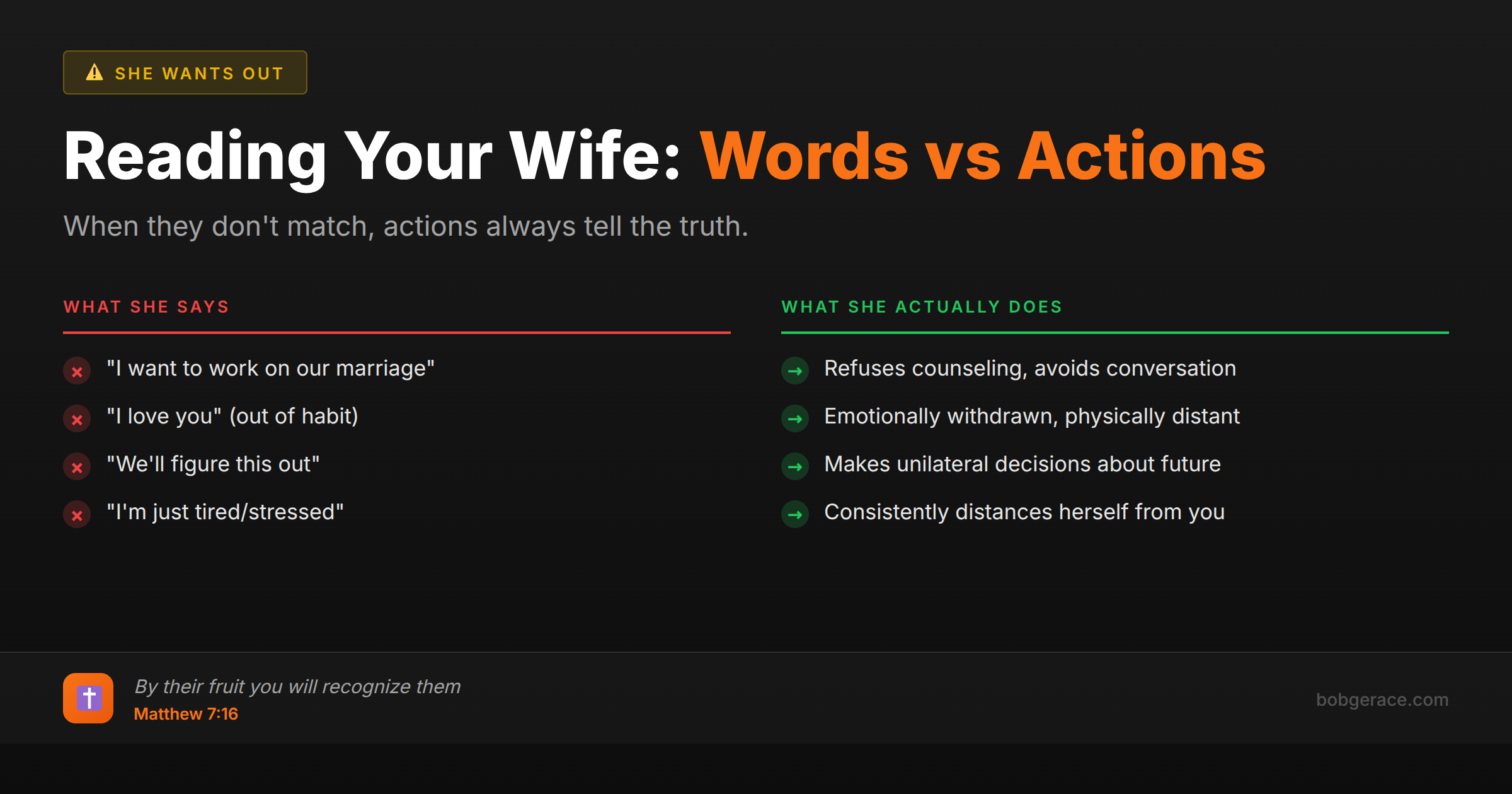
When your wife's actions don't match her words, always believe the actions. This isn't cynicism—it's reality. If she says she wants to work on the marriage but won't go to counseling, won't engage in conversation, or continues distancing behaviors, her actions are telling you where she really stands. The disconnect happens because words are often what we think we should say, while actions reveal what we actually feel and believe. She might say 'I love you' out of habit or guilt, but if she's emotionally withdrawn, physically distant, or making unilateral decisions about your future, those actions are her truth. Stop trying to convince yourself that her words override her behavior—that's just setting yourself up for more disappointment.
The Full Picture
The gap between words and actions in a marriage crisis isn't random—it's revealing. Your wife might be experiencing internal conflict between what she thinks she should feel and what she actually feels. This creates the confusing mixed signals that leave you spinning.
Common patterns you'll see: • Says she wants to work on things, but won't schedule time to talk • Claims she loves you, but treats you like a roommate • Agrees to counseling, then finds reasons to postpone or skip • Talks about the future together, but makes major decisions alone • Says she's committed, but emotionally invests elsewhere
Why this happens: She's often caught between societal expectations (good wives work on their marriages), family pressure, financial concerns, and her genuine feelings of disconnection or resentment. The words represent what she thinks she's supposed to want; the actions show what she actually wants.
The mistake most men make is focusing on the words because they're more hopeful. You'll analyze every positive thing she says while ignoring the consistent pattern of distancing behaviors. This is like studying the weather report while ignoring the storm outside your window.
Here's what's really happening: Actions require energy and intentionality. Words can be automatic or people-pleasing. When someone is emotionally checked out, they can still say loving things out of habit, but their actions will consistently show emotional unavailability. The actions are her authentic response; the words are often her guilt response.
What's Really Happening
From a psychological perspective, the disconnect between words and actions often reflects what we call 'cognitive dissonance'—the discomfort of holding contradictory beliefs or feelings simultaneously. Your wife may genuinely believe she should want to save the marriage while also feeling emotionally done with it.
Research in relationship psychology shows that behavioral consistency is a stronger predictor of relationship outcomes than verbal affirmations. The 'Gottman Ratio' research indicates that actions demonstrating fondness, admiration, and turning toward your partner matter more than declarations of love without corresponding behaviors.
Neurologically, when we're in emotional distress or relationship ambivalence, our limbic system (emotional brain) drives our actions while our prefrontal cortex (rational brain) produces the words we think we should say. This is why someone can say 'I love you' while their body language, tone, and behaviors communicate disconnection.
Another factor is 'emotional labor avoidance.' When someone feels overwhelmed by relationship conflict, they may use placating words to avoid immediate confrontation while their actions gradually create distance. This isn't necessarily manipulative—it's often an unconscious coping mechanism.
The therapeutic concept of 'ambiguous loss' also applies here. She may be grieving the marriage while still physically present, leading to contradictory messages. Understanding this doesn't mean accepting indefinite mixed signals, but it helps explain why the disconnect exists and why pressing for verbal reassurances often backfires.
What Scripture Says
Scripture consistently emphasizes that authentic faith and love are demonstrated through actions, not just words. This principle applies directly to reading your wife's true intentions and feelings.
Matthew 7:16 - 'By their fruit you will recognize them.' Jesus taught that we know people's hearts by observing their consistent actions over time. In your marriage, her 'fruit'—her daily choices, priorities, and behaviors—reveals more truth than her words.
1 John 3:18 - 'Dear children, let us not love with words or speech but with actions and in truth.' Biblical love is active, not passive. If love is present, it shows up in sacrificial actions, time investment, and genuine care for your well-being.
James 1:22 - 'Do not merely listen to the word, and so deceive yourselves. Do what it says.' This principle works both ways—don't deceive yourself by only listening to words while ignoring contradictory actions. Truth requires both hearing and seeing alignment.
Proverbs 20:11 - 'Even small children are known by their actions, so is their conduct really pure and upright?' God's wisdom teaches us that character and true intentions are revealed through consistent behavior patterns, not occasional good intentions.
1 Corinthians 4:20 - 'For the kingdom of God is not a matter of talk but of power.' Genuine transformation and commitment are demonstrated through the power of changed actions, not just improved communication.
This doesn't mean becoming cynical or unforgiving, but rather exercising the biblical wisdom to 'be shrewd as snakes and innocent as doves' (Matthew 10:16) in how you interpret the reality of your situation.
What To Do Right Now
-
1
Document patterns over the past month—write down specific examples where her actions contradicted her words
-
2
Stop asking for verbal reassurances and start observing her daily choices about time, energy, and priorities
-
3
Identify three specific behaviors that would demonstrate genuine investment in your marriage
-
4
Address the disconnect directly: 'I hear you saying X, but I see you doing Y. Help me understand.'
-
5
Set internal boundaries about what actions you'll accept as evidence of commitment versus empty words
-
6
Focus your own energy on consistent actions that align with your values, regardless of her mixed signals
Related Questions
- What stage of decision is she in?
- What does 'leaning out' behavior look like?
- Is this still a negotiation or is this execution?
- Is she testing me or serious?
- What is 'the point of no return' and is she past it?
- Why is she creating facts on the ground?
- What are markers of genuine remorse vs. guilt?
- How do I tell performance from genuine change?
- What is 'emotional disengagement'?
Also find Bob on
Subscribe for weekly videos on Christian marriage.
Bring Your Actual Marriage to a Coach
You're reading the pattern. A coach who knows your specific situation can tell you what her actions mean in your marriage—and what to do next.
Talk to Bob →