What is 'the point of no return' and is she past it?
6 min read
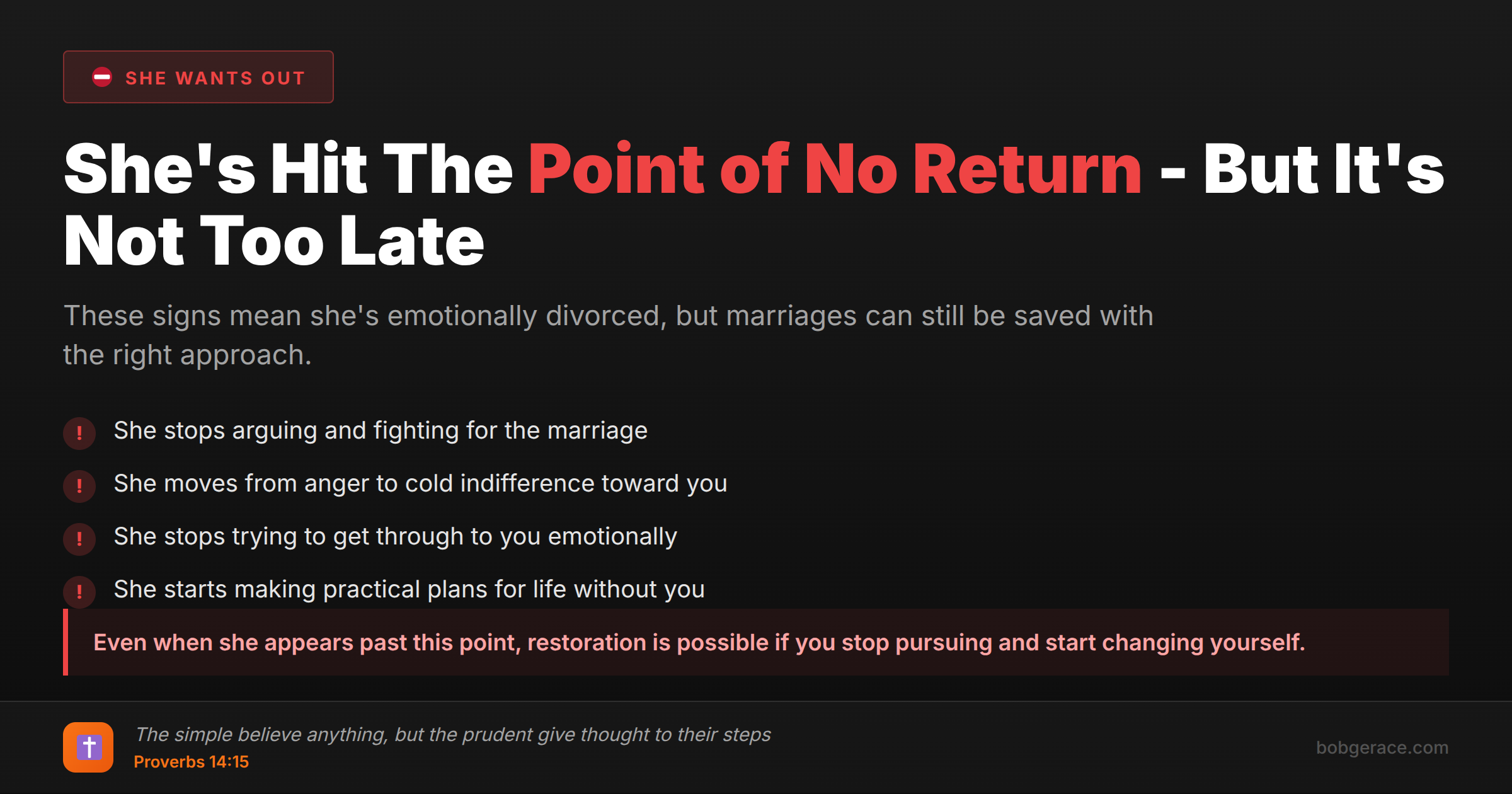
The 'point of no return' is when your wife has emotionally disconnected so completely that she's no longer willing to fight for the marriage. She's moved from anger and frustration to cold indifference. You'll know she's reached it when she stops arguing, stops trying to get through to you, and starts making practical plans for life without you. Here's what most men miss: the point of no return isn't about her filing papers or moving out. It's an internal shift that happens months or even years before those external actions. She's grieved the marriage, processed the loss, and made peace with ending it. But here's the critical truth - even when she appears past this point, marriages can still be saved if you're willing to do the deep work required.
The Full Picture
The point of no return isn't a single moment - it's a process. Your wife didn't wake up one day and decide she was done. She's been signaling distress for months, maybe years. She's tried talking, pleading, fighting, withdrawing, and finally protecting herself emotionally.
The progression typically looks like this:
• Stage 1: Active protest - She's fighting for the marriage, expressing needs, getting emotional • Stage 2: Bargaining - She's trying different approaches, maybe suggesting counseling or books • Stage 3: Despair - She's losing hope but still trying, often becoming depressed or anxious • Stage 4: Detachment - She stops fighting and starts protecting herself emotionally • Stage 5: Reorganization - She begins planning and preparing for life without you
Most men panic when they recognize stages 4 and 5, thinking it's too late. But women often test this detachment before fully committing to it. She might seem completely done but still be watching to see if you'll finally wake up and become the man and husband she needs.
Key indicators she's reached the point of no return:
• She's stopped complaining about your behavior • She's making major decisions without consulting you • She's creating separate friend groups and activities • She's financially preparing for independence • She discusses the future in terms of 'I' instead of 'we' • She's emotionally flat when discussing the relationship
The dangerous mistake men make is assuming that because she seems calm or resigned, the crisis has passed. In reality, this is often when she's most serious about leaving.
What's Really Happening
From a psychological perspective, the 'point of no return' represents what we call 'emotional divorce' - a protective mechanism where one spouse psychologically disengages to preserve their mental health. Research by Dr. John Gottman shows that women typically contemplate divorce for an average of two years before taking action, during which they're unconsciously preparing themselves for independence.
This process involves several psychological shifts. First, there's a reduction in what we call 'positive sentiment override' - the tendency to interpret neutral or even slightly negative behaviors positively. When this flips to 'negative sentiment override,' everything the partner does gets filtered through a negative lens.
Second, we see the activation of what psychologists call 'psychological reactance.' After repeated attempts to create change in the relationship, she begins to protect her sense of autonomy by emotionally withdrawing. This isn't manipulation - it's self-preservation.
The neurological reality is that chronic relationship stress literally rewires the brain. The emotional centers become hypervigilant to threat while the bonding and attachment systems shut down. What looks like coldness is often a trauma response to years of feeling unheard and unvalued.
However, neuroplasticity research shows us that these patterns can be changed. The brain can form new pathways when consistently presented with new experiences. This is why dramatic, sustained behavioral change from the husband can sometimes reactivate dormant attachment systems, even when she appears emotionally divorced.
The key therapeutic insight is that the 'point of no return' is often a final test rather than a final decision. She's unconsciously giving the marriage one last chance to prove it can be different.
What Scripture Says
Scripture doesn't use the term 'point of no return,' but it clearly addresses seasons of hardness and the possibility of restoration even in the most difficult circumstances. The Bible offers both sobering warnings and incredible hope.
Ephesians 4:18-19 warns about hearts becoming 'darkened' and 'callous,' describing a process where people become 'past feeling.' This mirrors what happens when someone reaches emotional divorce - they've protected themselves by shutting down feeling.
Yet Ezekiel 36:26 promises, 'I will give you a new heart and put a new spirit in you; I will remove from you your heart of stone and give you a heart of flesh.' God specializes in softening hearts that have become hardened by pain and disappointment.
Hosea 2:14 shows God's strategy for winning back a wayward heart: 'Therefore I am now going to allure her; I will lead her into the wilderness and speak tenderly to her.' Notice it's not through arguing or pleading, but through patient, tender pursuit.
The parable of the persistent widow in Luke 18:1-8 reminds us that God honors persistent, faithful love even when the situation seems hopeless. Sometimes restoration requires sustained faithfulness over time.
Joel 2:25 declares God's power to 'restore the years the locusts have eaten.' Even when years of damage seem irreversible, God can restore what was lost.
Finally, 1 Corinthians 13:7 defines love as something that 'always hopes, always perseveres.' This doesn't mean being naive about reality, but maintaining faith that God can work even in seemingly impossible situations.
The biblical framework calls us to honest assessment combined with persistent hope, trusting that God can soften the hardest hearts and restore the most damaged relationships.
What To Do Right Now
-
1
Stop all pursuing, pleading, and trying to convince her to stay - this only confirms her decision
-
2
Begin honest self-examination of your contribution to the marriage breakdown without blame-shifting
-
3
Start making dramatic changes in your character and behavior whether she notices or not
-
4
Create emotional space by focusing on your own growth rather than monitoring her responses
-
5
Seek professional help from a qualified marriage coach or counselor who understands crisis intervention
-
6
Begin praying specifically for her heart to soften while asking God to change you first
Related Questions
Don't Wait Until It's Actually Too Late
If you're seeing these warning signs, time is critical. Get the guidance you need to navigate this crisis effectively.
Get Help Now →