What is 'positive sentiment override' in the affair context?
6 min read
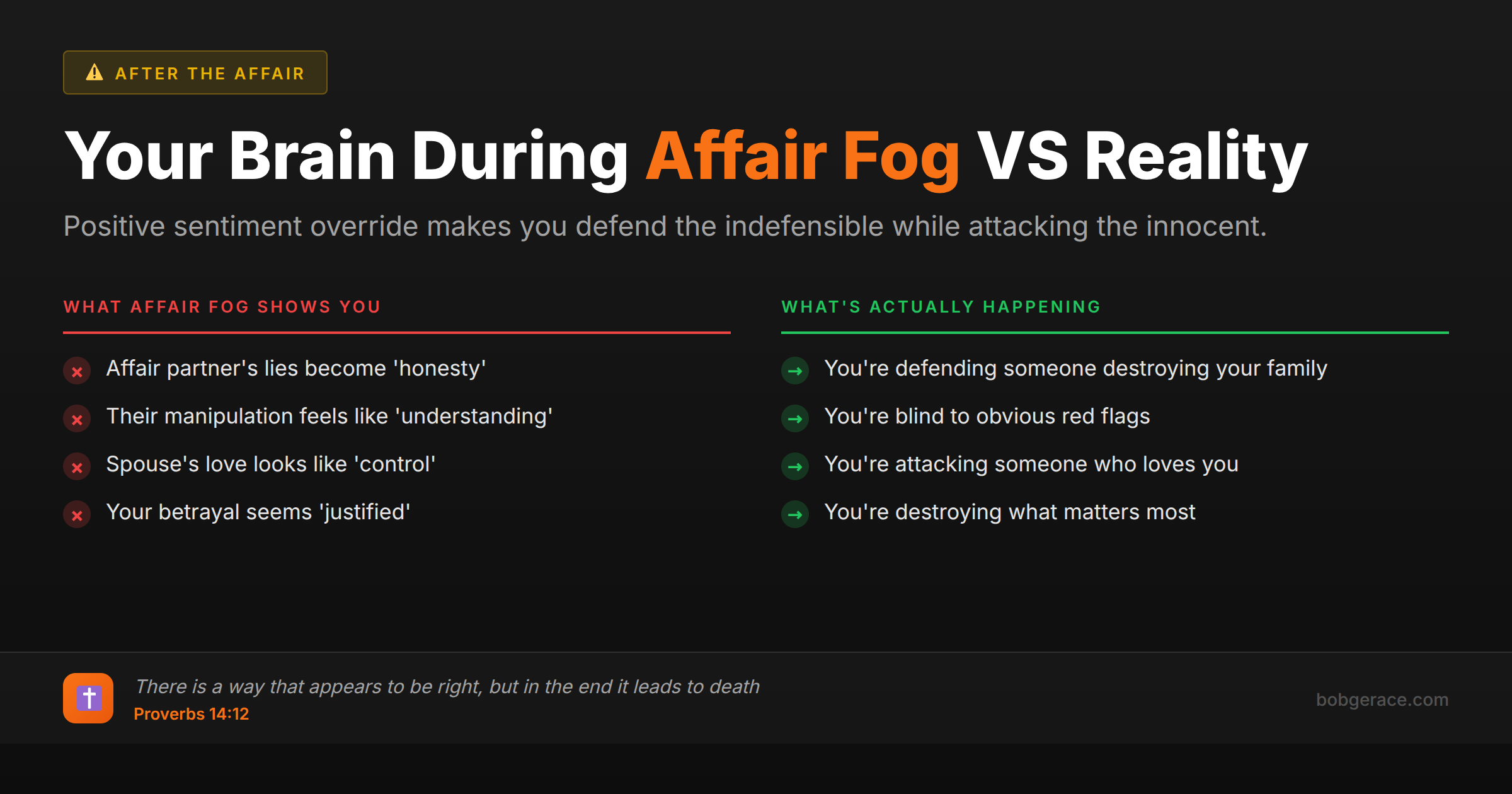
Positive sentiment override in affair contexts occurs when someone views their affair partner through an unrealistically positive lens while simultaneously viewing their spouse through an unrealistically negative one. This psychological phenomenon causes the unfaithful partner to interpret neutral or even negative behaviors from the affair partner as positive, while interpreting their spouse's positive behaviors as negative or suspicious. This override creates what many call 'affair fog' - a distorted reality where the affair partner can do no wrong and the spouse can do no right. It's not just preference or attraction; it's a complete rewiring of how the brain processes information about both relationships. The unfaithful spouse will defend behaviors from the affair partner they would never tolerate from their spouse, while criticizing their spouse for the same positive qualities they once appreciated.
The Full Picture
Positive sentiment override is one of the most destructive psychological phenomena in affairs. Originally identified by Dr. John Gottman in his marriage research, this concept describes how we interpret ambiguous behaviors based on our overall sentiment toward someone. In healthy marriages, positive sentiment override means spouses give each other the benefit of the doubt. In affairs, this same mechanism becomes weaponized against the marriage.
The affair partner becomes idealized beyond reason. Their flaws are reframed as charming quirks. Their selfishness becomes 'knowing what they want.' Their willingness to participate in deception becomes 'passion.' Meanwhile, the spouse - who may have been appreciated for years - suddenly becomes the source of all problems. Their efforts to connect are seen as 'needy.' Their concerns about the relationship become 'controlling.' Their positive qualities are either forgotten or reinterpreted negatively.
This isn't conscious manipulation - it's neurological. The brain's reward system, flooded with affair-related dopamine and norepinephrine, literally changes how information is processed. The unfaithful spouse genuinely believes their distorted perceptions are accurate. They'll swear their spouse 'changed' or that they 'never noticed' these problems before, when in reality, their perception changed.
The override extends to rewriting marital history. Happy memories become reinterpreted as 'just going through the motions.' Difficult seasons that were previously weathered together become evidence the marriage was 'always wrong.' The affair partner's brief presence in their life carries more emotional weight than years or decades of marriage.
Understanding this isn't about excusing the affair - it's about recognizing the depth of deception involved. The unfaithful spouse is both perpetrator and victim of their own psychological manipulation. Breaking free requires recognizing that their perceptions have become completely unreliable and choosing to act on commitment rather than feelings.
What's Really Happening
From a clinical perspective, positive sentiment override in affairs represents a complete breakdown of objective perception. The limerent //blog.bobgerace.com/marriage-pre-programming-christian-train-brain-before-crisis/:brain operates under a powerful cocktail of neurochemicals - dopamine, norepinephrine, and phenylethylamine - that create an altered state similar to addiction or mania. This neurochemical flood doesn't just create good feelings about the affair partner; it actively suppresses the ability to perceive them accurately.
We see three distinct perceptual distortions: First, the 'halo effect' around the affair partner where everything they do is interpreted through rose-colored glasses. Second, the 'horns effect' applied to the spouse where every action is viewed suspiciously. Third, and most damaging, the 'historical revision' where the entire marriage timeline gets rewritten to support the current narrative.
The most challenging aspect for recovery is that the unfaithful spouse genuinely believes their distorted perceptions. They're not lying when they say their spouse has 'changed' or become 'impossible to live with.' Their brain is literally processing the same behaviors differently than it did before the affair began. This is why logic, reasoning, or evidence rarely penetrates during active affairs.
Recovery requires neurochemical detox and cognitive restructuring. Complete separation from the affair partner allows brain chemistry to normalize, typically taking 90-180 days. During this period, memories and perceptions gradually become more accurate. However, the unfaithful spouse must actively work to rebuild objective thinking patterns and resist the urge to defend their distorted perceptions. This is why professional guidance is crucial - someone needs to hold space for reality when the unfaithful spouse's perception cannot be trusted.
What Scripture Says
Scripture warns extensively about the deceptive nature of sin and how it distorts our perception of reality. *'There is a way that appears to be right, but in the end it leads to death'* (Proverbs 14:12). This perfectly describes positive sentiment override - what feels completely right and justified to the unfaithful spouse is actually leading to destruction.
The Bible acknowledges that sin blinds us to truth: *'The god of this age has blinded the minds of unbelievers, so that they cannot see the light of the gospel'* (2 Corinthians 4:4). While this verse speaks of spiritual blindness, the principle applies to how sin creates perceptual distortion. The unfaithful spouse becomes blind to the reality of their spouse's value and their own covenant commitment.
Jeremiah 17:9 provides crucial insight: *'The heart is deceitful above all things and beyond cure. Who can understand it?'* This verse directly addresses the unreliability of feelings and emotions when we're in sin. The unfaithful spouse's heart is actively deceiving them, making their emotions completely untrustworthy guides for decision-making.
Jesus warned about the blinding effect of sin: *'If then the light within you is darkness, how great is that darkness!'* (Matthew 6:23). When we call evil good and good evil, our very ability to discern truth becomes compromised. The unfaithful spouse is living in this darkness, unable to see clearly.
However, Scripture offers hope for renewed vision: *'Create in me a pure heart, O God, and renew a steadfast spirit within me'* (Psalm 51:10). David's prayer after his own affair shows the path forward - acknowledgment that our heart and spirit need complete renewal. The solution isn't trusting our feelings but returning to God's truth about covenant, commitment, and love. Recovery requires choosing God's perspective over our distorted emotions and allowing His Word to reshape our understanding of reality.
What To Do Right Now
-
1
Acknowledge your perceptions are compromised - Accept that your feelings about both your spouse and affair partner cannot be trusted as accurate right now
-
2
Implement complete no-contact immediately - Cut all communication with the affair partner to begin neurochemical detox and clarity restoration
-
3
Stop defending your distorted narrative - Resist the urge to justify why your spouse is 'impossible' or why the affair partner is 'perfect'
-
4
Seek professional help specialized in affair recovery - You need objective guidance since your own judgment is severely compromised
-
5
Create a detailed timeline of your marriage - Document positive memories and your spouse's good qualities before the affair began
-
6
Commit to 90 days of covenant-based decisions - Make choices based on your marriage vows rather than current feelings while your brain chemistry rebalances
Related Questions
- What is limerence?
- Is she in love or in limerence?
- What is the neuroscience of limerence?
- Why does she rewrite our history during limerence?
- What is 'contrast effect' and why do I look worse to her?
- What happens in her brain when she sees him vs. me?
- What is 'negative sentiment override' and does she have it?
- Why does she remember everything differently than I do?
- What does 'I love you but I'm not in love with you' really mean?
- Why does she see him as perfect and me as flawed?
Also find Bob on
Subscribe for weekly videos on Christian marriage.
Your Wife Can't Compete With a Fantasy
If she's still in the fog, you need a coach who's seen this exact pattern and knows how to pull her back without pushing her further away. Talk to Bob about your specific situation.
Talk to Bob →