How does limerence affect perception and memory?
6 min read
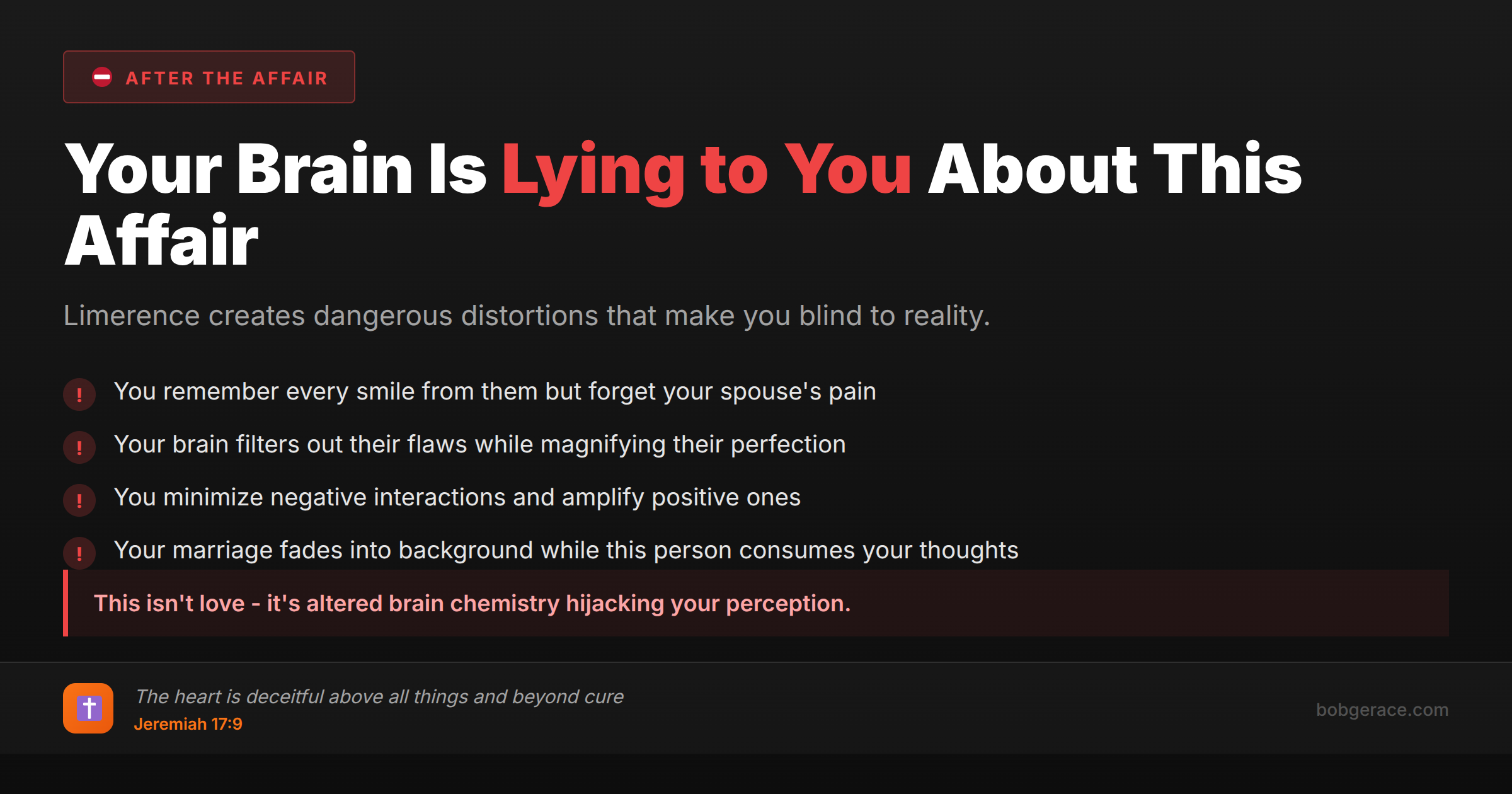
Limerence creates profound distortions in both perception and memory through neurochemical changes in the brain. When you're experiencing limerence, your brain literally rewires itself to hyper-focus on the limerent object while filtering out contradictory information. You'll find yourself remembering every positive interaction in vivid detail while minimizing or forgetting negative experiences. Your perception becomes tunnel-visioned - you notice every smile, text, or gesture from this person while becoming blind to their flaws or inappropriate behavior. This isn't just 'being infatuated' - it's your brain operating under altered neurochemistry similar to addiction. The same reward pathways activated by drugs are flooding your system with dopamine every time you think about or interact with this person. Meanwhile, your spouse and marriage fade into the background as your brain literally prioritizes the limerent relationship above all else.
The Full Picture
Limerence doesn't just change how you feel - it fundamentally alters how your brain processes reality. This neurochemical state creates what researchers call 'cognitive bias' on steroids. Your mind becomes a selective editing machine, crafting a narrative that supports and feeds the limerent obsession.
Memory distortions are particularly dangerous. You'll replay conversations with this person endlessly, each time adding more meaning and emotional weight. A simple 'good morning' becomes evidence of special connection. Meanwhile, memories of your spouse become flat, colorless, or negative. You might find yourself unable to remember why you fell in love with your spouse, while every interaction with the limerent object burns bright in your memory.
Perceptual changes are equally dramatic. Your brain develops tunnel vision - you notice everything about this person while becoming blind to obvious red flags. You'll interpret neutral behaviors as signs of reciprocal interest. A casual touch becomes electric. Professional courtesy becomes personal attention. This isn't conscious self-deception - your brain is literally filtering reality.
The comparison trap becomes inevitable. Your spouse, seen through normal everyday reality, can't compete with someone viewed through the rose-colored lens of limerent perception. It's like comparing a regular photograph to one with Instagram filters - the comparison is inherently unfair because you're not seeing the same reality.
This creates a feedback loop that strengthens over time. The more you focus on this person, the more your brain rewires to prioritize them. The more you compare your spouse unfavorably, the more justified the limerent feelings seem. Without intervention, this cycle can completely destroy your ability to see your marriage clearly.
What's Really Happening
From a neuroscience perspective, limerence creates measurable changes in brain function that //blog.bobgerace.com/marriage-identity-mirror-method-measuring-worth-sex/:mirror both addiction and obsessive-compulsive patterns. The anterior cingulate cortex, which processes emotional significance, becomes hyperactive when thinking about the limerent object. Simultaneously, the prefrontal cortex - responsible for rational judgment - shows decreased activity.
This creates what I call 'selective neuroplasticity.' Your brain literally rewires itself to prioritize limerent-related information while suppressing contradictory data. PET scans of individuals in limerent states show patterns remarkably similar to cocaine addiction, with dopamine pathways firing intensely in response to limerent triggers.
Memory consolidation becomes heavily biased during this state. The hippocampus, which forms new memories, is influenced by the emotional intensity created by limerent neurochemistry. Positive interactions get encoded with multiple sensory details and emotional markers, making them incredibly vivid and easily recalled. Negative information about the limerent object, or positive memories about your spouse, get encoded weakly or not at all.
The most concerning aspect is how this affects risk assessment. The brain's threat-detection systems become compromised. Behaviors that would normally trigger caution - secrecy, emotional manipulation, boundary violations - don't register as concerning because the reward pathways are overwhelming rational evaluation.
Recovery requires understanding that this isn't a character flaw - it's a neurochemical state that requires specific interventions. The brain can rewire itself back to normal function, but it requires intentional effort and often professional support to break these deeply ingrained neural pathways.
What Scripture Says
Scripture warns us repeatedly about the deceptive nature of our hearts and the importance of guarding our minds. The cognitive distortions of limerence are exactly what God's Word addresses when it talks about being deceived by our own desires.
Jeremiah 17:9 tells us, *'The heart is deceitful above all things and beyond cure. Who can understand it?'* This isn't poetry - it's a clinical description of what you're experiencing. Your heart is literally lying to you about reality, creating false narratives and distorted perceptions that feel absolutely true.
Proverbs 14:12 warns, *'There is a way that appears to be right, but in the end it leads to death.'* The path limerence creates seems right, feels right, and appears to offer life and happiness. But it leads to the death of your marriage, your integrity, and ultimately your joy.
2 Corinthians 10:5 gives us the solution: *'We demolish arguments and every pretension that sets itself up against the knowledge of God, and we take captive every thought to make it obedient to Christ.'* This is your marching orders - you must actively demolish the false thoughts and distorted perceptions that limerence creates.
Philippians 4:8 provides the framework for mental renewal: *'Finally, brothers and sisters, whatever is true, whatever is noble, whatever is right, whatever is pure, whatever is lovely, whatever is admirable—if anything is excellent or praiseworthy—think about such things.'* Your limerent thoughts fail every single one of these tests.
Romans 12:2 promises transformation: *'Do not conform to the pattern of this world, but be transformed by the renewing of your mind.'* God can restore your ability to see clearly, but it requires active participation in renewing your thought patterns.
1 Corinthians 13:4-7 describes real love - patient, kind, not self-seeking, keeping no record of wrongs. Limerence is the opposite of biblical love in every way.
What To Do Right Now
-
1
Stop feeding the distortion - Immediately cease all non-essential contact with the limerent object. Every interaction reinforces the neural pathways creating these perceptual distortions.
-
2
Document reality - Write down factual observations about both your spouse and the limerent object without emotional interpretation. Force your brain to process objective truth.
-
3
Challenge every positive memory - When limerent memories surface, immediately ask: 'What negative information am I ignoring?' Balance the selective editing your brain is doing.
-
4
Reconnect with your spouse's reality - Spend intentional time observing your spouse's positive qualities. Your brain has filtered these out, but they're still there.
-
5
Implement thought-stopping techniques - When limerent thoughts begin, immediately redirect to Scripture, prayer, or predetermined alternatives. Don't let your brain rehearse the distortions.
-
6
Seek professional help - The neurochemical changes in limerence often require clinical intervention. Find a therapist who understands both the science and sanctity of marriage.
Related Questions
- What is limerence?
- Is she in love or in limerence?
- What is the neuroscience of limerence?
- What brain chemicals are involved?
- Why does she rewrite our history during limerence?
- What is 'positive sentiment override' in the affair context?
- Why does she seem like a different person?
- What is 'negative sentiment override' and does she have it?
- Why does she remember everything differently than I do?
- What does dopamine addiction look like in affairs?
Also find Bob on
Subscribe for weekly videos on Christian marriage.
Your Brain Is Lying to You
Bob has walked hundreds of men through limerence while their marriages were on fire. He knows what's real in your situation and what's the neurochemical fog.
Talk to Bob →