How do I express need without rage?
6 min read
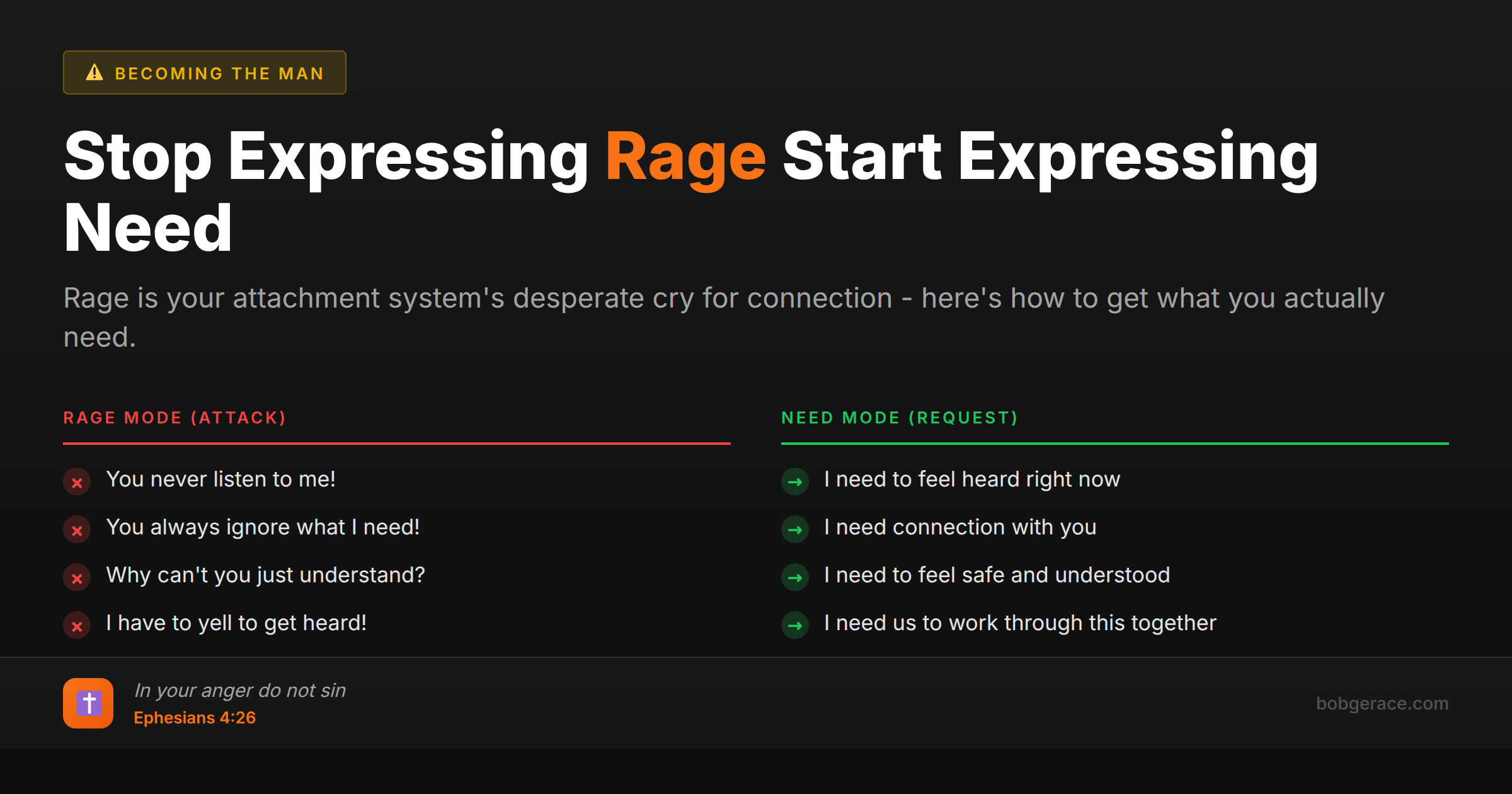
Rage happens when we feel our needs won't be met or heard any other way. It's often our attachment system's last-ditch effort to get attention and safety. The key is learning to recognize your needs before they become desperate and finding ways to express vulnerability instead of fury. Start by slowing down when you feel the heat rising. Take three deep breaths and ask yourself: 'What do I actually need right now?' Usually underneath anger is a need for connection, understanding, or safety. Practice saying 'I need...' instead of 'You always...' This shifts from attack mode to vulnerable request mode, which actually gets you what you're really after.
The Full Picture
When you find yourself exploding with rage every time you try to express a need, you're dealing with something much deeper than a communication problem. You're experiencing what happens when your attachment system gets hijacked by fear and desperation.
Here's what's really going on: Your brain has learned that gentle requests don't work. Maybe in your childhood, you had to get loud to be heard. Maybe in your marriage, calm expressions of need have been ignored or dismissed. So your nervous system has adapted by going straight to DEFCON 1 whenever you feel vulnerable about needing something.
The attachment piece is crucial. If you have an anxious attachment style, unexpressed needs feel like life-or-death situations. Your brain interprets your spouse's potential 'no' or lack of response as abandonment. If you have an avoidant attachment style, even having needs feels dangerous, so when they finally surface, they come out sideways as anger rather than vulnerability.
The rage serves a function - it's trying to create the connection and safety you actually need. But it backfires spectacularly. Instead of drawing your spouse closer, it pushes them away. Instead of getting your needs met, it makes your spouse defensive or shut down. You end up more disconnected than when you started.
The pattern becomes self-fulfilling. You need connection, you explode trying to get it, your spouse withdraws, you feel more disconnected, and the next time you need something, your brain remembers this threat and goes to rage even faster. Breaking this cycle requires understanding that rage is actually a secondary emotion covering up fear, hurt, and longing for connection.
What's Really Happening
From an attachment perspective, rage is often what we call a 'protest behavior.' When our attachment system perceives threat - like the possibility that our needs won't be met - it activates a sequence: first we reach out, then we get anxious, then we protest loudly, and finally we withdraw in despair.
Most people who struggle with rage when expressing needs are stuck in the protest phase. Their nervous system has learned that gentle bids for connection aren't effective, so it skips straight to the loudest, most attention-getting behavior available. It's actually a sign that attachment matters deeply to you - you wouldn't rage at a stranger about your needs.
Neurologically, what's happening is that your amygdala - your brain's alarm system - is detecting threat faster than your prefrontal cortex can engage rational thought. The 'threat' isn't your spouse; it's the possibility of disconnection or having your needs dismissed. Your brain floods with stress hormones, and suddenly you're fighting for your emotional life.
The pathway forward involves 'earned security' - learning new ways to get your attachment needs met. This means developing what we call 'emotional granularity' - the ability to identify and name what you need before it becomes desperate. It also means learning to communicate from your attachment longings rather than your attachment fears. Instead of 'You never listen to me!' try 'I'm feeling disconnected and need to know you care about what matters to me.'
What Scripture Says
Scripture has a lot to say about expressing our needs and managing our anger. God designed us for relationship and interdependence, so having needs isn't weakness - it's how He made us.
Start with Ephesians 4:26-27: 'In your anger do not sin: Do not let the sun go down while you are still angry, and do not give the devil a foothold.' Notice it doesn't say don't get angry - it says don't sin in your anger. The issue isn't the emotion; it's what you do with it.
Proverbs 15:1 gives us the alternative: 'A gentle answer turns away wrath, but a harsh word stirs up anger.' When you come at your spouse with rage, you're stirring up their defensive anger. When you come with gentleness, you create space for connection.
James 1:19-20 addresses the speed issue: 'My dear brothers and sisters, take note of this: Everyone should be quick to listen, slow to speak and slow to become angry, because human anger does not produce the righteousness that God desires.' That 'slow to speak' part is crucial - it's the pause that lets you move from rage to genuine expression of need.
Philippians 4:19 reminds us of the bigger picture: 'And my God will meet all your needs according to the riches of his glory in Christ Jesus.' Your spouse isn't your ultimate source of security - God is. This takes the life-or-death pressure off your requests.
Finally, 1 Peter 3:7 calls husbands to be 'considerate' and wives to have a 'gentle and quiet spirit' (verse 4). Both point toward approaching each other with tenderness rather than force. Your needs matter to God, and He wants them expressed in ways that build rather than tear down.
What To Do Right Now
-
1
Pause and breathe - When you feel rage building, take three deep breaths and ask 'What do I actually need right now?' Don't speak until you can identify the need under the anger.
-
2
Use 'I need' language - Replace 'You never' or 'You always' with 'I need' or 'I'm feeling.' This moves you from attack mode to vulnerable request mode.
-
3
Start small - Practice expressing minor needs calmly before tackling the big ones. Build success with low-stakes situations first.
-
4
Time it right - Don't express important needs when you're already activated or when your spouse is stressed. Choose moments of connection.
-
5
Own your attachment style - If you're anxious, remind yourself that a 'no' isn't abandonment. If you're avoidant, remind yourself that having needs is normal and healthy.
-
6
Follow up with repair - When you do blow it with rage, come back later and say 'I got scared about my need for connection and came at you wrong. What I really needed was...'
Related Questions
Ready to Transform How You Express Your Needs?
Learning to express needs without rage takes practice and often benefits from professional guidance to understand your unique attachment patterns.
Get Support →