What is emotional granularity?
6 min read
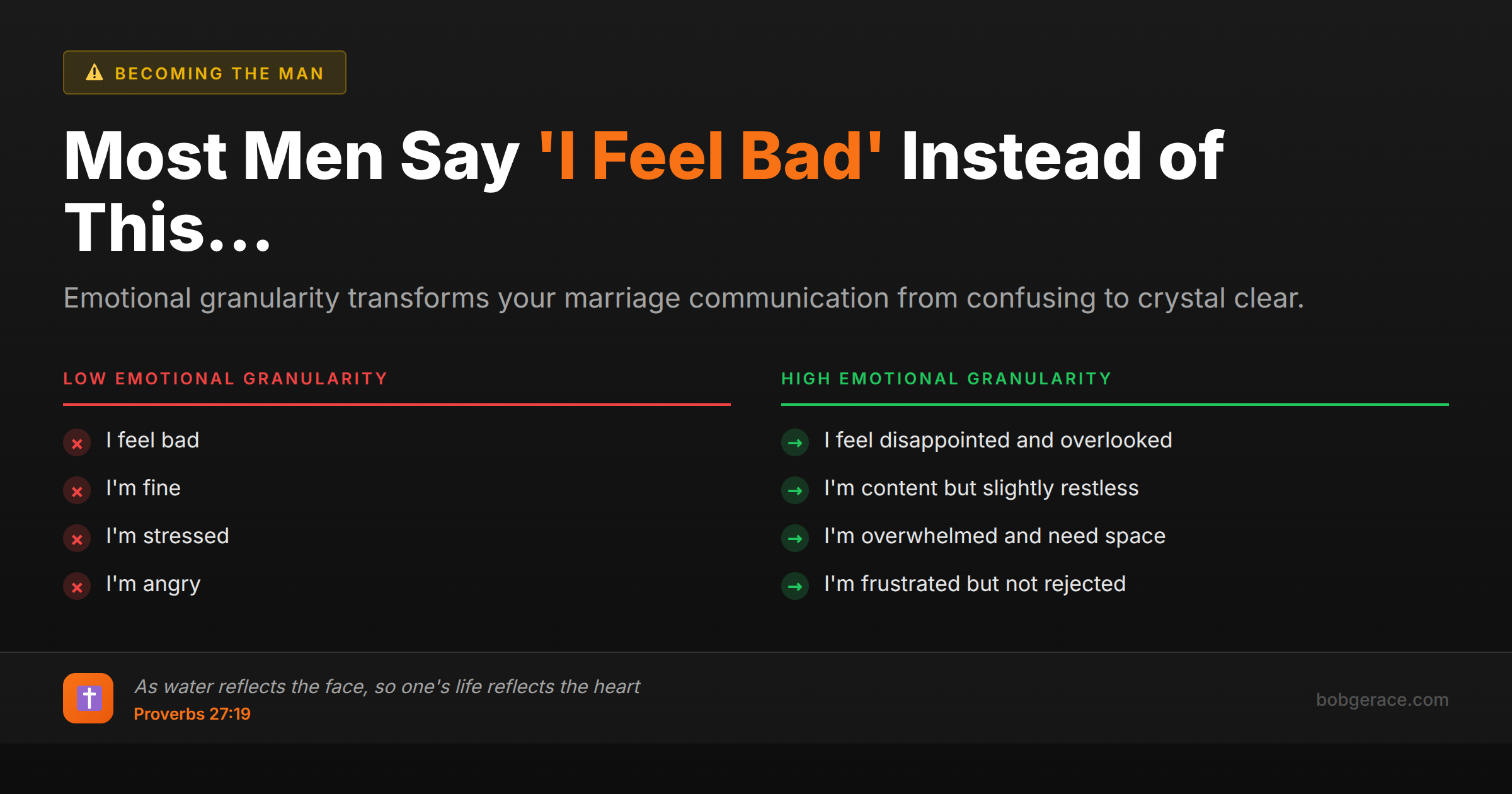
Emotional granularity is your ability to distinguish between different emotions with precision and specificity. Instead of just saying 'I feel bad,' a man with high emotional granularity can identify whether he's feeling disappointed, frustrated, overwhelmed, or rejected. This isn't about being overly analytical – it's about developing the vocabulary and awareness to understand what's actually happening inside you. In marriage, this skill is game-changing. When you can accurately identify your emotions, you can communicate them clearly to your wife instead of just acting them out. You move from reactive to responsive, from confusing to clear. Most men operate with about 3-4 emotional categories, but research shows we can develop the ability to recognize dozens of distinct emotional states.
The Full Picture
Think about the last time you had a conflict with your wife. If you're like most men, you probably felt 'angry' or 'frustrated.' But here's what was likely happening beneath the surface: maybe you felt unappreciated for working late, anxious about finances, disappointed that she didn't acknowledge your efforts, and guilty for raising your voice.
That's emotional granularity in action – the ability to break down the emotional soup into its individual ingredients. Without this skill, you're trying to solve problems with incomplete information. You're like a mechanic who only knows 'the car doesn't work' instead of identifying the specific faulty part.
Why Most Men Struggle With This
From childhood, most of us learned a simplified emotional vocabulary: mad, sad, glad. We were taught that 'real men' don't dwell on feelings, so we developed emotional shortcuts. Anger became our go-to emotion because it felt more acceptable than vulnerability.
But your wife needs more than 'I'm fine' or 'I'm pissed.' She needs to understand what's actually happening with you so she can respond appropriately. When you say 'I'm stressed about work,' she might offer solutions. When you get more granular and say 'I'm feeling undervalued by my boss and worried I'm disappointing you by working so much,' she can offer the support you actually need.
The Marriage Impact
Couples with higher emotional granularity have significantly better relationships. They fight less, resolve conflicts faster, and feel more connected. That's because they're addressing the real issues instead of dancing around surface-level symptoms. When both partners can identify and express their specific emotional needs, they can actually meet them.
What's Really Happening
Emotional granularity operates through your brain's ability to construct emotional experiences from basic physiological arousal. When you feel that familiar tightness in your chest and tension in your shoulders, your brain searches for the best emotional 'fit' based on context and past experience.
Men with low emotional granularity often default to broad categories like 'stressed' or 'angry' because that's where their emotional vocabulary ends. But those with high granularity can distinguish between anxiety, frustration, disappointment, overwhelm, and dozens of other specific states. This isn't just semantic – it's neurological.
Research by Dr. Lisa Feldman Barrett shows that people with higher emotional granularity have better emotional regulation, less anxiety and depression, and stronger relationships. Their brains literally construct more precise emotional experiences, leading to more targeted and effective responses.
In marriage therapy, I see this play out constantly. The husband who can only say 'she makes me crazy' is stuck in reactive patterns. But the man who can identify 'I feel disconnected when she's on her phone during dinner, and that triggers my fear that I'm not important to her' – he can work with that. His wife can work with that.
The good news is emotional granularity is learnable. Your brain maintains plasticity throughout life, meaning you can develop more nuanced emotional awareness through intentional practice. It starts with curiosity about your internal experience and builds through consistent attention to the subtle differences between emotional states.
What Scripture Says
Scripture calls us to emotional wisdom and self-awareness, not emotional numbness. Proverbs 27:19 tells us, 'As water reflects the face, so one's life reflects the heart.' God wants us to understand our hearts deeply, not just skim the surface.
Proverbs 20:5 says, 'The purposes of a person's heart are deep waters, but one who has insight draws them out.' Emotional granularity is exactly this – drawing out the deep purposes and experiences of your heart instead of settling for shallow understanding.
Jesus himself demonstrated remarkable emotional granularity. He didn't just feel 'bad' about Lazarus – John 11:35 shows He wept with grief. When facing the cross, He didn't just say He was 'stressed' – Matthew 26:38 records His specific words: 'My soul is overwhelmed with sorrow to the point of death.' He gave voice to His precise emotional experience.
Psalm 139:23-24 provides our model: 'Search me, God, and know my heart; test me and know my anxious thoughts. See if there is any offensive way in me, and lead me in the way everlasting.' David invited God to help him understand his own heart with precision.
In marriage, Ephesians 4:15 calls us to 'speak the truth in love.' You can't speak truth about your emotional experience if you don't know what that truth is. Emotional granularity enables the kind of honest, vulnerable communication that builds intimacy.
1 Corinthians 14:8 reminds us, 'If the trumpet does not sound a clear call, who will get ready for battle?' When you communicate your emotions with clarity and specificity, your wife knows how to respond. Vague emotional communication leaves her guessing and you both frustrated.
What To Do Right Now
-
1
Download an emotion wheel or feelings chart and keep it accessible on your phone for reference when identifying emotions
-
2
Set three daily check-ins where you pause and identify your specific emotional state using precise language
-
3
Create an emotion journal noting the physical sensations that accompany different emotional states in your body
-
4
Practice the 'What else?' technique - when you identify one emotion, ask yourself what other emotions might be present
-
5
Share your specific emotional experiences with your wife using 'I feel...' statements instead of vague descriptions
-
6
Learn one new emotion word each week and practice identifying when you experience that specific feeling
Related Questions
Ready to Develop Your Emotional Intelligence?
Stop guessing at your emotions and start understanding them. Get practical tools for developing the emotional clarity your marriage needs.
Work With Me →