What is 'alexithymia' and do I have it?
6 min read
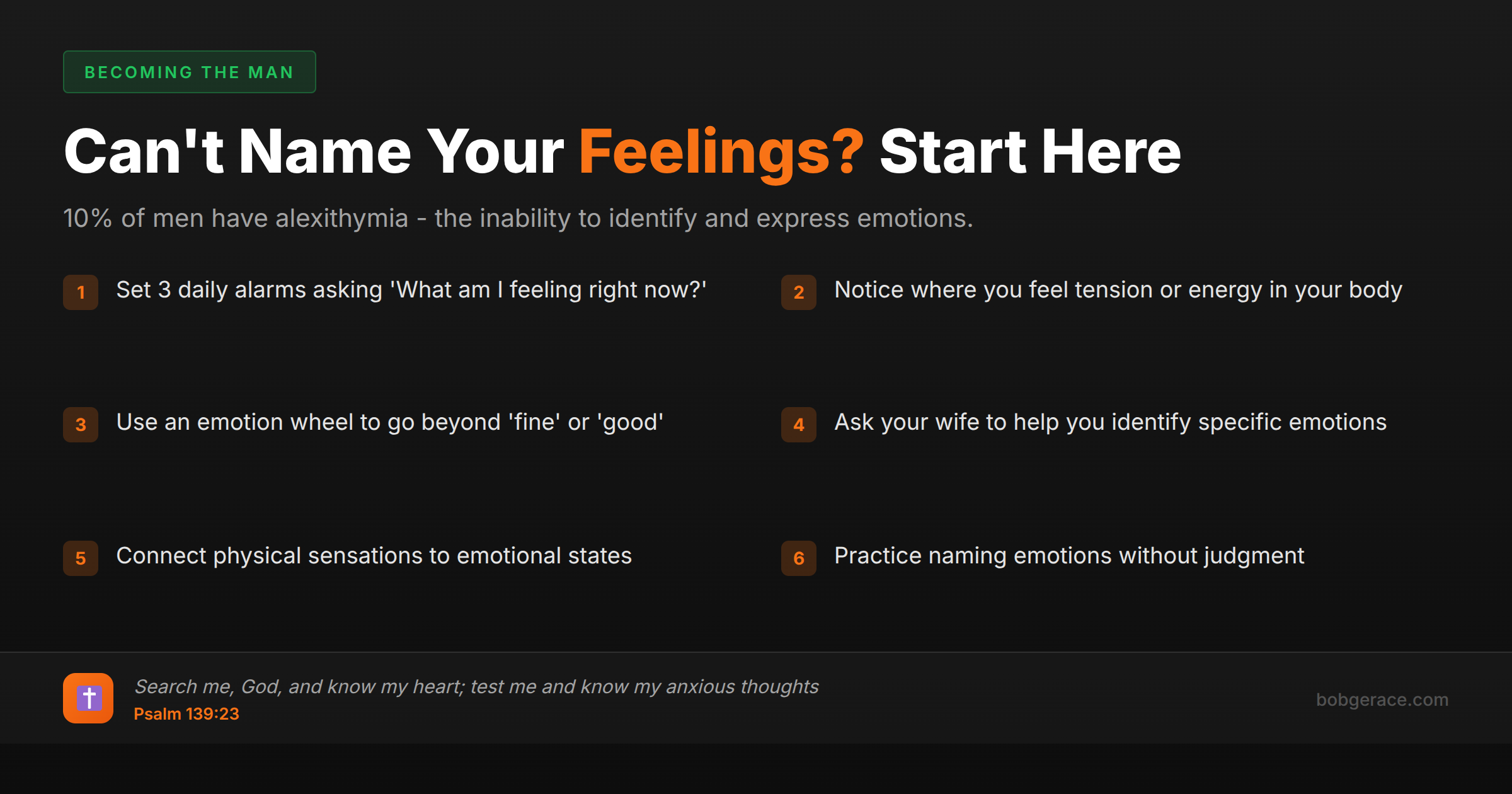
Alexithymia is the difficulty or inability to identify, understand, and express your own emotions. It's not a mental illness, but rather a personality trait that affects about 10% of the population. Men with alexithymia often struggle to put feelings into words, may seem emotionally distant, and have trouble connecting their physical sensations to emotional states. If you frequently find yourself saying "I don't know" when asked how you feel, struggle to differentiate between emotions like anger and frustration, or your wife tells you that you seem emotionally unavailable, you might have alexithymic traits. The good news? Emotional awareness is a skill that can be developed through intentional practice and the right tools.
The Full Picture
Alexithymia literally means "no words for emotions," and it's more common in men than women. This isn't about being "tough" or "strong" - it's about having a genuine difficulty accessing and articulating your emotional world.
The signs are often subtle but significant: - You rely on others to tell you how you're feeling - Physical symptoms (headaches, tension, fatigue) appear without obvious cause - You struggle to enjoy activities that used to bring pleasure - Conversations about feelings feel foreign or uncomfortable - You tend to focus on external events rather than internal experiences - Your wife says you seem "checked out" emotionally
This creates real problems in marriage. Your wife needs emotional connection and intimacy. When you can't identify or express what's happening inside you, she feels shut out. She might interpret your emotional unavailability as rejection or lack of care, even when that's not true.
The roots often trace back to childhood - perhaps you grew up in a family where emotions weren't discussed, or you learned early that expressing feelings was unsafe or unwelcome. Maybe you experienced trauma that caused you to disconnect from your emotional world as a protective mechanism.
But here's what you need to understand: This isn't a life sentence. Emotional awareness is like a muscle that can be strengthened. The brain's neuroplasticity means you can literally rewire your ability to recognize and express emotions, even if it feels impossible right now.
What's Really Happening
From a clinical perspective, alexithymia exists on a spectrum. Some men have mild difficulty with emotional awareness, while others have almost no access to their internal emotional world. What's fascinating is that the emotions are still there - they're just not being processed consciously.
Neurologically, we see differences in how the emotional centers of the brain communicate with the areas responsible for language and self-awareness. The anterior cingulate cortex and the insula, which help us recognize and label emotional states, may not be as well-connected in individuals with alexithymia.
In my practice, I often see men who've developed alexithymic traits as an adaptive response to their environment. If expressing emotions led to criticism, rejection, or punishment in childhood, the brain learns to suppress emotional awareness as protection. The military, certain professions, and cultural expectations can reinforce this pattern.
The impact on marriage is profound. Research shows that alexithymia is strongly correlated with relationship dissatisfaction, not because these men don't love their wives, but because emotional intimacy becomes nearly impossible. Wives often report feeling lonely, frustrated, and disconnected.
The encouraging news is that targeted therapeutic interventions, including mindfulness training, body awareness exercises, and gradual emotional vocabulary building, can significantly improve emotional intelligence. I've seen remarkable transformations when men commit to this work with patience and consistency.
What Scripture Says
God created us as emotional beings, and Scripture is filled with examples of men expressing the full range of human emotions. David poured out his heart in the Psalms: "Search me, God, and know my heart; test me and know my anxious thoughts" (Psalm 139:23). He didn't suppress or ignore his emotions - he brought them before God.
Jesus himself modeled emotional expression. "Jesus wept" (John 11:35) at Lazarus's tomb. He felt "deeply moved in spirit and troubled" (John 11:33). He experienced anger, compassion, joy, and sorrow - and he expressed these emotions authentically.
Scripture calls us to emotional awareness and growth: "Above all else, guard your heart, for everything you do flows from it" (Proverbs 4:23). You can't guard what you can't identify. God wants you to know your own heart so you can steward it well.
In marriage, emotional connection is part of becoming one flesh: "Therefore a man leaves his father and mother and holds fast to his wife, and they become one flesh" (Genesis 2:24). This unity includes emotional intimacy, not just physical or spiritual connection.
Paul encourages us toward maturity: "When I was a child, I talked like a child, I thought like a child, I reasoned like a child. When I became a man, I put the ways of childhood behind me" (1 Corinthians 13:11). Sometimes emotional numbness is a childhood coping mechanism that needs to be outgrown.
God has given us everything we need: "His divine power has given us everything we need for a godly life" (2 Peter 1:3). This includes the capacity to grow in emotional intelligence and intimacy.
What To Do Right Now
-
1
Start a daily emotion check-in: Set three phone alarms and ask yourself 'What am I feeling right now?' Even if the answer is 'nothing,' that's data.
-
2
Learn the physical language of emotions: Notice where you feel tension, tightness, or energy in your body when different situations arise.
-
3
Use an emotion wheel or app: Download a feelings chart and practice identifying specific emotions beyond 'good,' 'bad,' or 'fine.'
-
4
Practice with your wife: Ask her to help you identify emotions by sharing what she observes in your body language or tone.
-
5
Journal for five minutes daily: Write about your day focusing on internal experiences rather than external events.
-
6
Seek professional help: Consider working with a therapist who specializes in alexithymia and emotional intelligence development.
Related Questions
- How do I identify what I'm feeling?
- What is emotional intelligence and why does it matter?
- How do I build emotional vocabulary?
- What is emotional granularity?
- Why do men struggle with emotions?
- What is 'normative male alexithymia'?
- She says I'm emotionally unavailable
- Why does she seem numb/flat/dead inside?
- What is 'window of tolerance' and how do I widen mine?
- How do I notice feelings in my body?
Also find Bob on
Subscribe for weekly videos on Christian marriage.
Can't name the feeling? Let's work on that.
If alexithymia is showing up in your marriage, a coach who knows your specific patterns can help you build the skill your wife needs to see. You don't have to figure this out by reading alone.
Talk to Bob →