How do I become emotionally intelligent?
6 min read
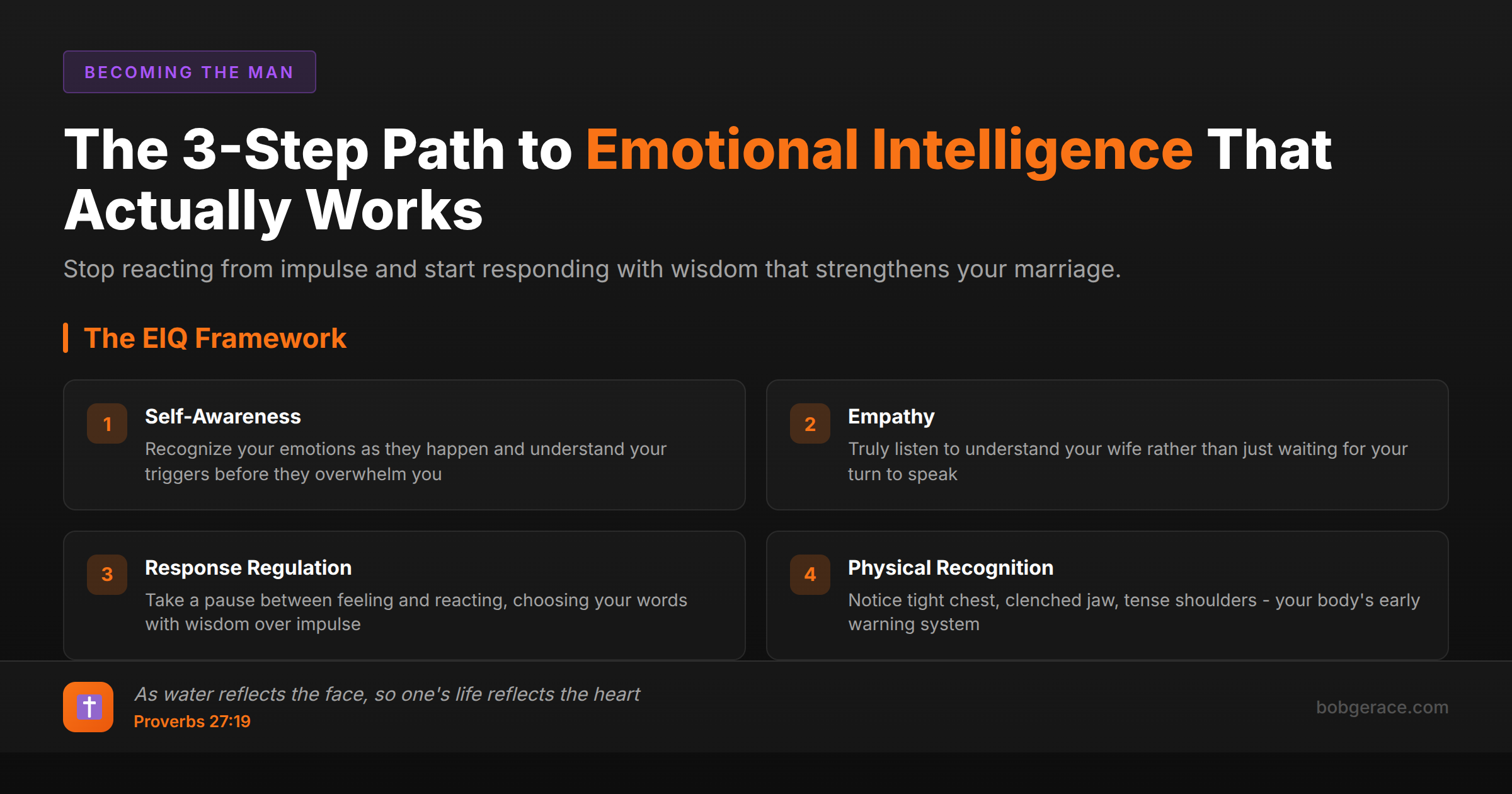
Emotional intelligence starts with self-awareness - recognizing your emotions as they happen and understanding why they arise. This means paying attention to your body's signals, your thought patterns, and your triggers before they overwhelm you or your relationships. The next crucial step is developing empathy - truly listening to understand others rather than just waiting for your turn to speak. Practice putting yourself in your wife's shoes, asking clarifying questions, and validating her feelings even when you disagree. Finally, learn to regulate your responses by taking a pause between feeling and reacting, choosing your words carefully, and responding with wisdom rather than impulse.
The Full Picture
Emotional intelligence isn't about becoming soft or overly sensitive - it's about becoming a stronger, more effective man and husband. Too many good men struggle in their marriages not because they don't love their wives, but because they can't navigate the emotional landscape of intimate relationship.
The four core components of emotional intelligence are self-awareness, self-regulation, empathy, and social skills. Self-awareness means you recognize your emotions in real-time. You notice when frustration is building, when you're feeling defensive, or when past wounds are being triggered. Most men operate on emotional autopilot, reacting without understanding what's driving their responses.
Self-regulation is your ability to choose your response rather than being controlled by your emotions. This doesn't mean suppressing feelings - it means feeling them fully while choosing how to express them constructively. When your wife brings up a concern, you can feel the defensiveness rise and still choose to listen with curiosity rather than immediately explaining why she's wrong.
Empathy is your secret weapon in marriage. It's not agreeing with everything your wife feels, but understanding her perspective deeply enough that she feels truly seen and heard. This creates the safety that allows her to be vulnerable with you.
Social skills tie it all together - knowing how to communicate clearly, resolve conflicts constructively, and build deeper intimacy through emotional connection. These aren't natural gifts for most men; they're learned skills that require intentional practice and development.
What's Really Happening
From a clinical perspective, emotional intelligence is fundamentally about neural pathway development and emotional regulation skills that many men weren't taught in childhood. Research shows that men often experience emotions just as intensely as women, but express them differently due to socialization patterns that discouraged emotional expression.
The good news is that emotional intelligence is highly trainable at any age due to neuroplasticity. When men practice emotional awareness and regulation techniques, we see measurable changes in brain activity in areas responsible for emotional processing and decision-making.
In marriage therapy, I consistently observe that couples where the husband develops emotional intelligence see dramatic improvements in relationship satisfaction. The wife feels more emotionally safe and connected, while the husband experiences less relationship conflict and greater intimacy.
The key clinical insight is that emotional intelligence isn't about becoming more emotional - it's about becoming more skilled at processing and responding to emotions effectively. This actually reduces emotional overwhelm and increases confidence in handling difficult conversations and conflicts that are inevitable in marriage.
What Scripture Says
Scripture calls us to emotional wisdom and self-control, not emotional numbness. Proverbs 27:19 tells us "As water reflects the face, so one's life reflects the heart." Your emotional responses reveal what's really happening in your heart, and God wants you to pay attention to that.
Jesus himself displayed perfect emotional intelligence. In John 11:35, "Jesus wept" at Lazarus's death, showing us that feeling deeply is not weakness but humanity. Yet in Matthew 26:53, facing crucifixion, he demonstrated perfect self-regulation: "Do you think I cannot call on my Father, and he will at once put at my disposal more than twelve legions of angels?"
Proverbs 20:5 says, "The purposes of a person's heart are deep waters, but one who has insight draws them out." This is emotional intelligence in action - the ability to understand the deeper motivations and feelings, both in yourself and others, especially your wife.
Ephesians 4:26-27 gives us the framework for emotional regulation: "In your anger do not sin: Do not let the sun go down while you are still angry, and do not give the devil a foothold." Notice it doesn't say don't feel anger - it says feel it without sinning, process it quickly, and don't let it fester.
James 1:19 provides the perfect template: "Everyone should be quick to listen, slow to speak and slow to become angry." This is emotional intelligence - awareness of your emotional state, regulation of your responses, and empathy through careful listening.
What To Do Right Now
-
1
Start an emotion journal - write down what you're feeling three times daily and what triggered those emotions
-
2
Practice the 6-second rule - when you feel strong emotions, count to six before responding (emotions peak and start declining after 6 seconds)
-
3
Ask your wife 'Help me understand...' instead of immediately defending when she shares concerns
-
4
Notice your physical responses to emotions - tight chest, clenched jaw, tense shoulders - these are your early warning system
-
5
Schedule weekly check-ins with your wife to practice emotional conversations in a low-pressure setting
-
6
Read one marriage or emotional intelligence book monthly and discuss insights with your wife
Related Questions
- What is emotional intelligence and why does it matter?
- How do I identify what I'm feeling?
- How do I express emotion without dumping?
- I never learned to process emotions
- How do I build emotional vocabulary?
- What is 'alexithymia' and do I have it?
- Why do I get defensive every time?
- How do I stop the mental movies?
- She says I'm emotionally unavailable
- How do I not lose my mind right now?
Also find Bob on
Subscribe for weekly videos on Christian marriage.
Ready to Apply This to Your Marriage?
Emotional intelligence isn't theoretical—it's built through real conversations with your actual wife. A coach helps you see what you're missing in your specific dynamic and practice the responses that work for you two.
Talk to Bob →