How do I identify what I'm feeling?
6 min read
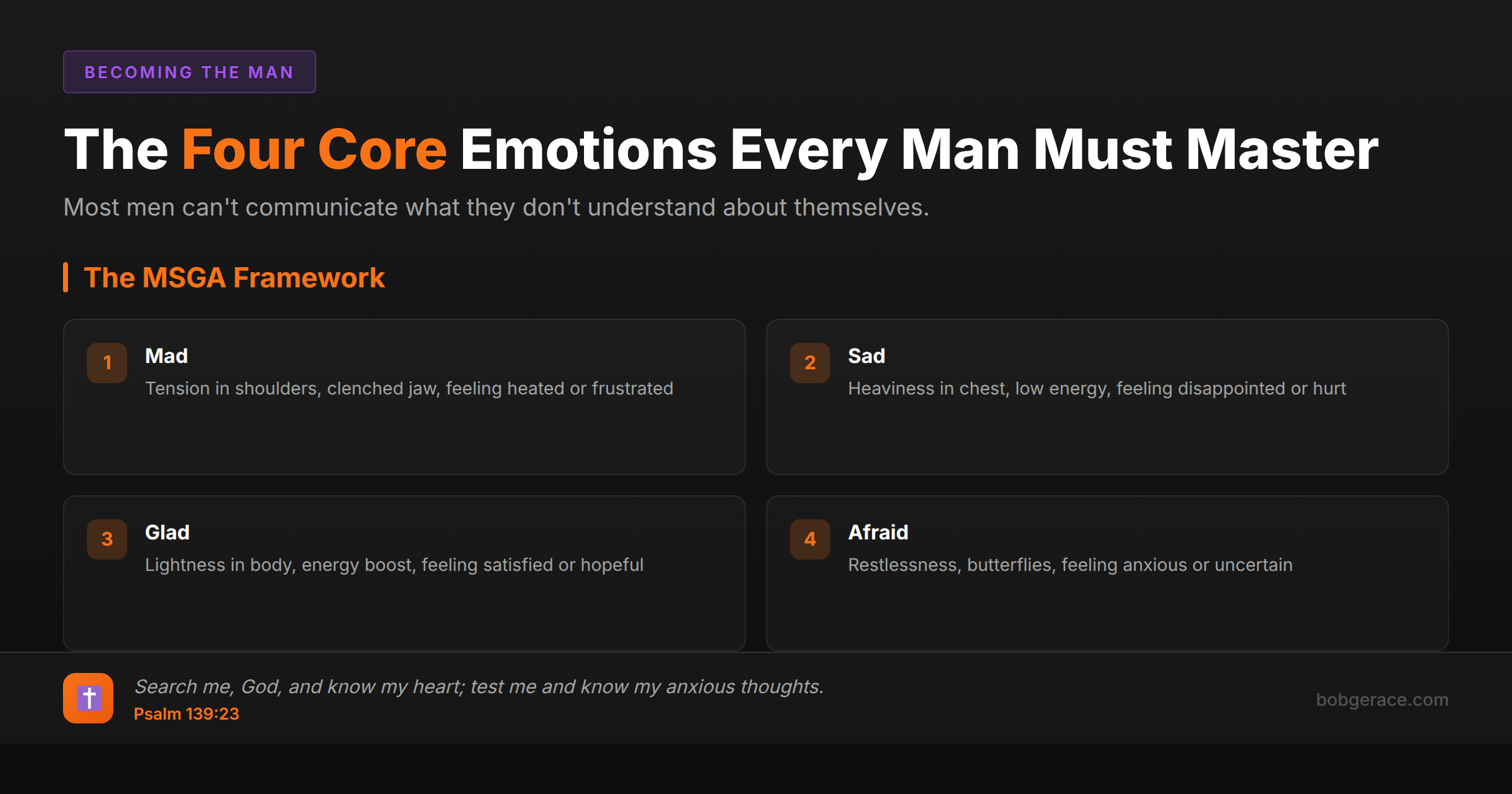
Most men struggle with identifying emotions because we weren't taught this skill growing up. The key is starting with the basics: Are you feeling mad, sad, glad, or afraid? These four core emotions are your foundation. Pay attention to your body—tension in your shoulders might signal anger, heaviness in your chest could indicate sadness, or restlessness might reveal anxiety. Start by checking in with yourself three times a day. Ask, "What am I feeling right now?" Don't judge it—just notice it. Many men think they're angry when they're actually hurt or scared. Learning to distinguish between these emotions is crucial for your marriage because you can't communicate what you don't understand about yourself.
The Full Picture
Here's the truth: Most men are emotionally illiterate, and it's destroying their marriages. We weren't raised to identify, understand, or express our feelings. We learned to suppress them, ignore them, or convert everything into anger because anger felt "safer" and more masculine.
But your wife needs you to be emotionally present and aware. She needs to know what's going on inside you, and frankly, so do you. When you can't identify your emotions, you're flying blind in your relationships and your life.
The problem isn't that you don't have feelings—it's that you don't recognize them. You might feel irritated and think it's just stress from work, when actually you're feeling unappreciated at home. You might feel withdrawn and call it "tired," when you're actually feeling disconnected from your wife.
Your body is constantly giving you information about your emotional state. Tight jaw? Probably anger or frustration. Heavy chest? Likely sadness or disappointment. Restless energy? Could be anxiety or excitement. Numbness? Often a sign you're overwhelmed and shutting down.
The stakes are higher than you think. When you can't identify your emotions, you can't manage them effectively. This leads to emotional outbursts, withdrawal, passive-aggressive behavior, or complete shutdown. Your wife feels like she's married to an emotional stranger, and intimacy becomes impossible.
Learning emotional awareness isn't about becoming "soft"—it's about becoming a complete man who can lead his family with wisdom and strength. It's about having access to all the tools God gave you, not just the ones society told you were acceptable.
What's Really Happening
From a clinical perspective, many men experience what we call "emotional granularity deficits." This means they can sense that something is happening internally, but lack the vocabulary and awareness to differentiate between complex emotional states. Research shows that men often have the same emotional experiences as women, but struggle with emotional labeling and expression due to socialization patterns.
The male brain tends to process emotions differently, often routing them through areas associated with physical sensations rather than verbal processing. This is why many men feel emotions in their body first—tension, restlessness, fatigue—before recognizing the emotional component.
Alexithymia, or difficulty identifying and describing emotions, affects approximately 10% of the population but is significantly more common in men. This isn't a character flaw—it's often a learned response to childhood messages about emotional expression being dangerous or unwelcome.
Neurologically, practicing emotional identification actually strengthens the connections between your limbic system and prefrontal cortex. This means the more you practice naming your emotions, the better you become at regulating them. The simple act of labeling an emotion reduces its intensity by about 20% according to fMRI studies.
For married men, emotional awareness is crucial for attachment security. When you can identify and communicate your emotional states, you create safety for your spouse and strengthen your emotional bond. This directly impacts marital satisfaction, conflict resolution, and sexual intimacy.
What Scripture Says
Scripture doesn't call us to suppress our emotions—it calls us to understand and steward them wisely. David, the man after God's own heart, was incredibly emotionally aware and expressive. Look at the Psalms—he's constantly identifying and processing his feelings before God.
*"Search me, God, and know my heart; test me and know my anxious thoughts."* (Psalm 139:23) David modeled emotional self-awareness as a spiritual discipline. He regularly examined his heart and brought his feelings to God.
*"In your anger do not sin: Do not let the sun go down while you are still angry."* (Ephesians 4:26) Notice this doesn't say "don't get angry." It assumes you'll recognize your anger and deal with it appropriately. You can't manage what you don't acknowledge.
*"Above all else, guard your heart, for everything you do flows from it."* (Proverbs 4:23) How can you guard something you don't understand? Emotional awareness is heart stewardship. It's taking responsibility for your internal world.
*"Be wise as serpents and innocent as doves."* (Matthew 10:16) Wisdom includes understanding yourself—your triggers, your patterns, your emotional responses. A wise man knows what he's feeling and why.
*"Therefore encourage one another and build each other up."* (1 Thessalonians 5:11) You can't truly encourage your wife if you're emotionally unavailable or unaware. Biblical manhood includes emotional presence and awareness.
Jesus himself displayed the full range of human emotions—joy, sorrow, anger, compassion. He didn't suppress or deny his feelings; he experienced them fully while maintaining perfect wisdom and self-control.
What To Do Right Now
-
1
Set three daily emotion check-ins: morning, lunch, and bedtime. Ask yourself, "What am I feeling right now?"
-
2
Use the basic four emotions as starting points: Mad, Sad, Glad, or Afraid. Don't overthink it—just pick one.
-
3
Notice your body signals: tense shoulders (anger), heavy chest (sadness), butterflies (anxiety), lightness (joy).
-
4
Keep an emotion journal for one week. Just one word per entry describing your predominant feeling each hour.
-
5
Practice the "Name it to tame it" technique: when you feel activated, pause and say "I'm feeling [emotion] right now."
-
6
Share one emotion with your wife each day, even if it's simple: "I'm feeling grateful for dinner" or "I'm feeling stressed about work."
Related Questions
Ready to Become Emotionally Intelligent?
Learning emotional awareness is a skill that will transform your marriage and your life. Let me help you develop this crucial ability.
Get Started →