Men aren't supposed to feel — is that true?
6 min read
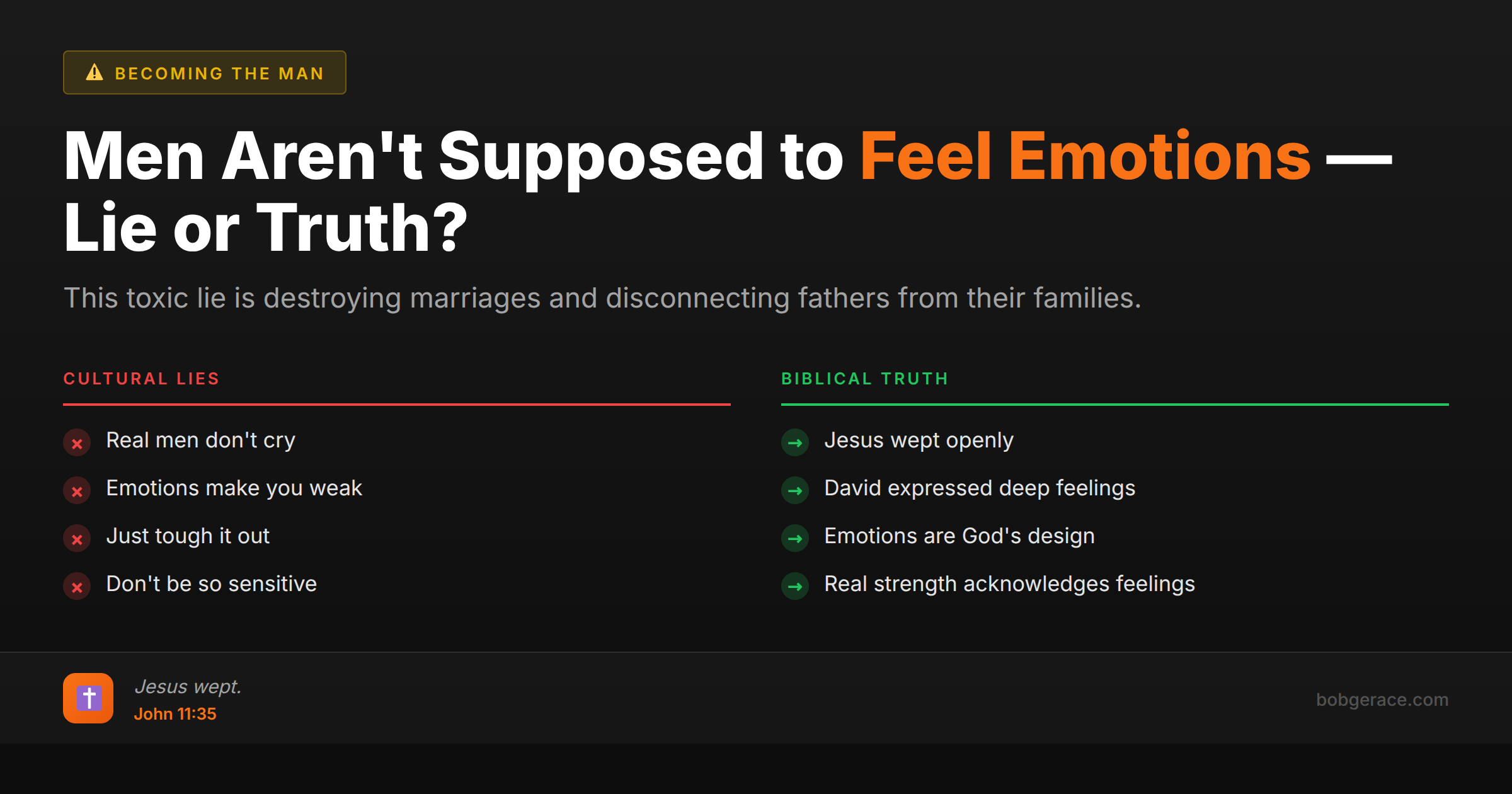
Absolutely not. The idea that men aren't supposed to feel is one of the most damaging lies our culture has sold to men and their families. Men were created by God with the full range of human emotions, and suppressing them doesn't make you stronger—it makes you disconnected, angry, and ultimately ineffective as a husband and father. Emotional suppression is not biblical masculinity; it's cultural conditioning that's destroying marriages. Real strength comes from acknowledging your emotions, understanding them, and channeling them constructively. When you shut down emotionally, you shut out your wife and kids, creating the very distance and conflict you're trying to avoid.
The Full Picture
The "men don't feel" myth is cultural garbage that's been passed down for generations, and it's destroying families. Here's what actually happens when men buy into this lie:
Your wife feels emotionally abandoned. She married you for connection, not just provision. When you shut down emotionally, she experiences it as rejection and will often pursue you harder or eventually give up entirely.
Your kids learn dysfunction. Your sons learn that emotions are weakness, setting them up for the same struggles. Your daughters learn that men are emotionally unavailable, affecting their future relationships.
You become a pressure cooker. Those emotions don't disappear—they get stuffed down until they explode as anger, addiction, or depression. The "strong silent type" often becomes the "angry distant type."
Your leadership suffers. Emotional intelligence is crucial for effective leadership in your home and workplace. You can't lead people you can't connect with, and you can't connect without emotional awareness.
Your marriage stagnates. Intimacy requires vulnerability. When you're emotionally shut down, your marriage becomes a business partnership focused on logistics rather than a thriving relationship.
The truth is, learning to feel and express emotions appropriately is one of the most masculine things you can do. It takes courage to be vulnerable, wisdom to understand your inner world, and strength to stay emotionally present when things get difficult. That's not weakness—that's the kind of man your family desperately needs.
What's Really Happening
From a psychological perspective, emotional suppression in men creates what we call "normative male alexithymia"—difficulty identifying and expressing emotions. This isn't a character flaw; it's learned behavior that starts in childhood when boys are told to "toughen up" or "stop crying."
Neurologically, men's brains process emotions differently than women's, but this doesn't mean men feel less intensely. Research shows men actually have stronger physiological responses to emotional stimuli but have learned to suppress the outward expression. This creates internal stress that manifests as physical symptoms, irritability, and relationship problems.
The impact on marriage is profound. In my practice, I consistently see couples where emotional disconnection from the husband creates what Dr. Sue Johnson calls "protest behaviors" in wives—criticism, demands for attention, or emotional withdrawal. The husband interprets this as confirmation that emotions are dangerous, creating a negative cycle.
Emotional development in men requires three key components: awareness (recognizing what you're feeling), acceptance (allowing emotions without judgment), and expression (communicating feelings appropriately). Men who develop these skills report higher marital satisfaction, better physical health, and more effective parenting.
The good news is that emotional intelligence is learnable at any age. The brain's plasticity means you can literally rewire these patterns through practice and intentional effort.
What Scripture Says
Scripture is clear that emotions are part of God's design for humanity, including men. Look at the emotional lives of biblical heroes:
Jesus wept (John 11:35). The Son of God—perfect masculinity—openly expressed grief, anger, compassion, and joy. If Jesus felt and expressed emotions, what makes us think we're stronger by suppressing ours?
David poured out his heart regularly. "I am weary with my groaning; every night I flood my bed with tears" (Psalm 6:6). The man after God's own heart wasn't afraid of emotional expression.
Paul expressed deep affection for those he served. "We were gentle among you, like a nursing mother taking care of her own children" (1 Thessalonians 2:7). He used tender, emotional language without compromising his authority.
God Himself displays emotions throughout Scripture—love, anger, grief, joy, jealousy. We're made in His image, which includes emotional capacity. "Be angry and do not sin" (Ephesians 4:26) assumes we'll experience anger and teaches us to handle it righteously.
Husbands are called to emotional connection. "Husbands, live with your wives in an understanding way" (1 Peter 3:7). You can't understand your wife without emotional intelligence and empathy.
Biblical masculinity isn't about emotional suppression—it's about emotional maturity. The goal isn't to avoid feelings but to steward them wisely, just as we steward our strength, resources, and authority. God gave you emotions for a purpose: to connect, to lead with wisdom, and to reflect His character in your relationships.
What To Do Right Now
-
1
Start an emotion journal - Write down one feeling you experienced each day and what triggered it
-
2
Practice the pause - When you feel triggered, take three deep breaths before responding
-
3
Use feeling words with your wife - Replace "fine" and "okay" with specific emotional words
-
4
Ask your wife how your emotional availability affects her - Listen without defending
-
5
Find a trusted male friend or mentor to practice emotional conversations with
-
6
Read Psalm 139 and thank God for creating you as an emotional being
Related Questions
Ready to Develop Real Emotional Strength?
Learning to feel and express emotions as a man takes guidance. Let's work together to develop the emotional intelligence your marriage needs.
Get Help →