How do I express emotion without dumping?
6 min read
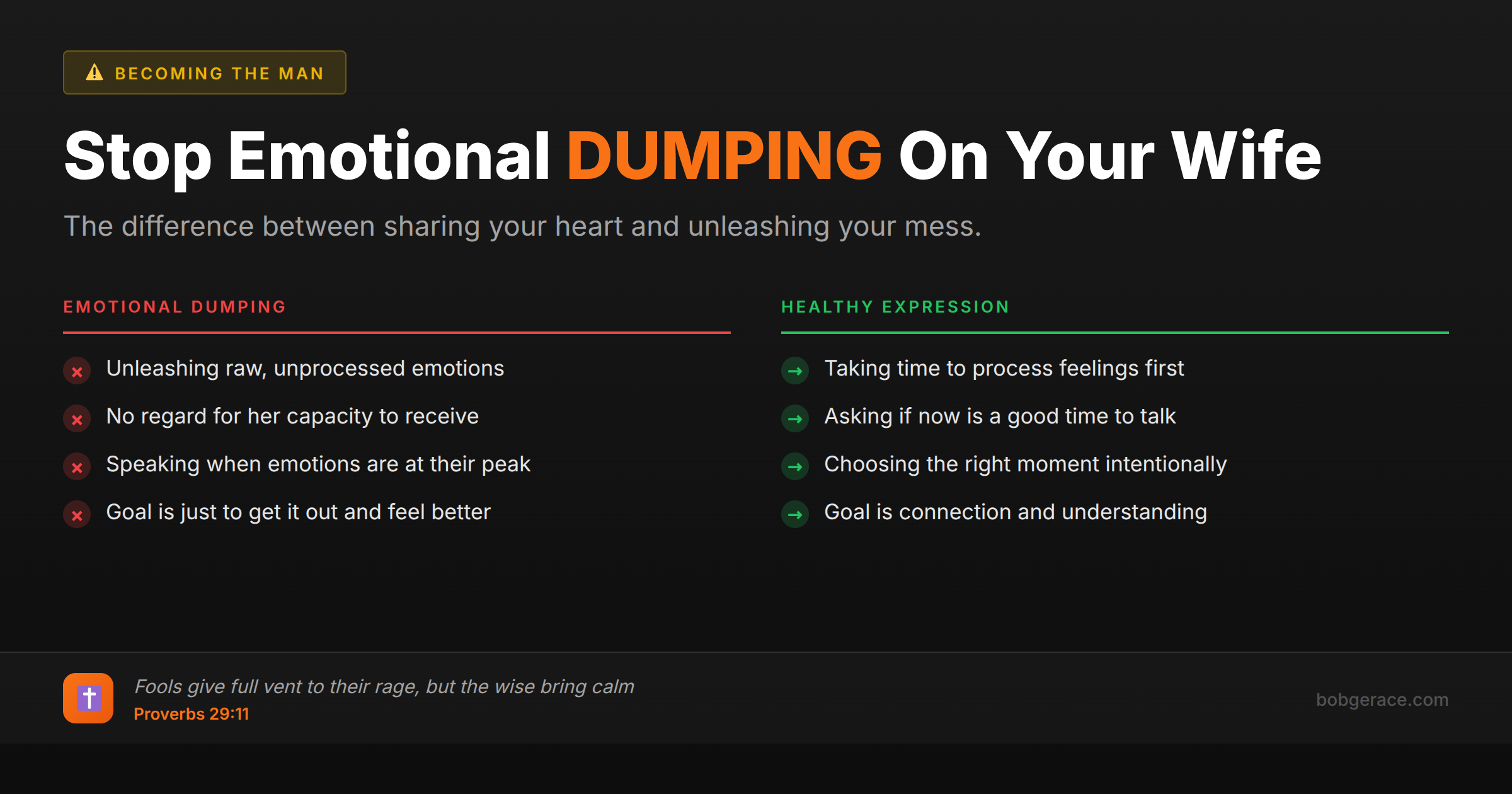
The key difference between expressing emotion and dumping is intentionality and consideration for your spouse. Healthy emotional expression involves taking time to process your feelings first, choosing the right moment, and communicating with the goal of connection rather than release. Emotional dumping happens when you unleash raw, unprocessed emotions onto your spouse without regard for their capacity to receive it. Start by learning to pause when emotions are high. Ask yourself: 'What am I actually feeling beneath the anger or frustration?' Then approach your spouse with statements like 'I'm feeling overwhelmed about work and need to share this with you. Is now a good time?' This shows respect for both your emotions and their emotional bandwidth.
The Full Picture
Most men struggle with the balance between emotional expression and emotional dumping because we've never been taught the difference. Society tells us to 'open up more' but doesn't give us the roadmap for doing it well. The result? We either stuff everything down until we explode, or we unleash our emotional chaos on our wives and wonder why they shut down.
Emotional dumping is when you use your spouse as an emotional garbage disposal. You're overwhelmed, stressed, or triggered, and you immediately unload everything onto them without processing it first. There's no filter, no consideration for timing, and no thought about whether they have the emotional capacity to handle what you're about to unleash.
Healthy emotional expression is different. It's intentional, processed, and considerate. You feel the emotion, you take time to understand what's driving it, and then you choose how and when to share it with your spouse in a way that invites connection rather than demands relief.
The biggest mistake I see men make is treating their wives like therapists instead of partners. Your wife wants to support you emotionally, but she's not equipped to handle the full weight of your unprocessed emotional life. That's not her job, and it's not fair to put that pressure on her.
Think of it this way: if you had a physical wound, you wouldn't just walk up to your wife and bleed all over her. You'd clean the wound first, assess the damage, and then ask for help with what you actually need. Emotions work the same way. Process first, then share with intention.
What's Really Happening
From a clinical perspective, emotional dumping is actually a form of emotional dysregulation that damages intimate relationships. When we dump our unprocessed emotions onto our partners, we're essentially making them responsible for regulating our emotional state – something that's developmentally appropriate for a parent-child relationship, but toxic in adult partnerships.
Healthy emotional expression requires what we call 'affect tolerance' – the ability to sit with uncomfortable emotions without immediately acting on them. Men who struggle with emotional dumping often have lower affect tolerance, meaning they feel compelled to discharge emotional tension immediately rather than processing it internally first.
The neurological reality is that when we're in emotional distress, our prefrontal cortex (responsible for thoughtful decision-making) goes offline, and our limbic system takes over. This is why 'taking a pause' isn't just good advice – it's neurologically necessary. The pause allows your prefrontal cortex to come back online so you can choose how to express what you're feeling.
Research shows that couples who practice healthy emotional expression have significantly higher relationship satisfaction and stability. The key is what we call 'co-regulation' – where both partners help each other maintain emotional equilibrium rather than one partner constantly destabilizing the other through emotional dumping.
What Scripture Says
Scripture gives us clear guidance on how to handle our emotions in relationships. Proverbs 29:11 tells us, *'Fools give full vent to their rage, but the wise bring calm in the end.'* This isn't saying don't feel emotions – it's saying don't unleash them without wisdom.
Ephesians 4:26-27 provides the framework: *'In your anger do not sin: Do not let the sun go down while you are still angry, and do not give the devil a foothold.'* Notice it doesn't say 'don't be angry.' It says don't sin in your anger and don't let it fester. There's a middle ground between stuffing emotions and dumping them.
James 1:19 gives us the practical application: *'Everyone should be quick to listen, slow to speak and slow to become angry.'* This is the pause principle in action. Feel the emotion, but be slow to speak it out until you can do so constructively.
Proverbs 27:14 warns us about poor timing: *'Whoever blesses their neighbor with a loud voice early in the morning will have it count as a curse.'* Even good intentions can become harmful when we ignore timing and our spouse's capacity to receive what we're sharing.
Galatians 6:2 calls us to *'carry each other's burdens,'* but verse 5 says *'each one should carry their own load.'* There's a difference between sharing legitimate burdens and dumping our unprocessed emotional load on our spouse.
As Christian men, we're called to love our wives as Christ loved the church – sacrificially and with consideration for their wellbeing, not just our own emotional relief.
What To Do Right Now
-
1
Practice the STOP technique - When you feel intense emotion rising, Stop what you're doing, Take a breath, Observe what you're actually feeling, and Proceed with intention rather than reaction.
-
2
Use the timing check - Before sharing heavy emotions, ask your spouse: 'I'm dealing with something difficult and would like to talk about it. Is now a good time, or should we plan for later?'
-
3
Process with the 5-minute rule - When triggered, take 5 minutes alone to identify what emotion you're actually feeling beneath the surface reaction before bringing it to your spouse.
-
4
Ask for what you need - Be specific about whether you want advice, just someone to listen, or prayer support. Don't make your spouse guess how to help you.
-
5
Set emotional boundaries - Commit to handling your daily stress and frustrations through prayer, exercise, or journaling before bringing only the significant issues to your spouse.
-
6
Check your motivation - Ask yourself: 'Am I sharing this to connect with my spouse, or am I just trying to feel better?' If it's just for relief, process it elsewhere first.
Related Questions
Ready to Transform Your Emotional Communication?
Learning to express emotions healthily takes practice and guidance. Let's work together to build the communication skills that will strengthen your marriage.
Work With Me →