I never learned to process emotions
6 min read
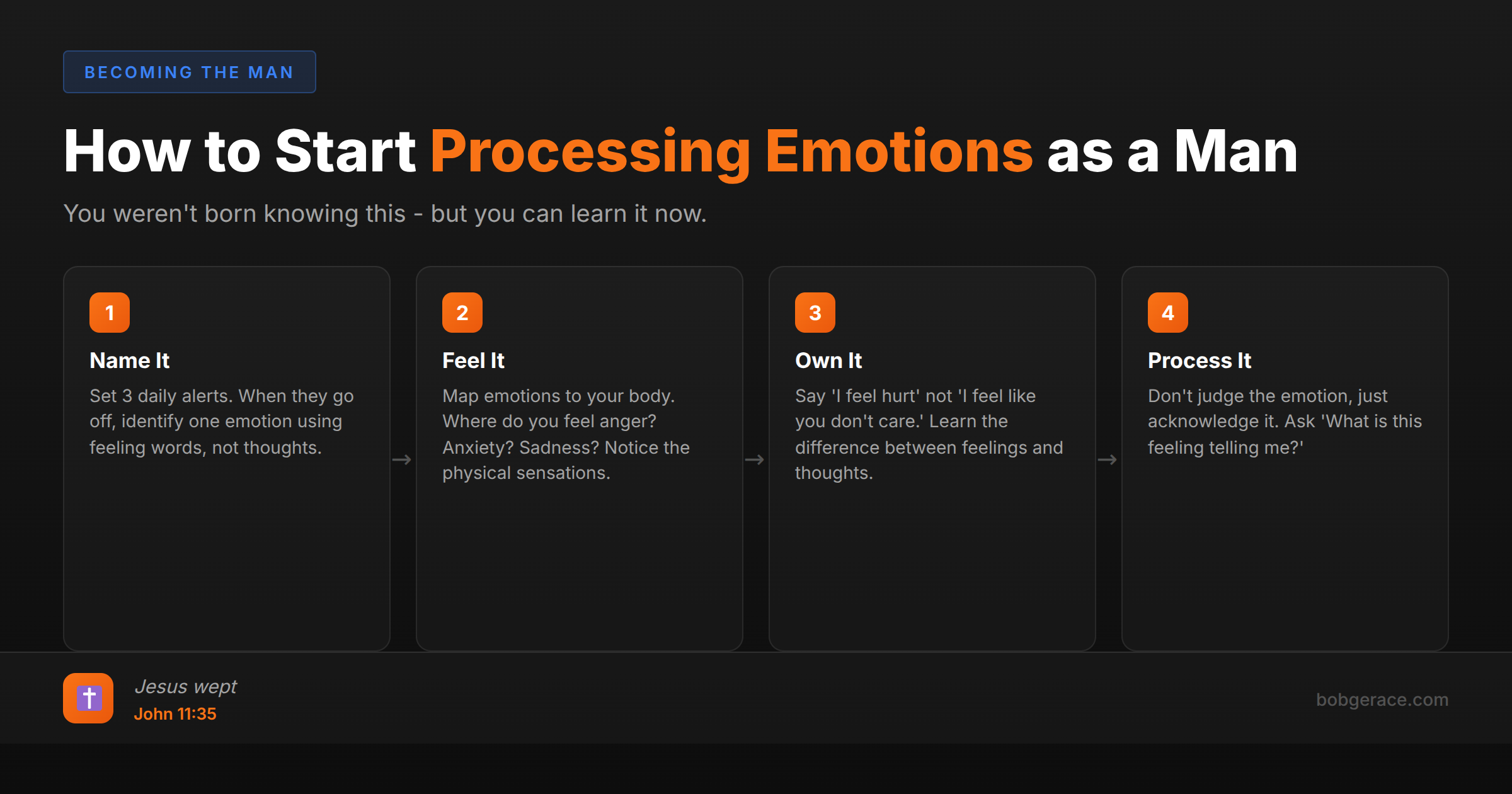
You're not alone - many men reach adulthood without learning healthy emotional processing skills. This often happens when we grow up in families where emotions weren't discussed, modeled poorly, or actively discouraged. The good news? Emotional skills can absolutely be learned at any age. Start by simply naming what you feel throughout the day. Mad, sad, glad, afraid, ashamed - these five core emotions cover most experiences. When you notice tension in your body or a shift in your mood, pause and ask 'What am I feeling right now?' Don't judge it, just acknowledge it. This awareness is the foundation of emotional processing.
The Full Picture
Most men weren't taught emotional processing because previous generations operated under different assumptions about masculinity. Your father and grandfather likely learned that "real men" push through feelings rather than process them. This wasn't malicious - it was survival-based thinking from harder times.
But here's what we know now: Unprocessed emotions don't disappear. They get stored in your body as tension, explode as anger, leak out as irritability, or create distance in your marriage. Your wife feels this emotional unavailability even when you think you're "fine."
The cost is real: Men who can't process emotions struggle with intimacy, make decisions based on hidden fears, and often feel disconnected from themselves and others. In marriage, this creates a dynamic where your wife feels like she's married to someone who's emotionally unreachable.
The biological reality: Men's brains actually have fewer neural pathways between the emotional and verbal centers compared to women. This means it genuinely takes us longer to identify and articulate feelings. But these pathways can be strengthened through practice.
Your emotional education starts now: Think of this as learning a new language. You wouldn't expect to speak Spanish fluently after one lesson, so don't expect emotional fluency overnight. The goal isn't to become overly emotional - it's to become emotionally intelligent and available to yourself and your wife.
What's Really Happening
What you're describing is called 'alexithymia' - literally meaning 'no words for emotions.' It's not a disorder, but rather an underdeveloped skill set that affects approximately 10% of the population, with men being disproportionately represented.
Neurologically, emotional processing involves the connection between your limbic system (where emotions originate) and your prefrontal cortex (where conscious thought occurs). When this pathway is underdeveloped, you experience emotions as physical sensations - tension, restlessness, fatigue - without the cognitive awareness of what you're actually feeling.
The development window for emotional skills is typically childhood through adolescence, but neuroplasticity research shows these neural pathways can be strengthened at any age through consistent practice. The key is creating new habits that bridge the gap between feeling and thinking.
In relationships, partners of men with underdeveloped emotional processing often feel lonely, frustrated, or rejected. They interpret emotional unavailability as lack of care, when it's actually a skills deficit. This creates a negative cycle where the woman pursues emotional connection, the man withdraws (feeling inadequate), and both partners feel misunderstood.
The encouraging news is that men who commit to developing emotional awareness often see rapid improvement in their relationships. The brain's reward system reinforces these new skills when they lead to better connection and reduced conflict.
What Scripture Says
God created you as an emotional being, and Scripture is filled with examples of godly men processing and expressing their feelings. This isn't weakness - it's part of being made in God's image.
Jesus modeled emotional processing: "Jesus wept" (John 11:35). He felt anger at injustice (Mark 3:5), experienced deep anguish (Luke 22:44), and expressed joy (Luke 10:21). If the Son of God processed emotions, so should we.
David wrote extensively about his emotional life: "Why, my soul, are you downcast? Why so disturbed within me?" (Psalm 42:5). David didn't ignore his feelings - he examined them, brought them to God, and worked through them.
Paul acknowledged the full range of human emotions: "Rejoice with those who rejoice; mourn with those who mourn" (Romans 12:15). He modeled emotional intelligence and empathy as essential Christian qualities.
Proverbs speaks to emotional wisdom: "Above all else, guard your heart, for everything you do flows from it" (Proverbs 4:23). You can't guard what you don't understand. Emotional awareness is biblical stewardship.
God invites emotional honesty: "Cast all your anxiety on him because he cares for you" (1 Peter 5:7). This requires identifying and acknowledging what you're actually feeling.
The goal is emotional maturity: "When I was a child, I talked like a child, I thought like a child, I reasoned like a child. When I became a man, I put the ways of childhood behind me" (1 Corinthians 13:11). Emotional processing is part of spiritual and personal maturity.
What To Do Right Now
-
1
Name five feelings daily: Set phone alerts for morning, lunch, and evening. When it goes off, identify one emotion you're experiencing using feeling words, not thoughts.
-
2
Learn the difference between feelings and thoughts: 'I feel like you don't care' is a thought. 'I feel hurt' or 'I feel scared' are feelings. Practice this distinction.
-
3
Map emotions to physical sensations: Notice where you feel anger (chest? jaw?), anxiety (stomach? shoulders?), or sadness (throat? chest?). Your body is your early warning system.
-
4
Practice the 24-hour rule: When something triggers you, wait 24 hours before discussing it. Use that time to identify what you're actually feeling underneath the initial reaction.
-
5
Start an emotion journal: Write three sentences each night: What happened today? What did I feel? Where did I feel it in my body? Keep it simple.
-
6
Ask your wife for patience and feedback: Tell her you're learning emotional processing and ask her to help you identify feelings when you're struggling. Make it a team effort, not a test.
Related Questions
Ready to Develop Your Emotional Intelligence?
Learning to process emotions takes guidance and practice. Let me help you develop these crucial skills for your marriage and personal growth.
Get Support →