What's underneath my anger?
6 min read
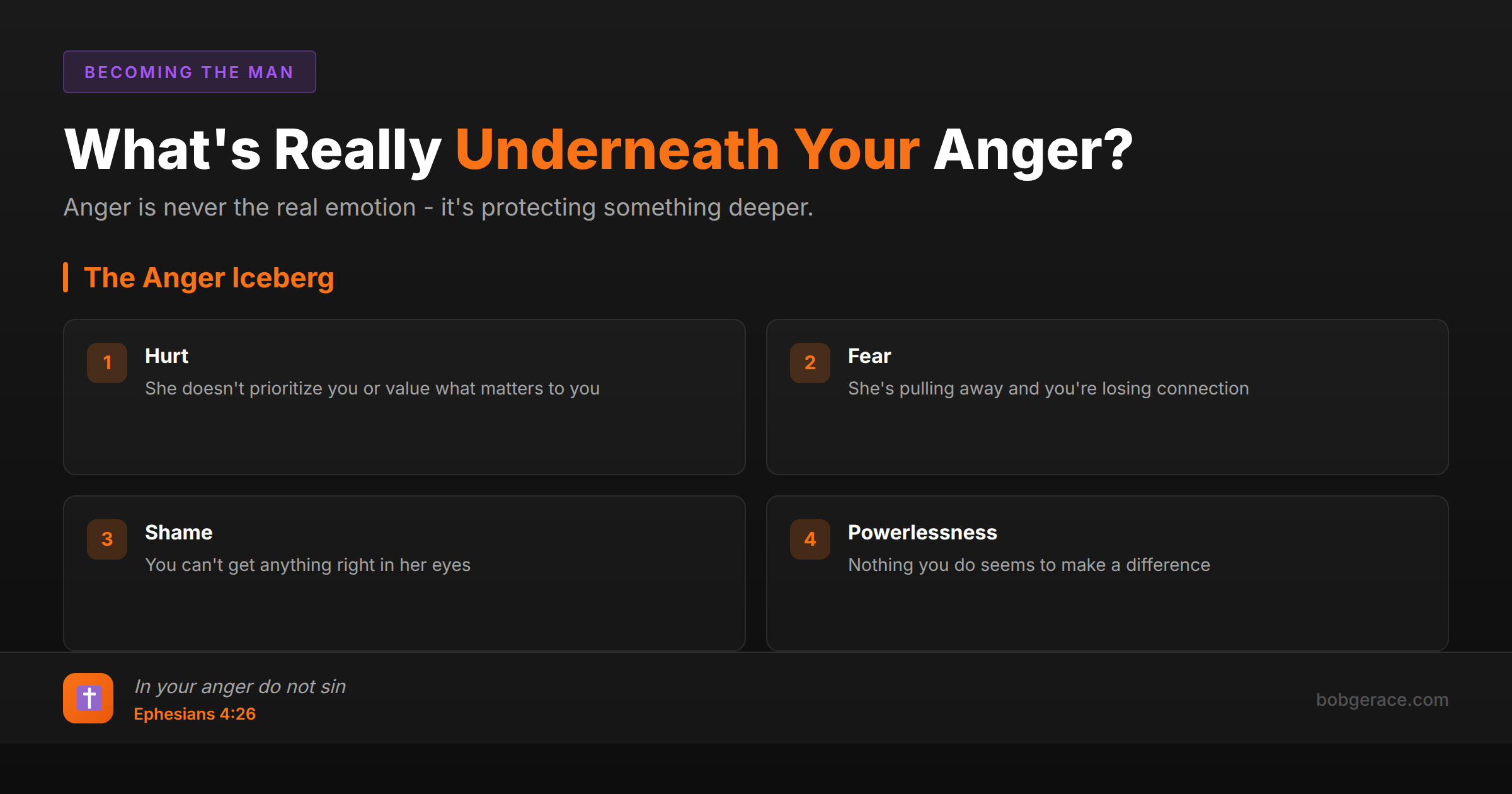
Anger is almost never the primary emotion - it's a protective response to something deeper. Underneath your anger, you'll typically find hurt, fear, shame, or feeling powerless. Maybe you're hurt that your spouse doesn't seem to prioritize you, afraid they're pulling away, or ashamed that you can't seem to get things right. Understanding what's beneath your anger is crucial because you can't heal what you won't acknowledge. When you start identifying these core emotions, you can address the real issues instead of just reacting to the surface symptoms. This awareness transforms how you communicate and connect with your spouse.
The Full Picture
Think of anger like the tip of an iceberg - what you see on the surface is just a fraction of what's really there. Below the waterline are the real culprits: deep hurt from feeling dismissed, fear of abandonment or rejection, shame about not measuring up, or the helplessness of feeling out of control.
The Most Common Hidden Emotions:
Hurt - Your spouse's words or actions wounded you, but expressing hurt feels vulnerable, so anger feels safer.
Fear - You're afraid of losing connection, being rejected, or that your marriage is falling apart.
Shame - You feel like a failure as a spouse, inadequate, or fundamentally flawed.
Powerlessness - You feel like nothing you do matters or that you can't influence positive change in your relationship.
Disappointment - Your expectations weren't met, and the letdown morphed into anger.
Here's what makes this tricky: anger gives us a temporary sense of power and control. It feels better than vulnerability. But it also pushes away the very person whose love and understanding we desperately want. Your spouse can't respond to your real needs if all they see is the anger on top.
The breakthrough comes when you can pause in heated moments and ask yourself: "What am I really feeling right now?" Usually, if you're honest, there's something much more tender underneath that anger - and that's where real healing begins.
What's Really Happening
From a psychological perspective, anger serves as what we call a 'secondary emotion' - it's your emotional system's attempt to protect you from more vulnerable primary feelings. This happens because anger activates your sympathetic nervous system, flooding you with adrenaline and creating a sense of power when you actually feel powerless.
Neurologically, when you experience threat or pain, your amygdala triggers a fight-or-flight response. Anger is the 'fight' option - it mobilizes you for action and temporarily masks the more painful emotions underneath. But here's the key: those primary emotions are still there, unprocessed and unhealed.
In marriage relationships, I often see patterns where individuals have learned that expressing vulnerability led to more hurt in the past - perhaps in childhood or previous relationships. So anger becomes their go-to protective mechanism. The problem is that while anger might feel safer, it creates distance and conflict rather than the connection and understanding your heart truly seeks.
The therapeutic process involves learning to tolerate and express those vulnerable emotions safely. When you can identify and communicate your hurt, fear, or shame directly, you give your spouse the opportunity to respond with empathy rather than defensiveness. This creates the emotional safety that allows both partners to lower their defenses and reconnect authentically.
What Scripture Says
Scripture doesn't condemn anger itself but calls us to understand and manage it wisely. Ephesians 4:26-27 instructs us: "In your anger do not sin: Do not let the sun go down while you are still angry, and do not give the devil a foothold." This passage acknowledges anger as a natural emotion while warning against letting it control us.
Proverbs 19:11 offers profound wisdom: "A person's wisdom yields patience; it is to one's glory to overlook an offense." This doesn't mean stuffing your emotions, but rather gaining the wisdom to see beyond the surface triggers to what's really happening in your heart.
Jesus himself demonstrated righteous anger when he cleansed the temple (Matthew 21:12-13), but His anger was motivated by love for His Father's house and concern for justice - not by personal hurt or fear. This shows us that understanding our motivations matters tremendously.
Psalm 139:23-24 provides a beautiful prayer for self-examination: "Search me, God, and know my heart; test me and know my anxious thoughts. See if there is any offensive way in me, and lead me in the way everlasting." When we invite God to reveal what's beneath our anger, He faithfully shows us.
James 1:19-20 reminds us: "Everyone should be quick to listen, slow to speak and slow to become angry, because human anger does not produce the righteousness that God desires." This passage calls us to pause and seek understanding - both of ourselves and our spouse - before reacting in anger.
God desires truth in our inner parts (Psalm 51:6). He wants us to be honest about our hurt, fear, and shame so He can bring healing and transformation to those wounded places.
What To Do Right Now
-
1
Pause and breathe - When anger rises, take 10 deep breaths and ask yourself: 'What am I really feeling underneath this anger?'
-
2
Journal your emotions - Write down what triggered your anger, then dig deeper: 'What did this situation make me feel about myself or my marriage?'
-
3
Identify your core emotion - Name the primary feeling: hurt, fear, shame, powerlessness, disappointment, or rejection
-
4
Share vulnerably with your spouse - Instead of 'You make me angry,' try 'When that happened, I felt hurt and afraid that...'
-
5
Pray for insight - Ask God to reveal the wounds and fears that fuel your anger, and for wisdom to communicate your needs clearly
-
6
Seek professional help - If anger feels overwhelming or you can't identify what's underneath, a counselor can help you navigate these deeper emotions safely
Related Questions
- Why do I rage at the people I love?
- What is 'secondary emotion' and is anger covering something?
- What role did my childhood play in my anger patterns?
- Is my anger an attachment cry gone wrong?
- What is 'amygdala hijack' and how do I interrupt it?
- What does 'protest behavior' look like as rage?
- What is 'betrayal trauma' and do I have it?
- Why do I feel like I'm going to die?
- What attachment injuries did I experience?
- What does chronic anger do to my nervous system?
Also find Bob on
Subscribe for weekly videos on Christian marriage.
Don't Keep Guessing What's Underneath
A coach who knows your marriage can help you name what you're actually feeling and what to do about it in your specific situation.
Talk to Bob →