Why do I rage at the people I love?
6 min read
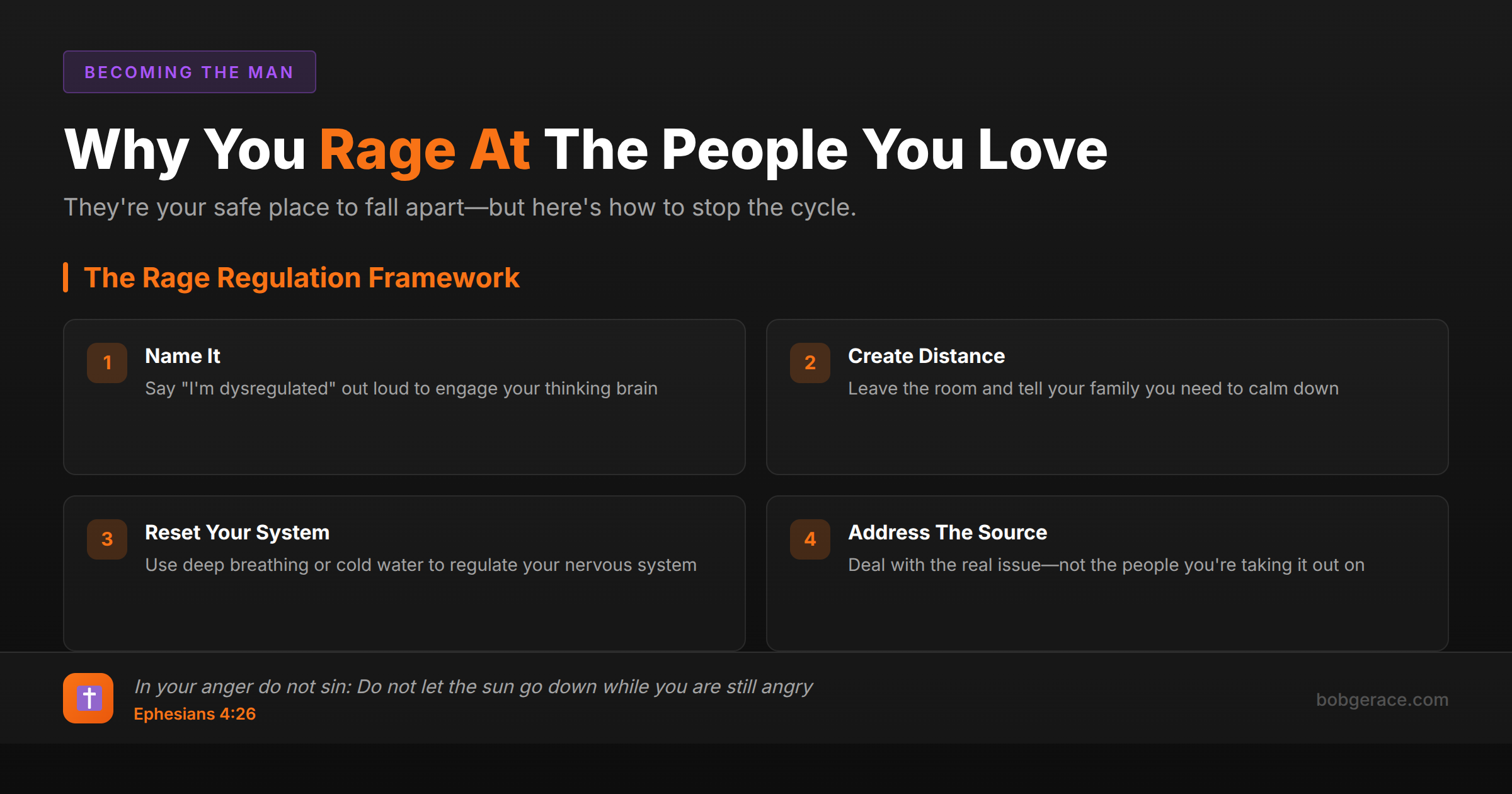
You rage at the people you love because they're your safe place to fall apart. It's a painful paradox - we unleash our worst on those who matter most because we unconsciously know they won't abandon us. Your loved ones get the brunt of your unprocessed pain, stress, and triggers because you feel secure enough in their love to let your guard down completely. But here's what's really happening: your nervous system is dysregulated, your emotional cup is overflowing, and you're operating from a place of survival rather than love. The rage isn't really about them - it's about unhealed wounds, overwhelming circumstances, or feeling powerless in other areas of your life. Your family becomes the release valve for pressure you can't express elsewhere.
The Full Picture
Let's get brutally honest about what's happening when you explode at the people you'd die for. This isn't about being a bad person - it's about being a human person who's operating from a broken emotional system.
The Safety Paradox is real. Your spouse and kids represent your deepest emotional safety net. Unconsciously, you know they'll still be there after the storm passes. You'd never rage at your boss or a stranger the way you rage at your wife because the consequences feel too risky. But with family? The primitive part of your brain says, "It's safe to fall apart here."
You're emotionally dysregulated. Think of your nervous system like a smoke detector that's been set too sensitive. Normal family stress - kids being loud, dishes in the sink, traffic on the way home - triggers a fire alarm response. What should be manageable frustrations become explosive rage because your emotional thermostat is broken.
The pressure cooker effect is crushing you. You're holding it together everywhere else - work stress, financial pressure, health concerns, family obligations. You paste on a smile, stuff down the frustration, and white-knuckle your way through the day. Then you walk through your front door, and the smallest trigger opens the floodgates.
Unhealed wounds are driving the bus. That rage? It's often not about the current moment. It's about feeling powerless as a kid, being criticized by a parent, or carrying shame you've never dealt with. Your family accidentally steps on these emotional landmines, and the explosion has nothing to do with them.
The devastating truth is that your rage is destroying the very relationships you're trying to protect. Your loved ones are walking on eggshells, your kids are learning that love looks like explosions, and your marriage is slowly bleeding out. But there's hope - once you understand the pattern, you can break it.
What's Really Happening
From a clinical perspective, raging at loved ones is a textbook example of what we call "emotional dysregulation with secure attachment displacement." Your brain is essentially hijacked by your amygdala - the alarm system that triggers fight-or-flight responses.
Here's the neurological reality: when you're stressed or triggered, your prefrontal cortex (the rational, loving part of your brain) goes offline. The limbic system takes over, and you're operating from pure survival mode. Your family becomes the "safest" target because attachment theory tells us we're most vulnerable with those we trust most deeply.
Trauma responses often play a significant role. Many people experiencing rage episodes have unprocessed childhood trauma, chronic stress, or what we call "little t" traumas - seemingly minor events that accumulated over time. Your nervous system is stuck in hypervigilance, scanning for threats even in safe spaces.
Shame cycles perpetuate the problem. After a rage episode, you're flooded with guilt and self-hatred. This shame actually increases your baseline stress, making you more likely to explode again. It becomes a vicious cycle: rage → shame → increased stress → more rage.
The good news is that this is treatable. Through therapy modalities like EMDR, cognitive behavioral therapy, and somatic approaches, you can literally rewire your brain's response patterns. Your nervous system can learn to regulate again, but it requires intentional work and often professional support. The pattern can be broken, but not through willpower alone.
What Scripture Says
God's Word doesn't sugarcoat the reality of human anger, but it provides a clear framework for understanding and overcoming it.
Ephesians 4:26-27 gives us crucial guidance: *"In your anger do not sin: Do not let the sun go down while you are still angry, and do not give the devil a foothold."* Notice Scripture doesn't say "don't get angry" - it says don't let anger lead you into sin. Your rage is giving the enemy a foothold in your most precious relationships.
James 1:19-20 cuts to the heart: *"My dear brothers and sisters, take note of this: Everyone should be quick to listen, slow to speak and slow to become angry, because human anger does not produce the righteousness that God desires."* Your explosive anger isn't producing the godly family you want - it's destroying it.
Proverbs 29:11 reveals the spiritual battle: *"Fools give full vent to their rage, but the wise bring calm in the end."* When you rage, you're operating as a fool, not as the wise leader God called you to be in your home.
Colossians 3:8 calls for radical transformation: *"But now you must also rid yourselves of all such things as these: anger, rage, malice, slander, and filthy language from your lips."* This isn't just behavior modification - it's spiritual warfare against the patterns destroying your family.
Psalm 103:8-10 reminds us of God's character: *"The Lord is compassionate and gracious, slow to anger, abounding in love. He will not always accuse, nor will he harbor his anger forever; he does not treat us as our sins deserve."* If our perfect God is slow to anger with us despite our rebellion, how much more should we extend that grace to our imperfect families?
The path forward isn't just psychological - it's deeply spiritual. God wants to transform your heart, not just manage your behavior.
What To Do Right Now
-
1
Stop and name it: The moment you feel rage building, say out loud "I'm dysregulated right now." This engages your prefrontal cortex and creates space between trigger and response.
-
2
Create physical distance: Leave the room, go outside, or remove yourself from the situation. Tell your family "I need a few minutes to calm down" and mean it.
-
3
Regulate your nervous system: Use deep breathing (4 counts in, 6 counts out), cold water on your face, or vigorous exercise to reset your fight-or-flight response.
-
4
Identify the real issue: Ask yourself "What am I really angry about?" Often it's not about the dishes or the kids - it's about feeling overwhelmed, disrespected, or powerless.
-
5
Take ownership immediately: When you've calmed down, apologize specifically without excuses. "I'm sorry I yelled. That wasn't about you, and you didn't deserve it."
-
6
Get professional help: If this is a pattern, you need more than self-help. Find a therapist who understands trauma and attachment. Your family is worth the investment.
Related Questions
- I can't control my anger
- What's underneath my anger?
- What is 'amygdala hijack' and how do I interrupt it?
- Why does anger feel like the only accessible emotion?
- What is 'secondary emotion' and is anger covering something?
- What role did my childhood play in my anger patterns?
- She's scared of my anger
- I said things I can't take back
- How do I stop exploding?
- What does 'be angry and sin not' mean?
Also find Bob on
Subscribe for weekly videos on Christian marriage.
Your Marriage Can't Survive Many More of These
You need someone who knows your specific triggers, your history, and what's actually driving this rage in your marriage. A coach who's seen this pattern before and can help you interrupt it today.
Talk to Bob →